

100% Updated ISTQB ISTQB-CTAL-TA Enterprise PDF Dumps
Use Valid Exam ISTQB-CTAL-TA by ExamTorrent Books For Free Website
ISTQB CTAL-TA certification is highly regarded in the software testing industry and is recognized worldwide. It is a mark of excellence that demonstrates a professional's knowledge and expertise in software testing. (ISTQB CTAL-TA) ISTQB Certified Tester Advanced Level - Test Analyst (Syllabus 2012) certification provides professionals with a competitive edge in the job market and enhances their career prospects. Obtaining the ISTQB CTAL-TA certification requires dedication and hard work, but the rewards are well worth it in terms of professional growth and recognition.
ISTQB-CTAL-TA certification exam is aimed at professionals who want to enhance their understanding of software testing and seek to advance their careers in the field. Candidates who pass the exam will have a strong foundation in software testing concepts, test analysis, design, and implementation. They will also have a good understanding of test automation, tool support for testing, and managing the testing process.
NEW QUESTION # 27
Which of the following statements about defect-based techniques is TRUE?
SELECT ONE OPTION
- A. The coverage criteria for black-box test techniques tend to be less systematic than for defect-based test techniques
- B. In defect-based testing, the type of defect sought is used as the basis for test design
- C. Defect-based techniques are mainly used by developers at the component test level
- D. Defect-based testing is a technique that identifies defects in requirements early in the lifecycle
Answer: B
Explanation:
Comprehensive and Detailed in Depth Explanation:
* Defect-based techniquesuse the knowledge of defects that have occurred in the past to develop test cases that target similar types of issues.
* Option Ccorrectly states that defect-based testing focuses on using known defect types as the basis for designing tests.
* Option Ais incorrect because defect-based testing can be applied at various levels, not just the component level.
* Option Bis incorrect since defect-based techniques do not necessarily guarantee more systematic coverage than black-box techniques.
* Option Dis incorrect because defect-based testing focuses on detecting specific defect types rather than verifying requirements early.
Hence, the correct answer isC (In defect-based testing, the type of defect sought is used as the basis for test design).
NEW QUESTION # 28
When applying for health insurance from Health4You, applicants are categorized according to their age, sex, the number of units of alcohol they consume in an average week, Body Mass Index (BMI), whether in full-time work, and whether a smoker.
Insurance is offered, and the premium is calculated according to the following rules:
* Insurance cover is NOT given to those aged 70 or more, or below 18
* Those who consume more than 14 units of alcohol a week have an additional premium of £25 per month
* Those with a BMI greater than 35 are NOT given insurance cover
* Smokers have an additional premium of £20 per month
* Those in full-time employment have a premium reduction of £20 per month How many test cases are required to give full coverage for the above rules when using a decision table that excludes rules containing infeasible combinations of condition values?
SELECT ONE OPTION:
- A. 0
- B. 1
- C. 2
- D. 3
Answer: A
Explanation:
Comprehensive and Detailed In-Depth Explanation:
* Conditions:
* Age (3): Below 18, 18-69, 70+
* Alcohol Consumption (2): #14 units, >14 units
* BMI (2): #35, >35
* Smoking (2): Yes, No
* Employment (2): Full-time, Not full-time
* Feasibility Check:
* Age < 18 and Age # 70: Not covered (2 invalid cases)
* BMI > 35: Not covered (1 invalid case)
Valid combinations: 3 × 2 × 2 × 2 × 2 = 96
Therefore, the correct answer is B (96).
NEW QUESTION # 29
You are running a regression test suite using a keyword-driven test approach for automation. One of the new test cases using a new keyword failed unexpectedly. What should be your first step?
SELECT ONE OPTION
- A. Examine the sequence of tests that led up to the failure to determine if the problem occurred in a previous step
- B. Remove the test case from the regression suite and convert it to a manual test to reduce further impact on project schedules
- C. Ask the technical test analyst to review the keyword script(s), as this is a new keyword and is the most likely cause of failure
- D. Run the test case manually to see if the failure lies in the System Under Test (SUT). If the test fails manually, raise a defect report
Answer: D
Explanation:
Comprehensive and Detailed in Depth Explanation:
Since the issue occurred during the execution of anew test caseusing anew keyword, it is important to first isolate whether the problem lies within the System Under Test (SUT) or the automation scriptitself.
* C. Run the test case manually:This helps to verify if the problem is with theSUTor theautomation script. If the manual test also fails, it indicates a potentialdefect in the SUT, otherwise, it could be an issue with the new keyword or the automation script.
* A. Examine the sequence of tests:This is not the most efficient first step because it does not directly identify if the issue is with the SUT.
* B. Remove the test case:Prematurely removing the test case is not a good practice without investigation.
* D. Ask the technical test analyst:While it could be a keyword issue, manually verifying the test first is a more practical approach.
The correct answer isC (Run the test case manually to see if the failure lies in the System Under Test).
NEW QUESTION # 30
During testing of a mobile banking application, traceability matrices are defined and maintained between test cases and user stories. This task is supported by a test management tool. Testing isexpected to report on the coverage level of the implemented and tested user stories. Which of the following test types is most likely being performed?
- A. Functional correctness testing
- B. Interoperability testing
- C. Functional appropriateness testing
- D. Functional completeness testing
Answer: D
Explanation:
The test type that is most likely being performed is functional completeness testing. Functional completeness testing is a test type that verifies that all the specified functional requirements have been implemented and tested. This test type is supported by traceability matrices that show the relationship between test cases and user stories, and by reporting on the coverage level of the implemented and tested user stories. Verified References: [ISTQB Certified Tester Advanced Level Test Analyst CTAL-TA], Section 5.1.1, page 59.
NEW QUESTION # 31
Ken finds the quality of the tea locally available to be so low, that he decides to research superior teas around the world. He decides to market, sell and distribute these superior teas via the web. His marketing strategy is to offer superior products on a well-designed website that has fast loading graphics, high availability, superior usability and fast response times. The website will offer the following:
- An innovative interactive catalogue of teas, which not only enables customers to buy the product, but also enables them to provide feedback by rating the teas (which will influence his stock purchasing levels).
- Provide the customer with the ability to use secure credit card transactions.
- Provide the customer with the ability to give general feedback.
Ken selects an iterative model for the development of the prototypes. The team consists of three developers who are experienced in web development Ken, although he doesn't have a technical skillset, is concerned with quality. He doesn't believe a lot of documentation is necessary and he wants the website to be completed quickly. The test basis contains the following:
- Story boards that show the information flow and page links through the site.
- HTML pages developed to date
- A set of non-functional requirements.
With the strategy taking shape, it is decided that exploratory testing should be used to complete the required testing, bearing in mind the nature of the application and the nature of Ken's overall objectives. You have now been given the task of identifying the exploratory tests, which will be executed as test sessions.
Which of the options below state what you will typically use for identifying the exploratory tests?
- A. Use external testers on the team to provide a new approach and fresh view to the testing effort
- B. Define low-level test cases to be executed by the end users.
- C. Create test chatters to be used to guide the testing
- D. Apply equivalence partitioning and boundary value analysis using the storyboard ideas as a basis to maximise functional coverage
Answer: C
Explanation:
The best way to identify the exploratory tests is to create test charters to be used to guide the testing. A test charter is a document that defines the scope, objectives, and approach of an exploratory testing session. A test charter helps to focus the testing on the most important aspects of the system under test and provides a structure for reporting and learning from the testing results. Verified References: [ISTQB Certified Tester Advanced Level Test Analyst CTAL-TA], Section 3.7.2, page 46.
NEW QUESTION # 32
To enhance both the effectiveness and efficiency of the test design phase, the purchase of a test design tool is being considered. Which one of these statements best characterizes a test design tool?
- A. A test design tool validates models of the software.
- B. A test design tool enables individual tests to be traced to requirements
- C. A test design tool enables tests to be executed automatic ally.
- D. A test design tool generates test inputs from requirements
Answer: D
Explanation:
The statement that best characterizes a test design tool is that a test design tool generates test inputs from requirements. A test design tool is a tool that supports the test design activity by generating test inputs or test cases from a specified source, such as requirements, models, or code. A test design tool can use various techniques, such as equivalence partitioning, boundary value analysis, decision tables, state transition diagrams, etc., to generate test inputs or test cases. Verified References: [ISTQB Certified Tester Advanced Level Test Analyst CTAL-TA], Section 6.2.1, page 77.
NEW QUESTION # 33
An energy monitor in-home display device has been designed to interact with the home's lighting system and automatically dim bedroom lights when the daily energy budget has reached 90%. A defect has been found causing lights to dim at 80%. What type of testing would MOST likely have uncovered this defect?
SELECT ONE OPTION
- A. Adaptability testing
- B. Interoperability testing
- C. Accessibility testing
- D. Functional appropriateness testing
Answer: D
Explanation:
Comprehensive and Detailed in Depth Explanation:
* Functional appropriateness testingverifies whether a function is suitable for its intended purpose.
* In this scenario, thedimming functionshould only activate at 90% usage, but it activates incorrectly at
80%.
* This defect relates directly to whether the system behavior (dimming at 90%) is correctly implemented, which is checked duringfunctional appropriateness testing.
* Interoperability testing (A)verifies compatibility between systems or devices, not functional accuracy.
* Accessibility testing (C)evaluates usability for people with disabilities.
* Adaptability testing (D)checks whether the system works in different environments or configurations.
Therefore, the correct answer isB (Functional appropriateness testing).
NEW QUESTION # 34
company in the medical domain has adopted methodical testing as its preferred test strategy Before being able to release to the market an external audit on the test process is mandatory. The test team consists of a mix of highly experienced domain-based testers and junior testers who only recently joined the company.
What is the BEST option regarding the level of detail and documentation required for test cases in the project?
- A. High-level test cases since it will make the process more effective and it will make the best use of the knowledge and skills of the experienced I domain testers.
- B. Low-level test cases since this will support both the external audit and the new junior testers.
- C. High-level test cases since this is consistent with the chosen test strategy
- D. Low-level test cases since it will make the process more effective and it will make the best use of the knowledge and skills of the experienced domain testers.
Answer: B
Explanation:
Low-level test cases are the best option for this project, as they provide more detail and documentation that will support both the external audit and the new junior testers. The external audit will require evidence of how testing was performed and what results were obtained, which can be provided by low-level test cases. The new junior testers will benefit from having more guidance and instructions on how to execute the tests and what to expect as outcomes, which can also be provided by low-level test cases. Verified References: ISTQB Certified Tester Advanced Level Test Analyst CTAL-TA, Section 3.1.1, page 29.
NEW QUESTION # 35
Based on the system state transition diagram of an ATM system shown below, using the state transition test technique which of the following is an example of a test case required to achieve 1-switch coverage?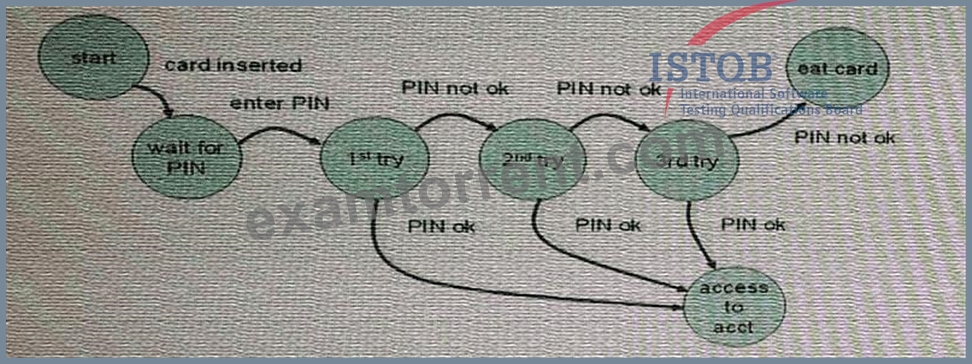
- A. 1st try -> 2nd try -> eat card
- B. 1 st try-> 2nd try
- C. 1 st try -> 2nd try -> 3rd try
- D. 1 st try -> 2nd try -> 3rd try -> access to act
Answer: A
Explanation:
The test case C is an example of a test case required to achieve 1-switch coverage, using the state transition test technique. A 1-switch test case is a test case that covers two states and the transition between them. To achieve 100% 1-switch coverage, all transitions between states must be covered by at least one test case. The test case C covers the transition from the state 1st try to the state 2nd try, and the transition from the state 2nd try to the state eat card. Verified References: [ISTQB Certified Tester Advanced Level Test Analyst CTAL- TA], Section 3.4.1, page 39.
NEW QUESTION # 36
A PIN entry component of an ATM system has been developed using the following state table: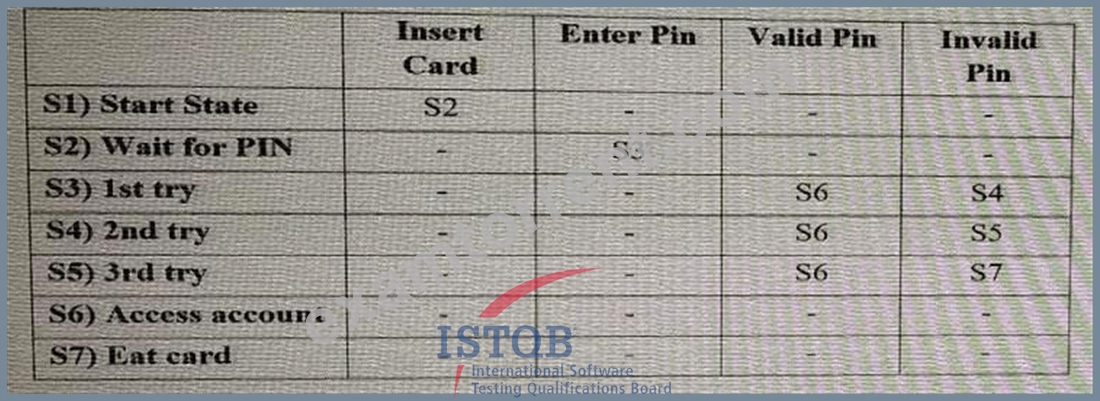
Using the state transition test technique, how many 0-switch test cases are needed to achieve 100% 0-switch coverage?
- A. 0
- B. 1
- C. 2
- D. 3
Answer: D
Explanation:
Eight 0-switch test cases are needed to achieve 100% 0-switch coverage. A state transition test technique is a technique that tests the behavior of a system or component based on its states and transitions between them. A
0-switch test case is a test case that covers one state and its associated actions and events. To achieve 100% 0- switch coverage, all states and their associated actions and events must be covered by at least one test case.
The states for this scenario are:
* Enter PIN
* PIN OK
* PIN not OK
* 1st try
* 2nd try
* 3rd try
* Access to act
* Eat card
Verified References: [ISTQB Certified Tester Advanced Level Test Analyst CTAL-TA], Section 3.4.1, page 39.
NEW QUESTION # 37
During which test stage is functional appropriateness typically tested?
- A. Adaptability testing
- B. Component testing
- C. Operability testing
- D. System testing
Answer: D
Explanation:
The test stage where functional appropriateness is typically tested is system testing. System testing is a test stage that evaluates the system or component as a whole against its specified requirements, including functional and non-functional requirements. Functional appropriateness is a software quality characteristic that evaluates how well the system or component provides functions that meet stated and implied needs when used under specified conditions. Verified References: [ISTQB Certified Tester Advanced Level Test Analyst CTAL-TA], Section 5.1.1, page 59.
NEW QUESTION # 38
REQ1 a sun cancer warning system shall produce a daily score sheet based on the number of hours expose to the sun and the intensity of sun radiation.
REQ2 The number of hours exposed to the sun shall be categorized in A (below 2), B (2 to 4 hours) or C (more than 4 hours) REQ3 The intensity of sun radiation shall be labelled as low, medium, high, or extreme.
Based on the requirements stated above a Test Analyst has defined the following three test cases:
How many test conditions to be identified from requirements REQ2 and REQ3, are NOT covered by the three test cases:
- A. 0
- B. 1
- C. 2
- D. 3
Answer: B
Explanation:
Four test conditions to be identified from requirements REQ2 and REQ3 are not covered by the three test cases. A test condition is an item or event of a component or systemthat could be verified by one or more test cases, such as a function, transaction, feature, quality attribute, or structural element. The test conditions to be identified from REQ2 and REQ3 are:
* Number of hours exposed to the sun = A
* Number of hours exposed to the sun = B
* Number of hours exposed to the sun = C
* Intensity of sun radiation = low
* Intensity of sun radiation = medium
* Intensity of sun radiation = high
* Intensity of sun radiation = extreme
The test conditions that are not covered by the three test cases are:
* Number of hours exposed to the sun = A
* Intensity of sun radiation = low
* Intensity of sun radiation = high
* Intensity of sun radiation = extreme
Verified References: [ISTQB Certified Tester Advanced Level Test Analyst CTAL-TA], Section 2.2.1, page 21.
NEW QUESTION # 39
Based on the tax system specification as described below, using boundary value analysis, which would be the best test set to explicitly test on single boundary value fully?
Tax system
A tax system needs to be updated due to new legislation. For a person with a salary of less than € 20 000 and who is married, the tax needs to be recalculated.
If a person has at least three and less than six children, an additional 10% reduction is applicable.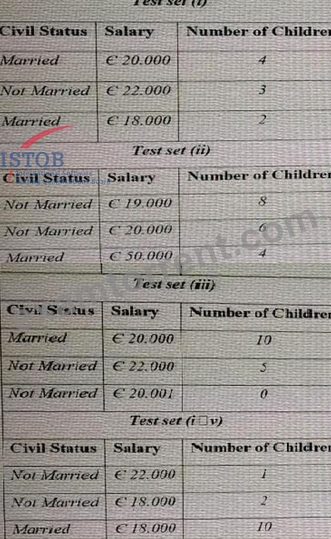
- A. Test set (ii)
- B. Test set (iii)
- C. Test set (iv)
- D. Test set (i)
Answer: A
Explanation:
The test set B is the best test set to explicitly test on single boundary value fully, using boundary value analysis. Boundary value analysis is a technique that tests the values at or near the boundaries of an input domain. The boundaries for this scenario are:
* Salary less than €20 000
* Number of children at least three and less than six
The test set B tests the boundary values of each boundary (€19 999, €20 000, three children, six children) and one value inside each boundary (€19 998, €20 001, four children). Verified References: [ISTQB Certified Tester Advanced Level Test Analyst CTAL-TA], Section 3.2.2, page 35.
NEW QUESTION # 40
How many cases are required to test the tax system specification as described below, using a decision table which is not collapsed?
Tax system
A tax system needs to be updated due to new legislation. For a person with a salary of less than € 20.000 and who is married, the tax needs to be recalculated. If the person also has more than two and less than five children, an additional 10% reduction is applicable.
- A. 0
- B. 1
- C. 2
- D. 3
Answer: B
Explanation:
Eight cases are required to test the tax system specification using a decision table that is not collapsed. A decision table is a technique that shows the combinations of conditions and actions for a given scenario. A decision table that is not collapsed contains all possible combinations of conditions and actions, regardless of whether they are valid or not. The conditions for this scenario are:
* Salary less than €20 000
* Married
* Number of children more than two and less than five
The number of cases is equal to the number of possible combinations of these conditions, which is 2^3 = 8.
Verified References: [ISTQB Certified Tester Advanced Level Test Analyst CTAL-TA], Section 3.3.1, page 37.
NEW QUESTION # 41
Return Item Use Case: The following depicts a main path through the use case, 'Return Item'.
Coverage Rules:
* One test case for basic behavior
* Multiple alternate behaviors may be incorporated into one test case if mutually compatible
* Nested alternate behaviors (like retry attempts) should be amalgamated into a single test case How many test cases should be designed?
SELECT ONE OPTION
- A. 0
- B. 1
- C. 2
- D. 3
Answer: B
Explanation:
Comprehensive and Detailed in Depth Explanation:
* Basic Behavior:One test case for the main path without errors (1 test case).
* El (Already logged in):Can be combined with the basic path (1 test case).
* E2 and E3 (Invalid login and account freeze):These are retry scenarios and can be amalgamated as one test case (1 test case).
* E4 (Go-Back):This occurs at two different steps (M7 and M9) but can be incorporated as a single test case because the behavior is the same (1 test case).
Hence, the total number of test cases is3(basic, login exception, go-back exception).
NEW QUESTION # 42
Based on the system state transition diagram of an ATM system shown below, using the state transition test technique which of the following is an example of a test case required to achieve 1-switch coverage?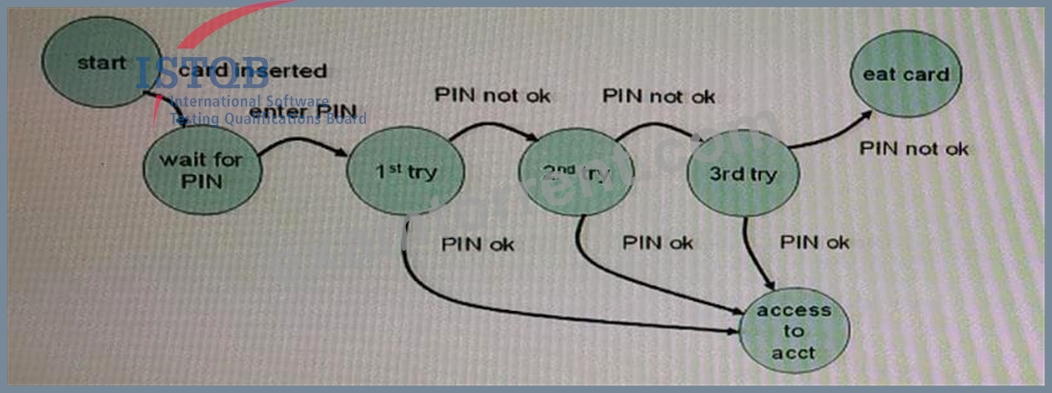
- A. 1st try -> 2nd try -> eat card
- B. 1 st try-> 2nd try
- C. 1 st try -> 2nd try -> 3rd try
- D. 1 st try -> 2nd try -> 3rd try -> access to act
Answer: A
Explanation:
The test case C is an example of a test case required to achieve 1-switch coverage, using the state transition test technique. A 1-switch test case is a test case that covers two states and the transition between them. To achieve 100% 1-switch coverage, all transitions between states must be covered by at least one test case. The test case C covers the transition from the state 1st try to the state 2nd try, and the transition from the state 2nd try to the state eat card. Verified References: [ISTQB Certified Tester Advanced Level Test Analyst CTAL- TA], Section 3.4.1, page 39.
NEW QUESTION # 43
Based on the classification tree shown below, using the pairwise testing technique how many test cases are required to test all pairs?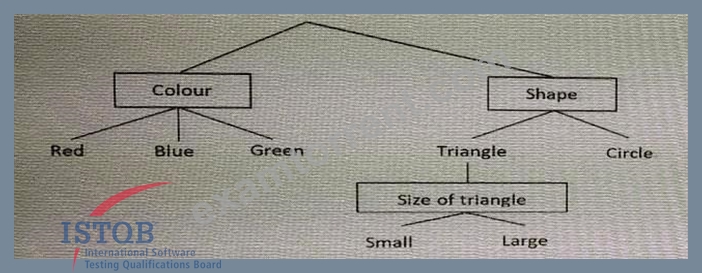
- A. 0
- B. 1
- C. 2
- D. 3
Answer: A
Explanation:
Nine test cases are required to test all pairs using the pairwise testing technique based on the classification tree. Pairwise testing is a technique that tests all possible pairs of inputs for a given scenario using a mathematical algorithm to reduce the number of combinations. The inputs for this scenario are:
* Power Unit: Petrol, Electric, Hybrid
* Body Style: Saloon, Hatchback, SUV
* Color: Red, Blue
The number of test cases is equal to the number of combinations generated by the algorithm that cover all pairs of inputs. Verified References: [ISTQB Certified Tester Advanced Level Test Analyst CTAL-TA], Section 3.5.2, page 42.
NEW QUESTION # 44
You are a Test Analyst in the banking domain. You have received the following requirement: "The system shall allow cash advances of at least 200 Euros for all supported credit cards. The following credit cards are supported: American Express, Diners, Visa, Mastercard and Eurocard.
Which one of the findings described below is true regarding this requirement?
- A. The requirement indicates potential usability problems
- B. The requirement is unclear in terms of advance limits.
- C. The requirement is ambiguous in terms of supported cards.
- D. The requirement indicates potential performance problems.
Answer: B
Explanation:
The finding that is true regarding this requirement is that it is unclear in terms of advance limits. The requirement states that the system shall allow cash advances of at least 200 Euros, but it does not specify what is the maximum amount or if there are any other restrictions or conditions for the cash advances. This makes the requirement ambiguous and incomplete, as it does not provide enough information for testing or implementation. Verified References: [ISTQB Certified Tester Advanced Level Test Analyst CTAL-TA], Section 2.3.1, page 23.
NEW QUESTION # 45
You have been asked to set up a session-based test management (SBTM) approach for exploratory testing on your current project. Which of the options below describes a correct sequence of steps for the first exploratory test session?
SELECT ONE OPTION
- A. Document test ideas for the session in a test charter, execute the tests until all documented ideas have been tested, record the results of the tests in the test management system
- B. Create a test charter for the session to record the areas to be tested, run a time-boxed test execution session, hold a debriefing session to gather and discuss the results of the tests
- C. Select existing test cases from the test management system most suitable for the session, copy them to a test charter, use a capture/replay tool to record the test execution session
- D. Run a debriefing session with the test manager to agree on the test procedures for the session, execute the test procedures, record the test results in a test charter
Answer: B
Explanation:
Comprehensive and Detailed in Depth Explanation:
Session-Based Test Management (SBTM) for exploratory testing follows these steps:
* Test Charter Creation:To outline the goals and scope of the session.
* Time-Boxed Test Execution:Allows focused, exploratory testing within a fixed duration.
* Debriefing Session:To discuss findings, assess coverage, and review results.
Option D accurately reflects this structure, making it the correct answer.
NEW QUESTION # 46
Based on the tax system specification as described below, using boundary value analysis, which would be the best test set to explicitly test on single boundary value fully?
Tax system
A tax system needs to be updated due to new legislation. For a person with a salary of less than € 20 000 and who is married, the tax needs to be recalculated.
If a person has at least three and less than six children, an additional 10% reduction is applicable.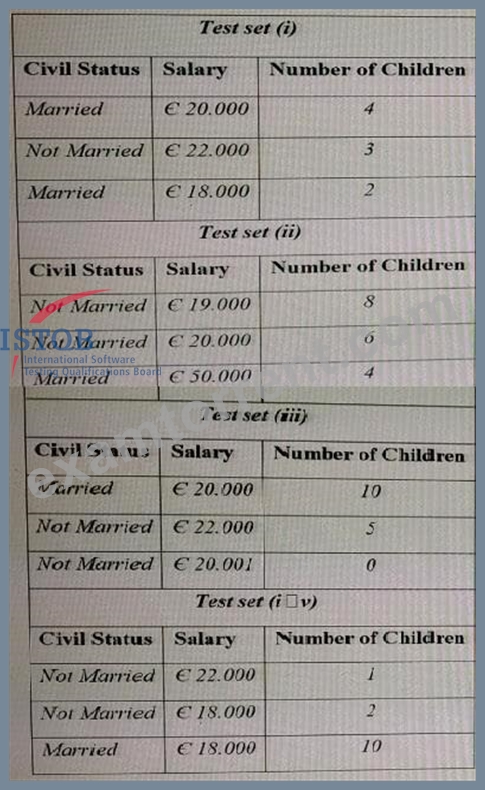
- A. Test set (ii)
- B. Test set (iii)
- C. Test set (iv)
- D. Test set (i)
Answer: A
Explanation:
The test set B is the best test set to explicitly test on single boundary value fully, using boundary value analysis. Boundary value analysis is a technique that tests the values at or near the boundaries of an input domain. The boundaries for this scenario are:
* Salary less than €20 000
* Number of children at least three and less than six
The test set B tests the boundary values of each boundary (€19 999, €20 000, three children, six children) and one value inside each boundary (€19 998, €20 001, four children). Verified References: [ISTQB Certified Tester Advanced Level Test Analyst CTAL-TA], Section 3.2.2, page 35.
NEW QUESTION # 47
......
ISTQB CTAL-TA certification is a valuable credential for software testing professionals who want to advance their careers. (ISTQB CTAL-TA) ISTQB Certified Tester Advanced Level - Test Analyst (Syllabus 2012) certification demonstrates the candidate's knowledge and skills in software testing and analysis and provides a competitive edge in the job market. (ISTQB CTAL-TA) ISTQB Certified Tester Advanced Level - Test Analyst (Syllabus 2012) certification exam is designed to test the candidate's expertise in various areas of software testing and is conducted in a proctored environment.
ISTQB ISTQB-CTAL-TA Official Cert Guide PDF: https://prep4sure.examtorrent.com/ISTQB-CTAL-TA-exam-papers.html
