

CRM-Analytics-and-Einstein-Discovery-Consultant Exam Dumps, CRM-Analytics-and-Einstein-Discovery-Consultant Practice Test Questions
PDF (New 2026) Actual Salesforce CRM-Analytics-and-Einstein-Discovery-Consultant Exam Questions
NEW QUESTION # 67
After the initial creation of a model, the first model insight explains
93% of the variation of the outcome variable. This is unusually high.
What is the most likely reason for this?
- A. The model contains too many outlier values.
- B. The outcome variable may be causing data leakage.
- C. The dataset contains multiple dominant values.
Answer: B
NEW QUESTION # 68
Exhibit: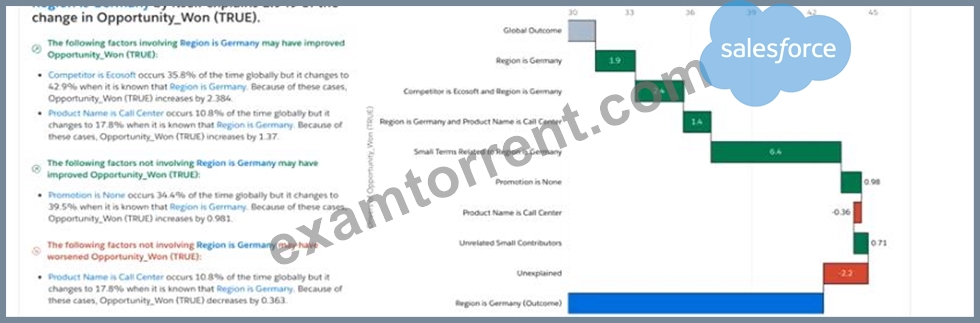
Which two statements can be determined based on the Why it Happened graphic above' Choose 2 answers
- A. Germany sells more Call Center product and that helps them increase their win rate.
- B. Germany performs lower than average but better when the product is Call Center.
- C. Call Center is a generally poor performing product, and since there is more in Germany that has a negative effect.
- D. The -2.2 Unexplained means there are effects that Einstein will never be able to explain regardless of the dataset.
Answer: A,C
NEW QUESTION # 69
Which security option is not available in Einstein Analytics for securing datasets?
- A. App level security
- B. Inherited security
- C. Field-level security
- D. Row-level security with security predicates
Answer: C
NEW QUESTION # 70
When Analytics runs a dataflow that accesses Salesforce objects, which user does it use?
- A. The Integration User
- B. The system administrator
- C. The record owner
- D. The current user
Answer: A
NEW QUESTION # 71
The below image shows a numeric outcome being deployed (Regression).
Which metric is used to calculate the performance of the model in production, specifically in the Model Manager?
The below image shows a numeric outcome being deployed (Regression).
Which metric is used to calculate the performance of the model in production, specifically in the Model Manager?
- A. Root Mean Square Error, Minimum Square Error
- B. Area Under Curve, R2 (R-squared)
- C. Area Under Curve, Confusion Matrix
Answer: A
Explanation:
In the context of a regression model being deployed, the performance metrics used to evaluate its effectiveness in production typically include:
Root Mean Square Error (RMSE): This metric provides a measure of the average magnitude of the errors between predicted values by the model and the actual values, giving a sense of how accurately the model predicts the outcome.
Minimum Square Error: While less commonly referenced as "Minimum Square Error", metrics like Mean Squared Error (MSE) are often used to quantify the average of the squares of the errors-essentially, the average squared difference between the estimated values and what is estimated.
These metrics are crucial for assessing the performance of regression models in CRM Analytics, as they directly reflect the accuracy and reliability of the model's predictions in real-world applications.
NEW QUESTION # 72
A large company has a single dataset that contains the attainment and commission fields for all sales reps. Each sales rep should be able to view the attainment data for each rep in their division. Each rep should only be able to see their own commission data.
Which option should be used to enforce this requirement?
- A. Add the sales organization to the attainment dataset access list.
- B. Create separate datasets for attainment and commission and apply security predicates and/or sharing inheritance.
- C. Apply a security predicate on the existing single dataset.
- D. Use sharing inheritance.
Answer: B
NEW QUESTION # 73
An Einstein Consultant is reviewing the "Why it Happened" Insights provided by Einstein Discovery with the customer. The customer would like to validate the results. Which action should the consultant take?
- A. Check the p-values and standard deviation
- B. Use the Share and Export feature to help the customer determine if the findings make logical sense
- C. Show the customer how to export and review the R-Code model validation results
- D. Consult with a Data Scientist to validate the findings
Answer: B
NEW QUESTION # 74
In a Compare Table formula, you can refer to other columns with:
- A. Their names
- B. Numbers (1..9)
- C. Letters (A..Z)
- D. All of the above
Answer: C
NEW QUESTION # 75
In the context of Analytics, what is faceting?
- A. Something only programmers can access
- B. Filtering all related widgets in a dashboard by your selection
- C. Measuring the number of significant digits of precision for a particular metric
- D. Choosing the color of the background in a graph
- E. Representing the number of widgets on a dashboard
Answer: B
NEW QUESTION # 76
The CRM Analytics consultant at Universal Containers notices that some users have access to sensitive data and dashboards they should not have access to in the Manager's app.
How should the consultant fix the problem?
- A. Develop separate dashboards and datasets and put them in the Manager's app.
- B. Apply data encryption using Salesforce Shield.
- C. Create separate apps, datasets, and dashboards, and share them with the proper users.
Answer: C
Explanation:
To address issues with unauthorized access to sensitive data and dashboards, the best practice is to create separate apps, datasets, and dashboards for different user groups and then manage their sharing settings appropriately. This allows you to maintain data security while ensuring that users only access the data and insights that are relevant to their roles. In this scenario, applying separate apps for managers with defined sharing rules will prevent users who shouldn't have access from seeing sensitive data.
Reference: Managing Data Access and Sharing in CRM Analytics
NEW QUESTION # 77
Exhibit.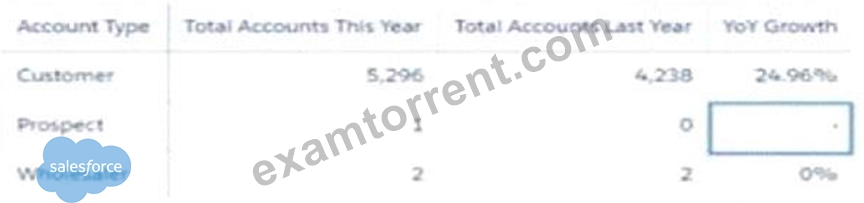
Universal Containers has a dashboard for sales managers to visualize the Year Over Year (YoY) growth of their customers. The formula used is:
YoY = [(This Year - Last Year) / Last Year] %
Based on the graphic, when there is not an account in the Last Year column, the YoY Growth shows null results. The sales managers want to replace it with 100% value.
What is the correct function to use?
- A. substr()
- B. coalesce()
- C. replace()
Answer: B
NEW QUESTION # 78
What is the order of filter, limit, order and offset functions in SAQL?
Answer:
Explanation:
Filter and order can be interchanged. Offset must be after filter/order and limit must come after offset.
NEW QUESTION # 79
CRM Analytics uses permissions of the Integration User to extract data from Salesforce objects and fields when a dataflow/recipe job runs.
Why should a consultant be cautious while syncing objects and fields containing sensitive data?
- A. The Integration User has Create and Modify All Data access.
- B. The Integration User has View All Data access.
- C. The Integration User has Modify All Data access.
Answer: B
NEW QUESTION # 80
Insights in a story show you how different variables and combinations of variables explain the variation of what kind of variable?
- A. Global variable
- B. Explanatory variable
- C. Tertiary variable
- D. Outcome variable
- E. Local variable
Answer: D
Explanation:
When you configure the story, you tell Einstein Discovery to maximize/minimize the variable. The variable is 'outcome variable' in your story
NEW QUESTION # 81
What are two benefits of designing using the "Progressive Disclosure" principle? Choose 2 answers
- A. Automatic conditional formatting
- B. Discounted EA licenses when growth is achieved
- C. improved ease of use for end users
- D. Better dashboard performance
Answer: C,D
Explanation:
https://developer.salesforce.com/blogs/developer-relations/2017/04/lightning-components-performance-best-practices.html
NEW QUESTION # 82
What kind of org should you use for checking challenges when you do Trailhead modules about Analytics?
- A. A higher education org, because analytics requires advanced math
- B. An enterprise org, because that type of org is typically used by large companies
- C. A Developer Edition org, because it's a free, safe environment where you can try things out
- D. A trial org, because you don't need to save anything
Answer: C
NEW QUESTION # 83
When organizing information in an Einstein Analytics dashboard, what does the "Progressive Disclosure' design principle mean'
- A. Only provide the user with the level of detail they need to see, with the option to drill down deeper into more details.
- B. Utilize the latest templates for the most modern look and feel.
- C. Implement strict security predicates to minimize the amount of information displayed to users.
- D. Intentionally omit specific details so that users can do ad-hoc exploration if needed for root-cause analysis.
Answer: A
NEW QUESTION # 84
A consultant is preparing a dataset to predict customer lifetime value and is collecting data from a questionnaire that asks for demographic information. A very small number of respondents fill in the Income box, but the consultant thinks that it is an informative column even though it only represents 1% of respondents.
What should the consultant do?
- A. Apply the predict missing values transformation in recipe nodes.
- B. Drop the field as it will be difficult to get future respondents.
- C. Fill in the missing data with an average of all incomes.
Answer: A
NEW QUESTION # 85
The Universal Containers company used Einstein Analytics to create two datasets:
Dataset A: contains a list of activities with an "activitylD" dimension and a "userlD" dimension Dataset B: contains a list of users with a "userlD" dimension The team wants to delete from Dataset A all activities related to users in Dataset B.
How can an Einstein Consultant help them achieve this?
- A. Use the dataflow transformation "delete" and set "userlD" as the deletion ID.
- B. Use a combination of dataflow transformations: "augment" and "filter."
- C. Use an external ETL tool to extract both datasets and delete records.
Answer: B
Explanation:
D, Use the recipe operation "delete" and set "userlD" as the deletion ID.
NEW QUESTION # 86
A model created with a GLM algorithm produced unsatisfactory results.
When re-running the model, which type of algorithm should the consultant use to improve the results?
- A. XGBoost
- B. Support Vector Machines
- C. K-Nearest Neighbors
Answer: A
NEW QUESTION # 87
The Einstein Analytics Plus Platform license is enabled for a Salesforce org and assigned to each user. However, these users cannot see the Einstein Analytics Studio in the App Launcher.
How can this issue be addressed?
- A. Assign the users to the permission set containing Manage Analytics.
- B. Share the app with the users in Einstein Analytics.
- C. Create user accounts for the users in Einstein Analytics.
- D. Assign the users to the permission set containing Use Analytics.
Answer: D
NEW QUESTION # 88
CRM Analytics team plans to enable data sync.
Which limit specific to data syne should the team consider before enabling the feature because it may impact existing jobs?
- A. Maximum number of Full Sync connection mode enabled
- B. Maximum number of objects that can be enabled for data sync
- C. Maximum number of data sync jobs cannot exceed the limit
Answer: B
Explanation:
In CRM Analytics, when planning to enable data sync, one of the critical considerations is the limit on the number of objects that can be enabled for data sync. This limit is essential because it determines how many different Salesforce objects (like Accounts, Opportunities, etc.) can be synchronized concurrently. Exceeding this limit could impact the performance of existing sync jobs or prevent new sync jobs from being configured.
Key points to consider include:
Performance Impact: Syncing too many objects simultaneously can lead to increased load times and potential delays in data availability, impacting users' ability to access up-to-date information.
Resource Allocation: CRM Analytics allocates resources based on the number of objects being synchronized, and there are practical limits to these resources to ensure stable and efficient operation.
For a more detailed understanding and to manage these limits effectively, Salesforce provides documentation and guidelines within the CRM Analytics resources, which can be further explored in the Trailhead modules specifically focusing on data management and synchronization practices.
NEW QUESTION # 89
......
Salesforce CRM-Analytics-and-Einstein-Discovery-Consultant Exam Syllabus Topics:
| Topic | Details |
|---|---|
| Topic 1 |
|
| Topic 2 |
|
| Topic 3 |
|
| Topic 4 |
|
| Topic 5 |
|
Updated Mar-2026 Pass CRM-Analytics-and-Einstein-Discovery-Consultant Exam - Real Practice Test Questions: https://prep4sure.examtorrent.com/CRM-Analytics-and-Einstein-Discovery-Consultant-exam-papers.html
