

ExamTorrent NS0-304 Exam Questions | Real NS0-304 Practice Dumps
Verified NS0-304 Exam Dumps Q&As - Provide NS0-304 with Correct Answers
NEW QUESTION # 63
Why would you want to schedule the shut down and restart of Cloud Volumes ONTAP?
- A. to earn Azure credits
- B. to lower compute costs
- C. to increase the throughput
- D. to lower capacity costs
Answer: B
NEW QUESTION # 64
An administrator is asked to set up a Cloud Volumes ONTAP (CVO) with high availability in AWS using all default configuration settings. Where is the IAM role created?
- A. AWS Systems Manager
- B. BlueXP
- C. Cloud Volumes ONTAP
- D. AWS console
Answer: D
Explanation:
When setting up Cloud Volumes ONTAP (CVO) with high availability in AWS, the creation of an IAM role associated with CVO is performed in the AWS console. Here's the process:
* Role Creation in AWS Console:The IAM role must be created within the AWS console. This role is crucial as it grants the Cloud Volumes ONTAP instance thenecessary permissions to access other AWS services as required by its configuration and operational needs.
* Permissions Configuration:The IAM role should be configured with policies that provide the appropriate permissions for services that CVO needs to interact with, such as S3 for storage, EC2 for compute resources, and others depending on the specific setup.
* Associate IAM Role with CVO:Once created, the IAM role is then associated with the CVO instance during its setup process in the AWS console or through BlueXP, which automates and manages NetApp configurations in cloud environments.
For detailed guidelines on creating and configuring IAM roles for Cloud Volumes ONTAP in AWS, please consult the AWS documentation and NetApp setup guides for CVO: NetApp CVO AWS Documentation.
NEW QUESTION # 65
An administrator is configuring a Red Hat Enterprise Linux system as a Workload Security Agent and wants to make sure that it meets requirements.
Which two changes should the administrator make to the system? (Choose two.)
- A. Install the ansible-core application
- B. Install the unzip application
- C. Disable the system firewall
- D. Disable SELinux
Answer: B,D
Explanation:
When configuring a Red Hat Enterprise Linux system as a Workload Security Agent, there are specific system requirements and preparations needed to ensure compatibility and functionality of the security agent. Among the potential adjustments:
* Disable SELinux: Security-Enhanced Linux (SELinux) can interfere with the operation of various security agents due to its strict access controls. Disabling SELinux may be recommended by certain security applications to ensure they can function without restrictions. This should be carefully considered in the context of overall system security policies.
* Install the unzip application: Many security agents requireunzipto extract and install necessary files.
Ensuring thatunzipis installed on the system can facilitate the installation and updating of the security agent.
Install the ansible-core applicationandDisable the system firewallare not typically required or recommended universally for configuring a Workload Security Agent:
* Ansible-coreis used for automation and configuration management but is not a prerequisite for most security agents unless specifically stated.
* Disabling the system firewallcan significantly reduce the system's security posture and is generally not advisable unless specifically required by the security agent, and even then, such advice should be critically evaluated.
For specific guidelines and requirements, the installation documentation of the Workload Security Agent should be consulted.
NEW QUESTION # 66
You are managing a large NetApp hybrid cloud estate across your business and are experiencing VM performance problems. You are asked to investigate. You need a tool that provides monitoring capabilities and enables you to solve specific issues quickly.
Which NetApp tool would you deploy to satisfy these requirements?
- A. NetApp Cloud Manager
- B. NetApp Cloud Compliance
- C. NetApp Cloud Insights
- D. Spot Eco by NetApp
Answer: C
NEW QUESTION # 67
How many VPCs are required to deploy CVO in Google Cloud?
- A. 0
- B. 1
- C. 2
- D. 3
Answer: B
Explanation:
To deploy Cloud Volumes ONTAP (CVO) in Google Cloud, typically two Virtual Private Clouds (VPCs) are required. This configuration generally involves:
* A VPC for the management of CVO operations, handling management traffic, control plane operations, and other administrative activities.
* A VPC dedicated to data traffic, ensuring data security and optimal network performance for storage operations.
This dual-VPC architecture helps in isolating management operations from data operations, providing enhanced security and performance. The management VPC can handle tasks like software updates and system monitoring, while the data VPC focuses purely on serving storage requests, thereby optimizing traffic flows and security policies accordingly.
For more detailed deployment instructions and VPC configuration guidelines, the official NetApp documentation on deploying Cloud Volumes ONTAP in Google Cloud provides comprehensive guidance.
NEW QUESTION # 68
You are setting up a Cloud Volumes ONTAP HA on AWS.
In this scenario, which high availability method is used for the data?
- A. Both nodes connect to a shared pool of S3 storage.
- B. Volume Snapshot copies are replicated between both nodes.
- C. Data is synchronously mirrored between both nodes.
- D. Both nodes connect to a shared pool of mirrored EBS disks.
Answer: C
NEW QUESTION # 69
You are provisioning a single node NetApp Cloud Volumes ONTAP instance in the public cloud.
In this scenario, which two LIFs are configured by Cloud Manager by default? (Choose two.)
- A. cluster management LIF
- B. FC data LIF
- C. intercluster LIF
- D. Storage Virtual Machine (SVM) management LIF
Answer: A,C
NEW QUESTION # 70
An administrator is troubleshooting a Cloud Data Sense deep scan that failed on a Cloud Volumes ONTAP (CVO) NFS export. The scan worked a day ago with no errors. The administrator notices that the NFS export is on a volume with a recently modified export policy rule.
Which export policy rule modification will resolve this issue?
- A. anon
- B. read
- C. superuser
- D. krb
Answer: B
Explanation:
If a Cloud Data Sense deep scan of an NFS export fails after a recent modification to the export policy rule, the most critical setting to check and adjust is the read permission. Here's how to resolve the issue:
* Review the Modified Export Policy:Access the export policy settings for the NFS volume that Cloud Data Sense is attempting to scan. Check for recent changes that might have restricted read access.
* Modify Export Policy to Allow Read Access:Ensure that the export policy rule specifically permits read access. This permission is essential for Cloud Data Sense to read the data stored on the NFS export and perform the scan effectively.
* Apply Changes and Re-test the Scan:After adjusting the export policy to ensure read access, re-run the Cloud Data Sense scan to confirm that the issue is resolved and that the scan completes successfully.
For detailed instructions on configuring NFS export policies in Cloud Volumes ONTAP, consult the NetApp documentation: NetApp NFS Export Policy Documentation.
NEW QUESTION # 71
An administrator is preparing to automate firmware updates with the help of Active IQ Digital Advisor. Which automation tool should the administrator use?
- A. Puppet
- B. Ansible
- C. Terraform
- D. Pulumi
Answer: B
Explanation:
To automate firmware updates effectively using Active IQ Digital Advisor, the best tool to use is Ansible.
Here's why:
* Ansible Integration with NetApp:Ansible is widely recognized for its powerful automation capabilities across various IT environments. NetApp provides specific Ansible modules designed to interact with its storage solutions and services, including the automation of firmware updates.
* Active IQ Digital Advisor Integration:Active IQ Digital Advisor offers predictive analytics, actionable intelligence, and proactive recommendations. By using Ansible, administrators can automate the implementation of these recommendations, including firmware updates, to enhance efficiency and reliability in operations.
To implement this, the administrator needs to leverage the NetApp Ansible modules that are specifically designed for storage management tasks. This can be found in the NetApp Automation Store, where administrators can access pre-built playbooks for firmware updates, simplifying the automation process.
For further details and specific implementation steps, please refer to the NetApp Automation Store and the official NetApp documentation on Ansible integration: NetApp Ansible Modules Documentation.
NEW QUESTION # 72
An administrator wants to use Cloud Data Sense to monitor all OneDrive accounts in the marketing department. Which two items are required? (Choose two.)
- A. Admin login credentials for the OneDrive for Business account
- B. Admin login credentials for the Azure tenant account
- C. User logins for every OneDrive account in the marketing department
- D. A list of the email addresses for all users whose OneDrive folders are to be scanned
Answer: A,D
Explanation:
To use Cloud Data Sense to monitor all OneDrive accounts in the marketing department, two key items are required:
* A List of the Email Addresses for All Users:This is necessary to identify and access the specific OneDrive accounts belonging to members of the marketing department. Cloud Data Sense needs this information to correctly target and scan the relevant data sets.
* Admin Login Credentials for the OneDrive for Business Account:These credentials are required to grant Cloud Data Sense the necessary permissions to access and scan the OneDrive accounts. Admin credentials ensure that Data Sense can perform scans across multiple user accounts without needing individual user logins.
These requirements ensure that Cloud Data Sense can effectively monitor and analyze the data within OneDrive accounts, providing insights into data usage and compliance.
For additional information on setting up Cloud Data Sense with OneDrive, refer to the NetApp documentation on Cloud Data Sense: NetApp Cloud Data Sense Documentation.
NEW QUESTION # 73
Which two security group configurations would be used when deploying Cloud Volumes ONTAP?
(Choose two.)
- A. Use an existing security group.
- B. Use no security group.
- C. Generate a security group.
- D. Generate a security group with no rules.
Answer: A,C
NEW QUESTION # 74
You want to set up Cloud Sync between your on-premises ONTAP node and your AWS Cloud Volumes Service NFS mount.
In this scenario, which two network components would you use? (Choose two.)
- A. Express Route
- B. Direct Connect
- C. VPN
- D. VPC endpoint
Answer: A
NEW QUESTION # 75
An administrator is configuring their environment using AppTemplate and wants to organize and be able to search through the various templates they have created.
Which feature should the administrator use?
- A. Annotations
- B. Comments
- C. Pull Requests
- D. Tags
Answer: D
Explanation:
In managing and organizing environments using AppTemplate, the ability to quickly search and categorize various templates is crucial. The use ofTagsis highly effective in this scenario:
* Tags: These allow for labeling templates with keywords or terms that make them easily searchable and categorizable. Tags help in organizing templates by themes, purposes, environments, or any classification that suits the administrative needs. This feature enhances manageability, especially in environments with a large number of templates.
Annotations,Comments, andPull Requestsserve different purposes:
* AnnotationsandCommentscan be used to add descriptive or explanatory texts but do not facilitate the searchability of templates in a structured manner like tags.
* Pull Requestsare typically used in version control systems for proposing changes and reviewing code, not for searching or organizing templates directly.
Using tags in AppTemplate effectively streamlines the management and operational efficiency, making it easier to locate and utilize templates as needed. Additional details on using tags can be found in the user guide or help section of the AppTemplate tool.
NEW QUESTION # 76
An administrator notices that Cloud Data Sense is not scanning the new NFS volume that was recently provisioned. What should the administrator enable?
- A. Write permissions
- B. Read permissions
- C. S3 access
- D. CIFS access
Answer: B
Explanation:
For Cloud Data Sense to scan an NFS volume effectively, it requires appropriate access permissions to the files and directories within the volume. Since the issue involves Cloud Data Sense not scanning a newly provisioned NFS volume, the most likely cause is insufficient read permissions. Here's what to do:
* Verify and Modify NFS Export Policies:Check the NFS export policies associated with the volume to ensure that they allow read access for the user or service account running Cloud Data Sense. This permission is critical for the service to read the content of the files and perform its data classification and management functions.
* Adjust Permissions if Necessary:If the current permissions are restrictive, modify the export policy to grant at least read access to Cloud Data Sense. This might involve adjusting the export rule in the NetApp management interface.
* Restart Cloud Data Sense Scan:Once the permissions are correctly configured, initiate a new scan with Cloud Data Sense to verify that it can now access and scan the volume.
For further guidance on configuring NFS permissions for Cloud Data Sense, refer to the NetApp documentation on managing NFS exports and Cloud Data Sense configuration: NetApp Cloud Data Sense Documentation.
NEW QUESTION # 77
An administrator wants to use BlueXP Observability to generate notifications whenever a volume in a FlexGroup on a GCP CVO system is nearing capacity.
Which option should the administrator use?
- A. AIQ ConfigAdvisor
- B. Service Level Annotation
- C. Log Monitor
- D. Data Collection API
Answer: D
Explanation:
To generate notifications whenever a volume in a FlexGroup on a GCP CVO system is nearing capacity using BlueXP Observability, the Data Collection API should be utilized. This option allows for the configuration of customized monitoring and alerting based on specific data points and thresholds. Here's the process:
* Setup Data Collection API:Configure the Data Collection API to monitor volume capacity metrics within your FlexGroup. This involves setting up the API to pull or receive data points related to storage utilization.
* Define Alerts:Set thresholds for when capacity is considered nearing its limit (e.g., 80% full). Configure alerts to be triggered when these thresholds are approached, ensuring administrators are notified in advance to take necessary actions.
* Implement Notification System:Integrate the alerting mechanism with your organization's notification system (e.g., email alerts, SMS, or a dashboard) to inform the relevant stakeholders or administrators promptly.
For detailed instructions on configuring the Data Collection API and setting up monitoring and alerting in BlueXP Observability, refer to the NetApp BlueXP documentation and API guides: NetApp BlueXP Documentation.
NEW QUESTION # 78
Which two advanced SMB features are available with Cloud Volumes ONTAP 9.5? (Choose two.)
- A. large MTU
- B. multichannel
- C. workgroup authentication
- D. credit limits
Answer: A,B
NEW QUESTION # 79
You have SnapMirror connectivity issues between two Cloud Volumes ONTAP dusters.
Which advanced ONTAP command would you use to troubleshoot and test replication connectivity?
- A. cluster peer ping
- B. vserver peer show
- C. cluster ping-cluster
- D. network ping
Answer: B
NEW QUESTION # 80
A company wants to use only SMB as a service in Azure. Which ONTAP offering meets this requirement?
- A. FSx
- B. CVO
- C. CVS
- D. ANF
Answer: C
Explanation:
Azure NetApp Files (ANF), referred to as Cloud Volumes Service for Azure (CVS), supports SMB as well as NFS file services in Azure. For a company specifically looking to use SMB as a service, CVS is an ideal choice because it is a Microsoft-managed service built together with NetApp. It provides seamless integration with Azure services and is optimized for file-based workloads with enterprise-level features. FSx refers to Amazon's service and is not applicable here. Cloud Volumes ONTAP (CVO) and Azure NetApp Files (ANF) are different products; ANF being the specific offering under CVS for Azure.For more information, refer to NetApp's official documentation on Cloud Volumes Service for Azure, which outlines the services and configurations specifically for SMB protocols within Azure environments.
NEW QUESTION # 81
An administrator wants to use BlueXP Ransomware Protection to protect their files in a CVO instance. What must be enabled first?
- A. BlueXP Copy and Sync
- B. BlueXP Classification
- C. BlueXP Observability
- D. BlueXP Tiering Feature
Answer: B
Explanation:
BlueXP Classification must be enabled first to utilize BlueXP Ransomware Protection. BlueXP Classification allows the system to scan and classify data, which is essential for identifying and protecting sensitive information against ransomware threats. This classification process is a prerequisite to effectively monitor and secure the data stored in a Cloud Volumes ONTAP (CVO) instance, ensuring that ransomware protection can be applied accurately based on the classified data.
References:
* NetApp Hybrid Cloud Administrator Course Material (Ransomware Protection module)
* NetApp Learning
Center:https://learningcenter.netapp.com/LC?ObjectType=WBT&ObjectID=00371904
NEW QUESTION # 82
You are the administrator of a company that has purchased a new NetApp HCI cluster. To ensure granular control over each VM's HDD performance, you decide to use only vVols in your VMware vSphere environment.
Your company also has a FAS system that is serving CIFS and an E-Series serving LUNs over InfiniBand. You are asked to back up all VMS to an offsite location.
What is a supported method to back up all of your VMs?
- A. Replicate the vVOLs using SnapMirror to the existing FAS using SnapContro
- B. Create a Snapshot policy for the datastores in SolidFire Cluster Administrator.
- C. Use third-party backup software to make a VADP backup of the VMs
- D. Replicate the vVOLs using SnapMirror to the existing E-Series using SnapCenter.
Answer: B
NEW QUESTION # 83
Click the Exhibit button.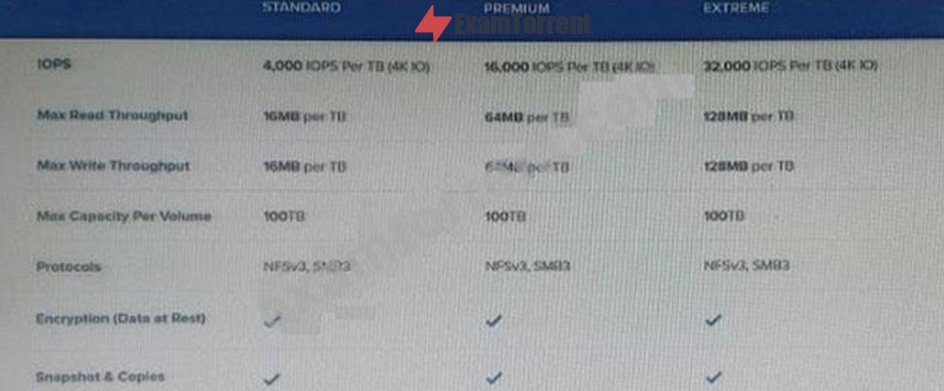
Your customer has chosen Premium Performance Tier on AWS Cloud Volume Services for a database requiring 15,000 TOPS. However, users are reporting that the database performance is very low.
Referring to the exhibit, what should you recommend?
- A. Disable Data at Rest Encryption
- B. Change the maximum bandwidth in the Premium Tier.
- C. Create a second Premium Instance
- D. Upgrade to the Extreme Performance Tier
Answer: B
NEW QUESTION # 84
......
Get Top-Rated Network Appliance NS0-304 Exam Dumps Now: https://prep4sure.examtorrent.com/NS0-304-exam-papers.html
