

[Feb 28, 2026] JN0-637 Sample with Accurate & Updated Questions
JN0-637 Exam Info and Free Practice Test | ExamTorrent
NEW QUESTION # 60
Refer to the Exhibit.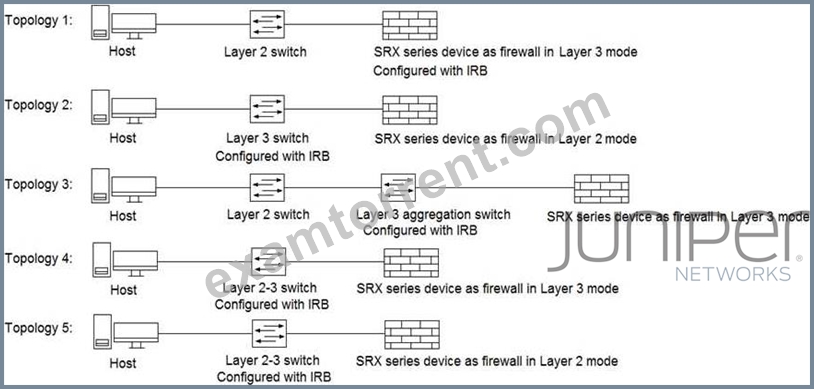
Referring to the exhibit, which three topologies are supported by Policy Enforcer? (Choose three.)
- A. Topology 4
- B. Topology 3
- C. Topology 2
- D. Topology 5
- E. Topology 1
Answer: A,B,E
Explanation:
Reference: https://www.juniper.net/documentation/en_US/junos-space17.2/policy- enforcer/topics/concept/policy-enforcer-deployment-supported-topologies.html
NEW QUESTION # 61
You are configuring an interconnect logical system that is configured as a VPLS switch to allow two logical systems to communicate.
Which two parameters are required when configuring the logical tunnel interfaces? (Choose two.)
- A. The logical tunnel interfaces should be configured with two logical unit pairs per logical system interconnect.
- B. The virtual tunnel interfaces should only be configured with two logical unit pairs per logical system interconnect.
- C. Encapsulation ethernet must be used.
- D. Encapsulation ethernet-vpls must be used.
Answer: A,D
NEW QUESTION # 62
Exhibit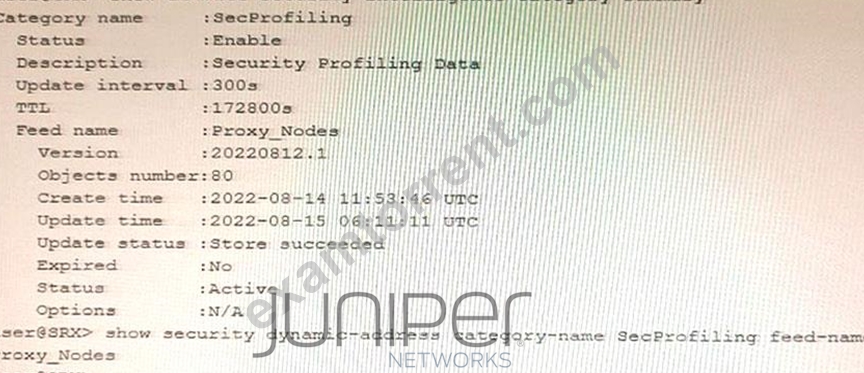
You have recently configured Adaptive Threat Profiling and notice 20 IP address entries in the monitoring section of the Juniper ATP Cloud portal that do not match the number of entries locally on the SRX Series device, as shown in the exhibit.
What is the correct action to solve this problem on the SRX device?
- A. Flush the DNS cache on the SRX device.
- B. Force a manual download of the Proxy__Nodes feed.
- C. Refresh the feed in ATP Cloud.
- D. You must configure the DAE in a security policy on the SRX device.
Answer: A
NEW QUESTION # 63
Exhibit
Your company recently acquired a competitor. You want to use using the same IPv4 address space as your company.
Referring to the exhibit, which two actions solve this problem? (Choose two)
- A. Configure IPsec Transport mode.
- B. Identify two neutral IPv4 address spaces for address translation.
- C. Configure static NAT on the SRX Series devices.
- D. Connect the competitor network using IPsec policy-based VPNs.
Answer: C,D
NEW QUESTION # 64
Exhibit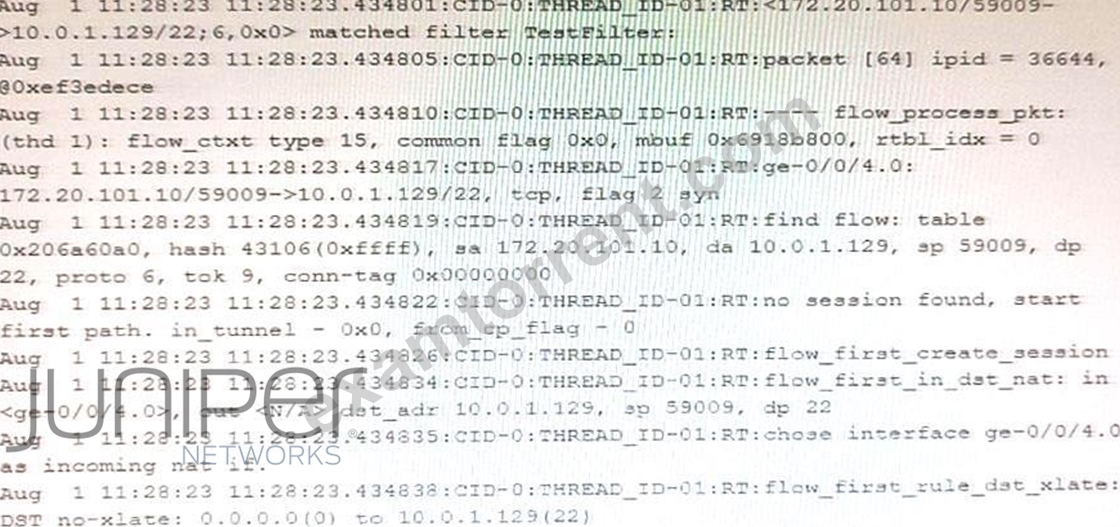
The exhibit shows a snippet of a security flow trace.
In this scenario, which two statements are correct? (Choose two.)
- A. The capture is a packet from the source address 172.20.101.10 destined to 10.0.1.129.
- B. Destination NAT occurs.
- C. This packet arrived on interface ge-0/0/4.0.
- D. An existing session is found in the table.
Answer: A,D
NEW QUESTION # 65
You are asked to connect two hosts that are directly connected to an SRX Series device. The traffic should flow unchanged as it passes through the SRX, and routing or switch lookups should not be performed. However, the traffic should still be subjected to security policy checks.
What will provide this functionality?
- A. MACsec
- B. Secure wire
- C. Mixed mode
- D. Transparent mode
Answer: B
Explanation:
Secure wire mode on SRX devices allows traffic to flow transparently through the firewall without being routed or switched, while still applying security policies. This is ideal for scenarios where traffic inspection is required without altering the traffic path or performing additional routing decisions.
In this scenario, you want traffic to pass through the SRX unchanged (without routing or switching lookups) but still be subject to security policy checks. The best solution for this requirement is Secure Wire.
Secure Wire allows traffic to flow through the SRX without any Layer 3 routing or Layer 2 switching decisions. It effectively bridges two interfaces at Layer 2 while still applying security policies. This ensures that traffic remains unchanged, while security policies (such as firewall rules) can still be enforced.
This is an ideal solution when you need the SRX to act as a "bump in the wire" for security enforcement without changing the traffic or performing complex network lookups.
NEW QUESTION # 66
Exhibit: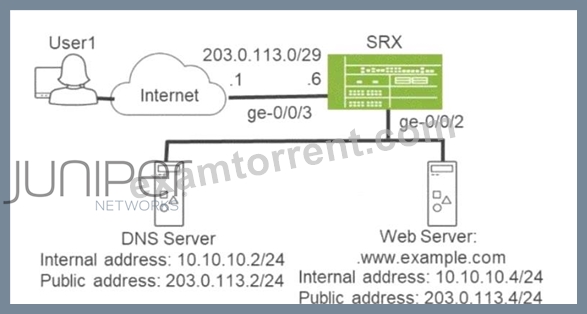
You are asked to ensure that Internet users can access the company's internal webserver using its FQDN.
However, the internal DNS server's A record only points to the webserver's private address.
Referring to the exhibit, which two actions are required to complete this task? (Choose two.)
- A. Configure destination NAT for both the DNS server and the webserver.
- B. Configure static NAT for both the DNS server and the webserver.
- C. Disable the DNS ALG.
- D. Configure proxy ARP on ge-0/0/3.
Answer: B,D
Explanation:
In the scenario where internal users are trying to access the company's web server via its FQDN but the DNS server resolves to a private IP, two key actions are needed:
* Static NAT (Answer B): Since the internal DNS server resolves the web server to its private IP address (10.10.10.4/24), you need to configure static NAT for both the DNS server and the webserver. This will ensure that requests coming from the internet will be translated to the web server's public IP (203.0.113.4) and the DNS server's public IP (203.0.113.2).
Example Command:
bash
Copy code
set security nat static rule-set public-to-private from zone untrust
set security nat static rule-set public-to-private rule dns-server match destination-address 203.0.113.2/32 set security nat static rule-set public-to-private rule dns-server then static-nat-prefix 10.10.10.2/32 set security nat static rule-set public-to-private rule web-server match destination-address 203.0.113.4/32 set security nat static rule-set public-to-private rule web-server then static-nat-prefix 10.10.10.4/32
* Proxy ARP (Answer D): The SRX needs to respond to ARP requests for the public IP addresses of both the DNS and webserver on the interface facing the internet (ge-0/0/3). This allows the SRX to handle requests directed at the public IPs.
Example Command:
bash
Copy code
set interfaces ge-0/0/3 unit 0 family inet proxy-arp interface-address 203.0.113.2/32 set interfaces ge-0/0/3 unit 0 family inet proxy-arp interface-address 203.0.113.4/32 These two configurations allow external users to access the internal web server via its public IP, as resolved by the DNS server.
NEW QUESTION # 67
You are asked to detect domain generation algorithms
Which two steps will accomplish this goal on an SRX Series firewall? (Choose two.)
- A. Attach the security-metadata-streaming policy to a security
- B. Attach the advanced-anti-malware policy to a security policy.
- C. Define a security-metadata-streaming policy under [edit
- D. Define an advanced-anti-malware policy under [edit services].
Answer: B,D
NEW QUESTION # 68
You are using trace options to troubleshoot a security policy on your SRX Series device.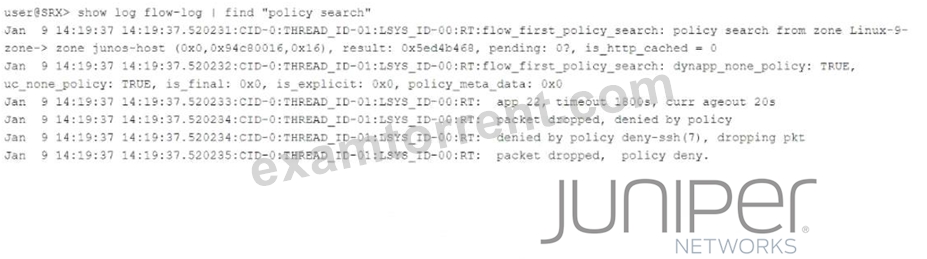
Referring to the exhibit, which two statements are true? (Choose two.)
- A. The SSH traffic matches an existing session.
- B. No entries are created in the SRX session table.
- C. The security policy controls traffic destined to the SRX device.
- D. The traffic is not destined for the root logical system.
Answer: B,C
Explanation:
The trace indicates that no session entry was created, suggesting a policy deny. The security policy affects control plane traffic heading to the SRX, not just transit traffic. Additional guidance can be found in Juniper Traceoptions and Security Policies.
In the trace options output provided, we observe the following details:
* No Entries in Session Table (Correct: Option B):The trace shows a message indicating the packet was dropped with the cause "policy deny-ssh." This means that the SSH traffic was denied by a security policy before a session could be created in the session table. Therefore, no session entries were recorded for this traffic, which aligns with the output where traffic is blocked at the policy evaluation stage.
* Security Policy Controls Traffic to SRX (Correct: Option D):The policy search in the trace log shows the traffic is being denied by a policy, and the destination is the SRX itself (zone junos-host).
This implies that the security policy is controlling inbound traffic to the SRX device's control plane. In this case, SSH traffic was denied by a policy designed to protect the control plane.
Juniper References:
* Juniper Trace Options Documentation: Provides detailed explanation of trace options output and how to interpret policy evaluation and session creation in SRX devices.
NEW QUESTION # 69
Which two statements are true when setting up an SRX Series device to operate in mixed mode?
(Choose two.)
- A. Packets from Layer 2 interfaces are switched within the same bridge domain.
- B. The SRX must be rebooted after configuring at least one Layer 3 and one Layer 2 interface.
- C. User logical systems support Layer 2 traffic processing.
- D. A physical interface can be configured to be both a Layer 2 and a Layer 3 interface at the same time.
Answer: A,B
Explanation:
In mixed mode, SRX devices can simultaneously handle Layer 2 switching and Layer 3 routing, but a reboot is required when configuring Layer 2 and Layer 3 interfaces to ensure the configuration takes effect. Layer 2 packets are switched within the defined bridge domain. Further guidance on SRX mixed mode can be found at Juniper Mixed Mode Documentation.
When an SRX Series device is configured in mixed mode, both Layer 2 switching and Layer 3 routing functionalities can be used on the same device. This enables the SRX to act as both a router and a switch for different interfaces.
After configuring the SRX to operate with at least one Layer 2 interface and one Layer 3 interface, the device needs to be rebooted. This is required to properly initialize the mixed mode configuration, as the SRX needs to switch between Layer 2 and Layer 3 processing modes.
In mixed mode, traffic from Layer 2 interfaces is switched within the same bridge domain. A bridge domain defines a Layer 2 broadcast domain, and packets from Layer 2 interfaces are forwarded based on MAC addresses within that domain.
NEW QUESTION # 70
Which method does an SRX Series device in transparent mode use to learn about unknown devices in a network?
- A. LLDP-MED
- B. RSTP
- C. IGMP snooping
- D. packet flooding
Answer: D
NEW QUESTION # 71
You are asked to create multiple virtual routers using a single SRX Series device. You must ensure that each virtual router maintains a unique copy of the routing protocol daemon (RPD) process.
Which solution will accomplish this task?
- A. Tenant system
- B. Secure wire
- C. Logical system
- D. Transparent mode
Answer: C
Explanation:
Logical systems on SRX Series devices allow the creation of separate virtual routers, each with its unique RPD process. This segmentation ensures that routing and security policies are isolated across different logical systems, effectively acting like independent routers within a single SRX device.
To create multiple virtual routers on a single SRX Series device, each with its own unique copy of the routing protocol daemon (RPD) process, you need to use logical systems. Logical systems allow for the segmentation of an SRX device into multiple virtual routers, each with independent configurations, including routing instances, policies, and protocol daemons.
A logical system on an SRX device enables you to create multiple virtual instances of the SRX, each operating independently with its own control plane and routing processes. Each logical system gets a separate copy of the RPD process, ensuring complete isolation between virtual routers. This is the correct solution when you need separate routing instances with their own RPD processes on the same physical device.
NEW QUESTION # 72
Referring to the exhibit,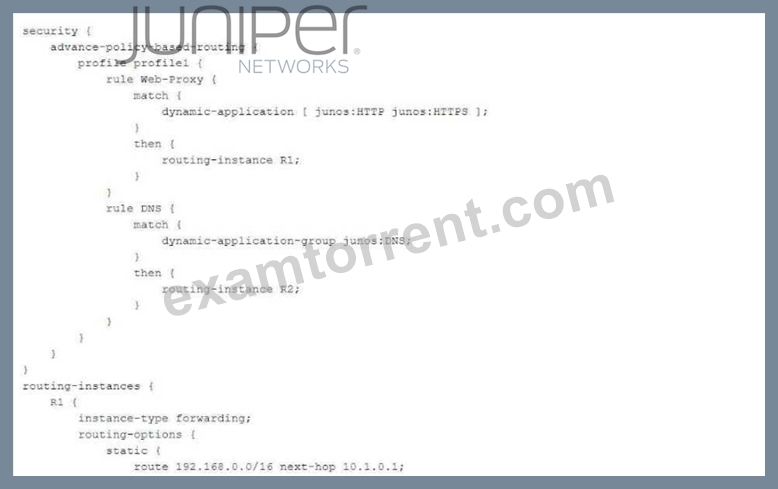
Which statement about TLS 1.2 traffic is correct?
- A. TLS 1.2 traffic will be sent to routing instance R1 and forwarded to next hop 10.1.0.1.
- B. TLS 1.2 traffic will be sent to routing instance R1 but not forwarded to the next hop.
- C. TLS 1.2 traffic will be sent to routing instance R2 but not forwarded to the next hop.
- D. TLS 1.2 traffic will be sent to routing instance R2 and forwarded to next hop 10.2.0.1.
Answer: B
NEW QUESTION # 73
You are asked to look at a configuration that is designed to take all traffic with a specific source ip address and forward the traffic to a traffic analysis server for further evaluation. The configuration is no longer working as intended.
Referring to the exhibit which change must be made to correct the configuration?
- A. Create a routing instance named default
- B. Apply the filter as in input filter on interface xe-0/0/1.0
- C. Apply the filter as in output filter on interface xe-0/1/0.0
- D. Apply the filter as in input filter on interface xe-0/2/1.0
Answer: B
NEW QUESTION # 74
An ADVPN configuration has been verified on both the hub and spoke devices and it seems fine.
However, OSPF is not functioning as expected.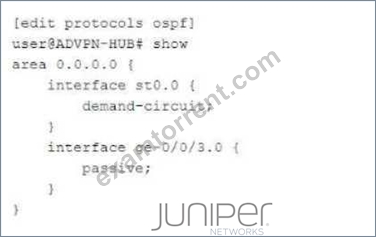
Referring to the exhibit, which two statements under interface st0.0 on both the hub and spoke devices would solve this problem? (Choose two.)
- A. dynamic-neighbors
- B. interface-type p2mp
- C. interface-type p2p
- D. passive
Answer: A,B
Explanation:
For ADVPN with OSPF, using a point-to-multipoint (p2mp) interface type and enabling dynamic- neighbors are crucial. This configuration allows dynamic discovery of neighbors and the establishment of tunnels. For more information, refer to Juniper ADVPN Configuration Guide.
In the ADVPN configuration, OSPF isn't functioning as expected due to the interface configuration on st0.0.
NEW QUESTION # 75
You have noticed a high number of TCP-based attacks directed toward your primary edge device.
You are asked to configure the IDP feature on your SRX Series device to block this attack.
Which two IDP attack objects would you configure to solve this problem? (Choose two.)
- A. Protocol anomaly
- B. Network
- C. Signature
- D. host
Answer: A,C
NEW QUESTION # 76
You want to create a connection for communication between tenant systems without using physical revenue ports on the SRX Series device.
What are two ways to accomplish this task? (Choose two.)
- A. Use a secure wire.
- B. Use an external router.
- C. Use an interconnect VPLS switch.
- D. Use a point-to-point logical tunnel.
Answer: A,D
Explanation:
Secure wire and logical tunnels provide internal connectivity options for isolated tenant systems within an SRX device, avoiding the need for physical interfaces. Secure wire maintains security context, while logical tunnels facilitate inter-system communication. More on this can be found at Juniper Tenant Systems Documentation.
To create a connection between tenant systems without using physical interfaces on an SRX Series device, you have two effective options:
* Secure Wire (Answer C): This feature allows you to create a secure, internal connection between security zones. Essentially, traffic is bridged between two zones without needing to pass through physical interfaces, providing a "virtual" wire.
Configuration Example:
bash
Copy code
set security zones security-zone zone1 interfaces ge-0/0/0.0 host-inbound-traffic system-services all set security zones security-zone zone2 interfaces ge-0/0/1.0 host-inbound-traffic system-services all set security secure-wire secure-wire1 from-zone zone1 to-zone zone2
* Point-to-Point Logical Tunnel (Answer D): This establishes a virtual connection between two different points (zones or systems) within the SRX device using logical interfaces like lt (logical tunnel interfaces). No physical ports are required, and it's useful for connecting isolated tenant systems.
Configuration Example:
bash
Copy code
set interfaces lt-0/0/0 unit 0 family inet address 192.168.1.1/30
set interfaces lt-0/0/1 unit 0 family inet address 192.168.1.2/30
set security zones security-zone zone1 interfaces lt-0/0/0.0
set security zones security-zone zone2 interfaces lt-0/0/1.0
Both methods are suitable for connecting systems within the SRX without using physical interfaces.
NEW QUESTION # 77
You have deployed automated threat mitigation using Security Director with Policy Enforcer, Juniper ATP Cloud, SRX Series devices, Forescout, and third-party switches. In this scenario, which device is responsible for communicating directly to the third-party switches when infected hosts need to be blocked?
- A. Juniper ATP Cloud
- B. SRX Series device
- C. Policy Enforcer
- D. Forescout
Answer: C
Explanation:
Policy Enforcer receives these policies and translates them into device-specific commands. It then communicates with the third-party switches (using protocols like SNMP, RADIUS, or vendor- specific APIs) to enforce those commands, such as blocking the infected hosts' MAC addresses or port access.
Centralized Enforcement: Policy Enforcer acts as the central point of enforcement for Security Director policies, ensuring consistent security across the network. Multi-Vendor Support: It can interact with a wide range of network devices, including switches from different vendors.
Automation: Policy Enforcer automates the policy enforcement process, enabling rapid response to threats.
NEW QUESTION # 78
You want to use a security profile to limit the system resources allocated to user logical systems.
In this scenario, which two statements are true? (Choose two.)
- A. If you do not specify anything for a resource, no resource is reserved for a specific logical system, but the entire system can compete for resources up to the maximum available.
- B. One security profile can be applied to multiple logical systems.
- C. One security profile can only be applied to one logical system.
- D. If nothing is specified for a resource, a default reserved resource is set for a specific logical system.
Answer: A,B
Explanation:
When using security profiles to limit system resources in Juniper logical systems:
* No Resource Specification (Answer B): If a resource limit isnot specifiedfor a logical system, no specific amount of system resources is reserved for it. Instead, the logical system competes for resources along with others in the system, up to the maximum available. This allows flexible resource allocation, where logical systems can scale based on actual demand rather than predefined limits.
* Multiple Logical Systems per Security Profile (Answer D): A single security profile can be applied to multiple logical systems. This allows administrators to define resource limits once in a profile and apply it across several logical systems, simplifying management and ensuring consistency across different environments.
These principles ensure efficient and flexible use of system resources within a multi-tenant or multi-logical- system environment.
NEW QUESTION # 79
What are three attributes that APBR queries from the application system cache module. (Choose Three)
- A. DSCP
- B. TTL
- C. destination port
- D. protocol type
- E. service
Answer: C,D,E
NEW QUESTION # 80
What are three core components for enabling advanced policy-based routing? (Choose three.)
- A. APBR profile
- B. Routing instance
- C. Filter-based forwarding
- D. Routing options
- E. Policies
Answer: A,B,C
Explanation:
To enable Advanced Policy-Based Routing (APBR) on SRX Series devices, three key components are necessary: filter-based forwarding, routing instances, and APBR profiles. Filter- based forwarding is utilized to direct specific traffic flows to a routing instance based on criteria set by a policy. Routing instances allow the traffic to be managed independently of the main routing table, and APBR profiles define how and when traffic should be forwarded. These elements ensure that APBR is flexible and tailored to the network's requirements. Refer to Juniper's APBR Documentation for more details.
NEW QUESTION # 81
You are asked to configure tenant systems.
Which two statements are true in this scenario? (Choose two.)
- A. You can commit multiple tenant systems at a time.
- B. Tenant systems have their own configuration database.
- C. After successful configuration, the changes are merged into the primary database for each tenant system.
- D. A tenant system can have only one administrator.
Answer: A,B
Explanation:
Each tenant system maintains its own configuration database, isolating configurations from others, enhancing security and operational efficiency. Junos OS supports multiple concurrent commit operations across tenant systems.
When configuring tenant systems on an SRX device, the following principles apply:
Tenant Systems Have Their Own Configuration Database (Answer C): Each tenant system has its own isolated configuration database, ensuring that changes made in one tenant system do not affect others. This allows for multi-tenant environments where different tenants can have independent configurations.
Commit Multiple Tenant Systems Simultaneously (Answer D): The system allows for multiple tenant systems to be committed at the same time, simplifying management when working with multiple tenants. This is particularly useful in large environments where multiple logical systems or tenants need updates simultaneously.
NEW QUESTION # 82
You have deployed automated threat mitigation using Security Director with Policy Enforcer, Juniper ATP Cloud, SRX Series devices, Forescout, and third-party switches.
In this scenario, which device is responsible for communicating directly to the third-party switches when infected hosts need to be blocked?
- A. Juniper ATP Cloud
- B. Policy Enforcer
- C. SRX Series device
- D. Forescout
Answer: D
Explanation:
In the described scenario, Forescout is responsible for communicating with the third-party switches to enforce mitigation actions when infected hosts are detected. Forescout integrates with Policy Enforcer and other network security products to provide dynamic network access control. When an infected host is detected by Juniper ATP Cloud or SRX devices, Forescout interacts with the switches to enforce the quarantine or block policy, ensuring that the compromised device is isolated from the network.
Forescout manages the access control lists (ACLs) or other blocking mechanisms on the third-party switches, while Policy Enforcer coordinates with different systems like SRX devices and ATP Cloud for real-time threat mitigation.
NEW QUESTION # 83
......
Juniper JN0-637 Exam Syllabus Topics:
| Topic | Details |
|---|---|
| Topic 1 |
|
| Topic 2 |
|
| Topic 3 |
|
| Topic 4 |
|
| Topic 5 |
|
Pass Juniper JN0-637 Premium Files Test Engine pdf - Free Dumps Collection: https://prep4sure.examtorrent.com/JN0-637-exam-papers.html
