

[Jul-2025] The EMC D-RP-OE-A-24 Exam Test For Brief Preparation
Revolutionary Guide To Exam EMC Dumps
NEW QUESTION # 20
A RecoverPoint administrator wants to add volumes from an unlicensed array to a RecoverPoint/EX cluster.
Which supported RecoverPoint volume type(s) addresses the
administrator's requirement?
- A. Journal only
- B. Repository only
- C. Repository and Journal
Answer: C
Explanation:
In a RecoverPoint/EX cluster, the administrator can add volumes from an unlicensed array as a repository volume.The repository volume is used for internal RecoverPoint operations, such as storing metadata and system information necessary for the RecoverPoint cluster to function1.
The repository volume does not require a license as it is not part of the data replication path and does not store user data. This allows the administrator to utilize storage from an unlicensed array for this purpose.However, for journal and copy volumes, which are directly involved in data protection and replication, a licensed array is required to ensure proper functionality and support1.
It is important to note that while the repository can be on an unlicensed array, all other volumes involved in replication (such as journal and copy volumes) must be on licensed arrays.This ensures compliance with licensing agreements and enables full support and functionality of the RecoverPoint system1.
For the most accurate and up-to-date information, it is always best to consult the latest official Dell RecoverPoint documentation or contact Dell EMC support directly1.
NEW QUESTION # 21
A RecoverPoint administrator is failing over a Consistency Group including two non-production copies. What will be the replication state between the new production and former production when the administrator selects "Set Copy as Production"?
- A. A short initialization is started between the new production and former production
- B. Replication is paused between the new production and former production
- C. A full sweep is started between the new production and former production
- D. A volume sweep is started between the new production and former production
Answer: C
Explanation:
Questions no:What will be the replication state between the new production and former production when the administrator selects "Set Copy as Production"?
Verified answer:When "Set Copy as Production" is selected, the failover replica copy is confirmed as the new Production and initiates replication to additional replicas other than the original Production copy which is already receiving writes after the failover1. This means that the replication state between the new production and former production would involve initiating replication to the additional replicas.
Step by Step Comprehensive Detailed Explanation with References:
* Failover Occurs: The administrator initiates a failover, which involves switching the roles of the production and non-production copies.
* Set Copy as Production: The administrator selects the "Set Copy as Production" option, which confirms the failover replica copy as the new Production.
* Replication Initiated: Replication is initiated to additional replicas, excluding the original Production copy, which continues to receive writes after the failover.
* State of Former Production: The former production copy, now a replica, will be in a state where it is receiving the replicated data from the new production copy.
This process ensures that the data protection and replication continue seamlessly after the failover, with the new production copy taking over the role of the source for replication1.
NEW QUESTION # 22
An application protected by RecoverPoint has spanned onto a second XtremlO system. How can this application continue to be protected by RecoverPoint?
- A. Reconfigure the existing Consistency Group to be a Distributed Consistency Group
- B. Create another Consistency Group and define group sets with periodic parallel bookmarks
- C. Extend the existing Consistency Group onto the second XtremIO system
- D. Encapsulate the application volumes using VPLEX and use the VPLEX splitter
Answer: A
Explanation:
When an application protected by RecoverPoint spans onto a second XtremIO system, it is necessary to ensure that the protection extends across both systems. The appropriate action in this scenario is to reconfigure the existing Consistency Group to be a Distributed Consistency Group.This allows for the inclusion of multiple storage systems under the same protection umbrella, ensuring that all parts of the application, even those that span multiple systems, are consistently protected1.
A Distributed Consistency Group in RecoverPoint is designed to maintain synchronous or asynchronous replication across different arrays, which may be geographically dispersed.This ensures that write operations are captured and replicated in a manner that maintains the consistency of the application data, regardless of the underlying storage system1.
For detailed guidance on configuring Distributed Consistency Groups and extending protection to additional storage systems, it is recommended to refer to the official Dell RecoverPoint documentation or contact Dell EMC support for assistance tailored to the specific configuration and version of the RecoverPoint system being used1.
NEW QUESTION # 23
To determine whether physical or virtual RPAs are in use on a specific cluster, what is a correct sequence of steps to determine the type of RPAs for that cluster when using Unisphere?
- A. Click on Protection > Cluster name > RPA details
- B. Click on Admin > System Analysis Tools > RPAs
- C. Click on Dashboard > RPAs > RPA type
- D. Click on RPA clusters > Cluster name > RPAs
Answer: D
Explanation:
To identify whether physical or virtual RPAs are in use on a specific cluster using Unisphere for RecoverPoint, follow these steps:
* Navigate to RPA Clusters: In Unisphere, locate and click on the 'RPA clusters' section.
* Select Cluster Name: Find and select the specific cluster you want to investigate.
* View RPA Details: Click on the 'RPAs' option to view detailed information about the RPAs associated with the selected cluster.
This process will provide you with the necessary information to determine the type of RPAs (physical or virtual) that are being used within the specified cluster1.
NEW QUESTION # 24
A storage administrator is unable to perform Direct Access to a copy in their RecoverPoint environment.
Which array type has this limitation with regards to RecoverPoint copies?
- A. VNX
- B. VPLEX
- C. XtremIO
- D. VMAX
Answer: C
Explanation:
In a Dell RecoverPoint environment, Direct Access mode allows for write access to a replica volume during testing or other scenarios. However, when using XtremIO arrays, Direct Access mode is not available because XtremIO handles replication differently compared to other array types.Instead, XtremIO uses its snapshot technology, which does not support Direct Access in the same way as traditional replication methods1.
Here's why Direct Access is limited with XtremIO:
* XtremIO Snapshot Technology: XtremIO arrays use snapshot technology for replication, which is different from the replication methods used by other array types like VMAX, VNX, or VPLEX.
* Direct Access Mode: This mode typically allows a replica volume to be mounted and written to directly, but due to the way XtremIO handles snapshots, this functionality is not supported.
* RecoverPoint Integration: RecoverPoint integrates with XtremIO to provide replication and disaster recovery solutions, but the Direct Access feature is not compatible with XtremIO's snapshot-based replication1.
Therefore, when using XtremIO arrays in a RecoverPoint environment, administrators need to be aware of this limitation and plan their disaster recovery and testing strategies accordingly1.
NEW QUESTION # 25
When replicating a Consistency Group between clusters using XtremlO at each site that are connected through Fibre Channel, what is the maximum throughput per RPA?
- A. 240 MB/s
- B. 450 MB/s
- C. 300 MB/s
- D. 150 MB/s
Answer: C
Explanation:
When setting up replication for a Consistency Group between clusters using XtremIO storage arrays at each site connected through Fibre Channel, the maximum throughput that can be expected per RecoverPoint Appliance (RPA) is 300 MB/s. This throughput is a measure of how much data can be transferred from one site to another per second by each RPA involved in the replication process.
The throughput capacity is important for planning and ensuring that the RecoverPoint system can handle the expected data load during replication activities. It affects the Recovery Point Objective (RPO) and the overall efficiency of the disaster recovery setup.The 300 MB/s figure provides a benchmark for administrators to gauge the performance capabilities of their RecoverPoint system when used in conjunction with XtremIO storage arrays1.
It's important to note that actual throughput can vary based on several factors, including network conditions, the amount of data being replicated, and the specific configuration of the RecoverPoint and XtremIO systems1.
NEW QUESTION # 26
In order to balance the workload of a RecoverPoint system, an administrator decided to change the primary RPA for specific Consistency Groups. Where is this setting configured?
- A. Group Policy tab for the Consistency Groups
- B. Link Policy tab for the Consistency Groups
- C. Copy Policy tab for the production copy
- D. Copy Policy tab for the remote copy
Answer: A
Explanation:
The setting to change the primary RecoverPoint Appliance (RPA) for specific Consistency Groups is configured under the Group Policy tab for the Consistency Groups.This tab allows administrators to manage and adjust policies that affect the entire Consistency Group, including the assignment of the primary RPA, which is responsible for managing the replication for the group1.
The process for changing the primary RPA typically involves:
* Accessing the Unisphere for RecoverPoint interface.
* Navigating to the Consistency Groups section.
* Selecting the specific Consistency Group to be modified.
* Going to the Group Policy tab.
* Adjusting the settings to designate a new primary RPA for the group.
This change can help balance the workload across the RPAs in the RecoverPoint system, ensuring that no single RPA becomes a performance bottleneck and that the replication process remains efficient and effective1.
NEW QUESTION # 27
After a logical corruption, data on a production volume is inaccessible. As the volume is replicated using RecoverPoint, the administrator decides to use the "Test a Copy and Recover Production" wizard to restore this volume to its state prior to the logical corruption.
What is the correct sequence of steps to complete the recovery activity?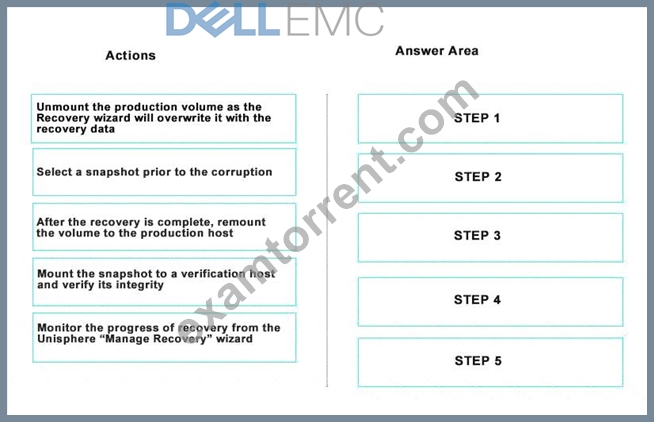
Answer:
Explanation: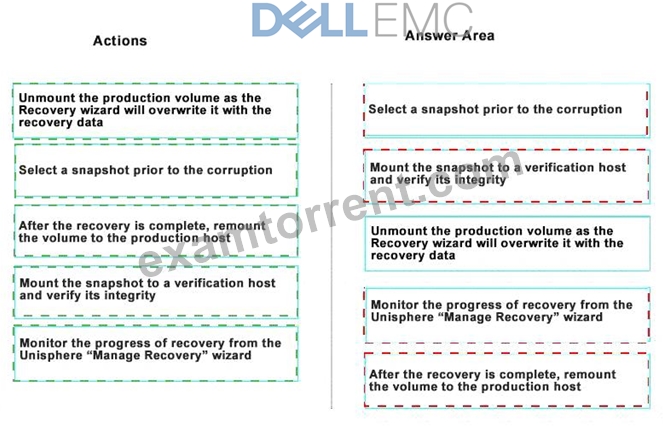
Explanation:
A screenshot of a recovery program Description automatically generated with medium confidence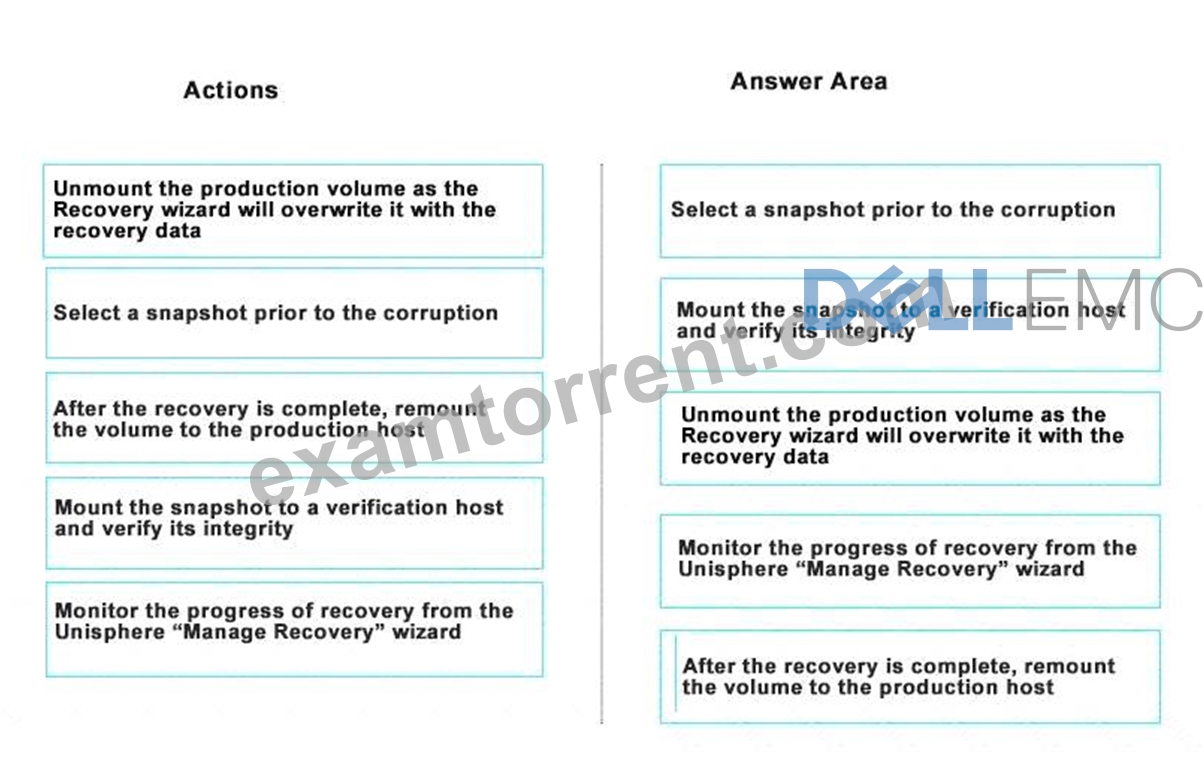
To recover a production volume that has become inaccessible due to logical corruption using RecoverPoint's
"Test a Copy and Recover Production" wizard, follow these steps:
* Select a snapshot prior to the corruption: Identify and choose the appropriate point-in-time image from the Journal that was taken before the corruption occurred.
* Mount the snapshot to a verification host and verify its integrity: Attach the selected snapshot to a non-production host where you can perform checks to ensure the data is consistent and free from corruption.
* Unmount the production volume as the Recovery wizard will overwrite it with the recovery data:
Ensure that the current production volume is not in use because the recovery process will overwrite the existing data with the data from the snapshot.
* Monitor the progress of recovery from the Unisphere 'Manage Recovery' wizard: Use Dell EMC's Unisphere interface to track the recovery process and ensure that the data is being restored correctly.
These steps are based on the standard procedures outlined in Dell RecoverPoint documentation for using the "Test a Copy and Recover Production" wizard to restore volumes to a previous state1.
NEW QUESTION # 28
When attempting to protect new XtremlO LUNs, the administrator is unable to add an XtremIO source LUN to the Consistency Group. What is a possible reason for this issue?
- A. XtremlO array was not licensed in RecoverPoint
- B. XtremlO arrays are only protected with RecoverPoint for VMs
- C. RecoverPoint/EX only allows the protection of VNX arrays
- D. XtremIO LUN was created with a 512-byte block size
Answer: A
Explanation:
One possible reason for the inability to add an XtremIO source LUN to the Consistency Group in RecoverPoint could be that the XtremIO array was not licensed in RecoverPoint. Licensing is a critical step in enabling the features and functionalities of RecoverPoint for specific storagearrays.If the XtremIO array is not licensed, RecoverPoint would not recognize or allow the addition of its LUNs to a Consistency Group1.
Additionally, it's important to ensure that the RecoverPoint version supports the XtremIO array model.For instance, RecoverPoint does not support XtremIO X2 arrays until version 5.11. Therefore, if the RecoverPoint version is earlier than 5.1, it would not be able to replicate volumes from an XtremIO X2 array, which could manifest as an issue when trying to add LUNs to a Consistency Group.
For the most accurate and up-to-date information, it is always best to consult the latest official Dell RecoverPoint documentation or contact Dell EMC support directly.
NEW QUESTION # 29
Which command can be used to reduce the impact of the initial volume synchronization on production applications?
- A. config_link_policy group=cgname copy_1=prod_copy copy_2=dr_copy regulate_application=yes
- B. config_link_policy group=cgname copy_1=prod_copy copy_2=dr_copy regulate_application=no
- C. config_io_throttling throttling=none
- D. config_io_throttling throttling=high
Answer: A
Explanation:
To reduce the impact of the initial volume synchronization on production applications in a Dell RecoverPoint system, the config_link_policy command can be used with the regulate_application=yes parameter.This command configures the link policy for a Consistency Group and allows for the regulation of I/O to minimize the impact on production applications during synchronization1.
The process involves:
* Identifying the Consistency Group: Determine the name of the Consistency Group that contains the production volume you wish to regulate.
* Running the command: Execute the config_link_policy command with the appropriate parameters, including the Consistency Group name and the copies involved.
* Setting regulate_application=yes: This parameter tells the system to regulate the application I/O, which helps to manage the load on production applications during the initial synchronization.
* Monitoring the impact: After applying the command, monitor the production applications to ensure that the impact of the synchronization is minimized as intended.
This command is part of the RecoverPoint CLI and is used to manage the performance impact of replication activities on production environments1.
NEW QUESTION # 30 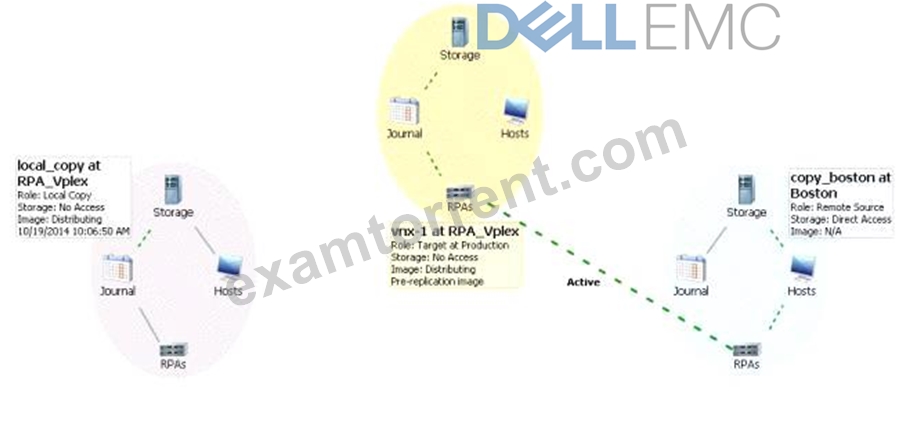
Based on the Consistency Group status shown in the exhibit, why is the local copy not connected to the production and remote copy?
- A. Connection to the local copy cluster has failed
- B. Local copy has failed
- C. Consistency Group is failing over
- D. Test a Copy wizard is in progress
Answer: D
Explanation:
When the "Test a Copy" wizard is in progress in a Dell RecoverPoint environment, it temporarily disconnects the local copy from the production and remote copies to allow testing of the data at a specific point in time without affecting the ongoing replication and production operations. The steps involved are:
* Initiate Test a Copy: The administrator starts the "Test a Copy" wizard from the RecoverPoint management interface.
* Disconnect Local Copy: The wizard disconnects the local copy from the production and remote copies to isolate it for testing.
* Perform Testing: The administrator or users perform necessary tests on the local copy, which is now in an isolated state.
* Reconnect Local Copy: Once testing is complete, the wizard will reconnect the local copy to resume normal replication and protection operations.
This process ensures that testing can be conducted on a consistent dataset without impacting the production environment or replication processes1.
NEW QUESTION # 31
Which RecoverPoint CLI command can be used to show a summarization of the errors and warnings for either one site or the entire RecoverPoint system?
- A. get_rpa_states
- B. get_clusters_topology
- C. get_system_status
- D. get_events_log
Answer: C
NEW QUESTION # 32
What occurs when Journal volumes are masked to hosts in a RecoverPoint environment?
- A. RecoverPoint GUI and CLI logs an event confirming the masking has occurred
- B. Journals become available for use in the "Consistency Group" wizard
- C. Splitter is attached to the newly exposed Journal volumes
- D. Hosts are able to write to the Journal volumes but will lead to Journal corruption
Answer: D
Explanation:
In a Dell RecoverPoint environment, Journal volumes are critical components used to track and manage point-in-time images for data replication and recovery. If Journal volumes are mistakenly masked to hosts, the following occurs:
* Hosts Gain Access: The hosts that are zoned/masked to the Journal volumes gain the ability to write to these volumes.
* Potential for Corruption: Any write access by hosts to the Journal volumes can lead to corruption of the Journal. This is because Journals are meant to be managed exclusively by RecoverPoint and should not be directly accessed or modified by hosts.
* Impact on Replication: Journal corruption can disrupt the RecoverPoint replication process, potentially leading to data loss or an inability to recover to specific points in time.
* Resolution: To prevent such issues, it is crucial to ensure that Journal volumes are not exposed to hosts and are only accessed by RecoverPoint Appliances (RPAs) for replication purposes12.
It is important to follow best practices for zoning and masking in a storage environment to avoid such critical configuration errors12.
NEW QUESTION # 33
A RecoverPoint administrator wants to use the compression setting to save bandwidth in their environment.
What will be the impact of changing the link compression setting on aConsistency Group?
- A. Journal history will be lost
- B. Long resynchronization
- C. Temporary high-load
Answer: A
Explanation:
Changing the link compression setting on a RecoverPoint Consistency Group can result in a temporary high-load on the system. This is because when compression is enabled or settings are changed, the system needs to compress the existing data before it can be transmitted, which requires additional processing power and can temporarily increase the load on the RecoverPoint Appliances (RPAs).
The process involves:
* The administrator changes the link compression setting in the Consistency Group configuration.
* The RPAs begin compressing the data that needs to be replicated across the network.
* This compression process increases the CPU and memory usage on the RPAs, leading to a temporary high-load situation.
* Once the initial compression is completed, the system load returns to normal levels, and replication continues with the new compression setting in effect.
It's important to note that while the system is under high-load, there might be a temporary impact on performance, but this does not affect the integrity of the replication or the Journal history.The system is designed to handle such temporary increases in load without losing any critical data1.
NEW QUESTION # 34
Which RecoverPoint CLI command can be used to show a summarization of the errors and warnings for either one site or the entire RecoverPoint system?
- A. get_rpa_states
- B. get_clusters_topology
- C. get_system_status
- D. get_events_log
Answer: C
Explanation:
The get_system_status command in the RecoverPoint CLI is used to provide a summary of the system's health, including any errors and warnings. This command can be executed to check the status of one site or the entire RecoverPoint system. The output includes information about the RecoverPoint Appliances (RPAs), Consistency Groups, and any issues that may need attention.
The process for using this command is as follows:
* Access the CLI: Log into the RecoverPoint CLI using appropriate credentials.
* Run the Command: Execute the get_system_status command to retrieve the system status.
* Review the Summary: The command output will display a summarization of the system's health, including errors and warnings.
* Take Action: Based on the summary, the administrator can take necessary actions to address any reported issues.
This command is a useful tool for administrators to quickly assess the state of the RecoverPoint environment and ensure that it is functioning correctly1.
NEW QUESTION # 35
What is the result of configuring the I/O throttling level to "low"?
- A. Limit the data parallelism and I/O parallelism on the particular RPA where the setting will permit a maximum read rate of 200 MB/s
- B. Limit the data parallelism and I/O parallelism of all RPAs in a RecoverPoint cluster to a maximum read rate of 200 MB/s
- C. Limit the data parallelism and I/O parallelism on the particular RPA where the setting will permit a maximum read rate of 10 MB/s
- D. Limit the data parallelism and I/O parallelism of all RPAs in a RecoverPoint cluster to a maximum read rate of 10 MB/s
Answer: C
NEW QUESTION # 36
A RecoverPoint system has been deployed with XtremlO at production and disaster recovery sites. What is an accurate statement, if the replication mode for a Consistency Group has been set as "Continuous"?
- A. Set minimum time between cycles
- B. Effective RPO will be 0 seconds
- C. Set customized time between cycles
- D. Effective RPO can be < 60 seconds
Answer: D
Explanation:
In a Dell RecoverPoint system with XtremIO arrays at both production and disaster recovery sites, setting the replication mode for a Consistency Group as "Continuous" implies that the replication occurs continuously without predefined intervals. This mode aims to minimize the Recovery Point Objective (RPO), which is the maximum targeted period in which data might be lost due to a major incident. While an RPO of 0 seconds is ideal, it is often not practical due to network latency and system processing times.Therefore, an effective RPO of less than 60 seconds is a realistic target for a
"Continuous" replication mode, ensuring that data loss is minimized to the lowest possible timeframe in the event of a disaster1.
NEW QUESTION # 37
An administrator wants to integrate Site Recovery Manager (SRM) with RecoverPoint. Where should the RecoverPoint storage replication adapter be installed?
- A. On the same servers running VCenter and the SRM service
- B. On servers running SRM service only
- C. On servers running VCenter only
- D. On a newly installed server
Answer: B
Explanation:
To integrate Site Recovery Manager (SRM) with RecoverPoint, the storage replication adapter is a critical component that allows SRM to manage RecoverPoint replication properly. The installation steps are as follows:
* Identify SRM Servers: Determine which servers are running the VMware Site Recovery Manager
* service.
* Install SRA: Install the RecoverPoint SRA on each of the SRM server hosts at both the recovery and protected sites.
* Verify Installation: Ensure that the SRA is correctly installed and recognized by the SRM service.
* Configure Replication: Use the SRA within SRM to configure and manage replication settings for disaster recovery.
It's important to use the most current version of the SRA to ensure optimal compatibility and available features.The SRA can be downloaded from the VMware website, and the SRA release notes and product documentation should be consulted to determine compatibility with SRM versions1.
NEW QUESTION # 38
What is the purpose of the save_settings command?
- A. Modify or configure the RecoverPoint configuration backup interval
- B. Create a script file that can later be used to recreate the system configuration
- C. Preserve the configuration of a RecoverPoint Appliance prior to replacement
- D. Commit cluster configuration changes to the repository volume
Answer: D
Explanation:
The save_settings command in Dell RecoverPoint is used to commit cluster configuration changes to the repository volume. When changes are made to the RecoverPoint cluster configuration, they need to be saved to ensure that they persist across system reboots and are recognized by all nodes in the cluster.The repository volume serves as a centralized storage location for these configurations1.
The process of using the save_settings command is as follows:
* After making configuration changes to the RecoverPoint cluster, the administrator issues the save_settings command.
* The command commits the changes to the repository volume, which is a dedicated space on the storage array for storing system settings.
* This ensures that the configuration changes are preserved and can be accessed by the RecoverPoint Appliances (RPAs) when needed1.
It's important to note that the save_settings command does not create a script file for later use, nor does it modify the configuration backup interval.Its primary function is to ensure that any changes made to the cluster configuration are saved and applied correctly1.
NEW QUESTION # 39
Which factor affects the time it takes a Consistency Group to complete the first-time initialization?
- A. Performance of the Journal volumes at the remote copy
- B. Number of RPAs at the production cluster
- C. Distance between the production and remote copy clusters
- D. Number of RPAs at the remote copy cluster
Answer: A
Explanation:
The performance of the Journal volumes at the remote copy can significantly affect the time it takes for a Consistency Group to complete the first-time initialization. The Journal volumes are where all the changes to the protected volumes are recorded before they are replicated to the remote site.If the Journal volumes are performing poorly, due to issues like high latency or low IOPS (Input/Output Operations Per Second), it can slow down the initialization process as the system struggles to record and replicate the data efficiently1.
Other factors such as the distance between the production and remote copy clusters and the number of RecoverPoint Appliances (RPAs) at both the production and remote copy clusters can also influence the initialization time. However, these factors typically affect the ongoing replication performance rather than the initial synchronization.The number of RPAs can impact the system's ability to process and replicate data, but the most direct impact on initialization time is the performance of the Journal volumes, as they are the bottleneck in the data recording process1.
For the most accurate and up-to-date information, it is always best to consult the latest official Dell RecoverPoint documentation or contact Dell EMC support directly1.
NEW QUESTION # 40
A storage administrator has created a new Consistency Group with a remote copy. After enabling the new group, the administrator notices several other Consistency Groups are experiencing high load alerts.
What is possible cause for the high load conditions?
- A. Initialization is consuming all the WAN bandwidth
- B. Journal pool for the new Consistency Group is undersized
- C. Not enough licensed replication storage is available for the new Consistency Group
- D. Journal pool for the new Consistency Group has poor performing storage
Answer: A
NEW QUESTION # 41
During the Write phase of RecoverPoint replication, when does the write splitter send an acknowledgement back to the host that initiated the write?
- A. After the splitter has received an acknowledgement from the RPAs
- B. After the Distribution phase has completed
- C. As soon as the splitter receives the write
- D. After the splitter has received an acknowledgement from the production LUN
Answer: D
Explanation:
* RecoverPoint Write Phase:
* In the RecoverPoint replication process, the write splitter plays a crucial role in intercepting writes from the host and forwarding them to both the production storage and the RecoverPoint appliances (RPAs).
* Write Splitter Functionality:
* The write splitter intercepts write I/O requests from the host and splits the I/O to both the production LUN and the RPAs. This ensures that the data is written to both the primary storage and replicated copies.
* Acknowledgement Process:
* During the write phase, the write splitter must ensure that the data is successfully written to the production LUN before acknowledging the write request back to the host.
* This is because the primary concern is ensuring data integrity and confirming that the data is safely stored in the production environment before any replication considerations.
* Detailed Workflow:
* Step 1: Host issues a write request.
* Step 2: The write splitter intercepts the write request.
* Step 3: The write splitter forwards the write to the production LUN and the RPAs.
* Step 4: The production LUN processes the write and sends an acknowledgement back to the write splitter.
* Step 5: Upon receiving the acknowledgement from the production LUN, the write splitter then sends an acknowledgement back to the host.
NEW QUESTION # 42
......
D-RP-OE-A-24 Free Study Guide! with New Questions: https://prep4sure.examtorrent.com/D-RP-OE-A-24-exam-papers.html
