

[Jul-2026] Free CCDAK Exam Dumps to Improve Exam Score
2026 Realistic CCDAK Dumps Exam Tips Test Pdf Exam Material
The CCDAK certification exam is meant for developers, architects, and engineers who have experience with Kafka development, and are looking to validate their expertise in the field. CCDAK exam provides a recognized validation of Kafka proficiency, which is valuable for both individuals and organizations. For individuals, the certification can help to enhance their career prospects and demonstrate their expertise to potential employers. For organizations, the certification can help to identify skilled Kafka developers and ensure that they have the necessary expertise to meet business needs.
NEW QUESTION # 12
A Kafka cluster has four brokers with a topic t1 with eight partitions. A client application has just one broker specified in the bootstrap URL.
Brokers:
b1.host.domain.com
b2.host.domain.com
b3.host.domain.com
b4.host.domain.com
Bootstrap URL:
b2.host.domain.com
What would be the impact of such configuration?
- A. Consumers and producers will get NotEnoughReplicasException.
- B. Consumers and producers will only be able to consume and produce from partitions on broker b2.
- C. Consumers and producers will not be able to consume or produce any messages.
- D. Consumers and producers will work as expected as long as broker b2 is available.
Answer: D
NEW QUESTION # 13
You have a Kafka consumer in production actively reading from a critical topic.
You need to update the offset of your consumer to start reading from the beginning of the topic.
Which action should you take?
- A. Temporarily configure the topic's retention.ms parameter to 0 to empty the topic.
- B. Update the consumer group's offset to the earliest position using the kafka-consumer-groups CLI tool.
- C. Update the consumer configuration by setting auto.offset.reset=earliest.
- D. Start a new consumer application with the same consumer group id.
Answer: B
Explanation:
To reset offsets for an existing consumer group, you must use the kafka-consumer-groups.sh tool with the -- reset-offsets and --to-earliest flags.
From Kafka Consumer Group Tool Documentation:
"You can use the kafka-consumer-groups tool to reset offsets for a consumer group. This is required if the consumer has already committed offsets." Setting auto.offset.reset=earliest only works if no committed offset exists.
Starting a new consumer with the same group won't reset offsets.
Retention settings don't affect committed offsets.
Reference: Kafka Consumer Group CLI Tool
NEW QUESTION # 14
StreamsBuilder builder = new StreamsBuilder();
KStream<String, String> textLines = builder.stream("word-count-input"); KTable<String, Long> wordCounts = textLines
.mapValues(textLine -> textLine.toLowerCase())
.flatMapValues(textLine -> Arrays.asList(textLine.split("\W+")))
.selectKey((key, word) -> word)
.groupByKey()
.count(Materialized.as("Counts"));
wordCounts.toStream().to("word-count-output", Produced.with(Serdes.String(), Serdes.Long())); builder.build(); What is an adequate topic configuration for the topic word-count-output?
- A. max.message.bytes=10000000
- B. compression.type=lz4
- C. cleanup.policy=delete
- D. cleanup.policy=compact
Answer: D
Explanation:
Result is aggregated into a table with key as the unique word and value its frequency. We have to enable log compaction for this topic to align the topic's cleanup policy with KTable semantics.
NEW QUESTION # 15
You have a Kafka client application that has real-time processing requirements.
What are the most important metrics available in Kafka that you should monitor?
- A. Total time to serve requests to replica followers
- B. Aggregate incoming byte rate
- C. Consumer lag between the brokers and the consumers
- D. Consumer heartbeat rate to the group coordinator
Answer: C
NEW QUESTION # 16
In Avro, removing or adding a field that has a default is a __ schema evolution
- A. backward
- B. forward
- C. breaking
- D. full
Answer: D
Explanation:
Clients with new schema will be able to read records saved with old schema and clients with old schema will be able to read records saved with new schema.
NEW QUESTION # 17
What is the default port that the KSQL server listens on?
- A. 0
- B. 1
- C. 2
- D. 3
Answer: A
Explanation:
Default port of KSQL server is 8088
NEW QUESTION # 18
Match the topic configuration setting with the reason the setting affects topic durability.
(You are given settings like unclean.leader.election.enable=false, replication.factor, min.insync.replicas=2)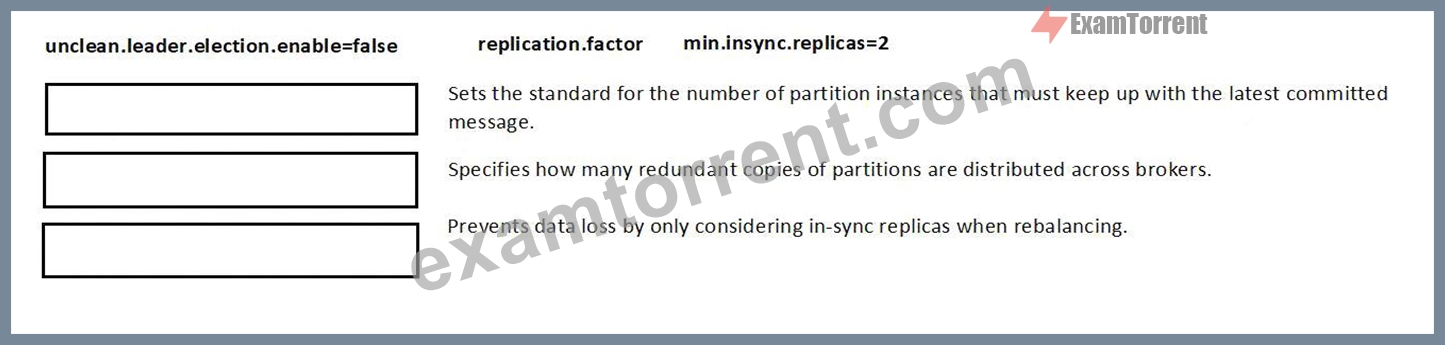
Answer:
Explanation: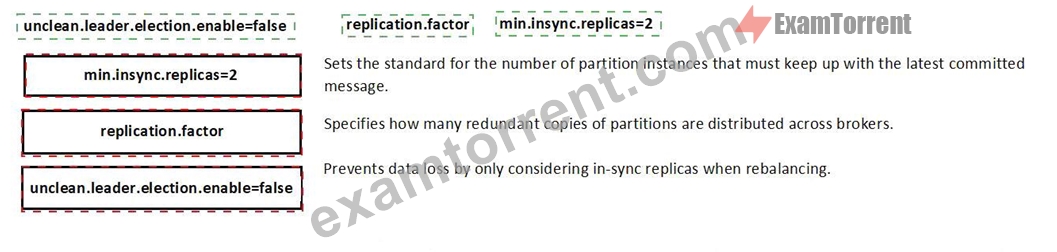
* unclean.leader.election.enable=false# Prevents data loss by only considering in-sync replicas when rebalancing.
* replication.factor# Specifies how many redundant copies of partitions are distributed across brokers.
* min.insync.replicas=2# Sets the standard for the number of partition instances that must keep up with the latest committed message.
* unclean.leader.election.enable=false ensures that onlyin-sync replicascan be elected as leaders. If disabled, an out-of-sync replica may become leader, potentially leading to data loss.
* replication.factor defineshow many brokerswill maintain copies of each partition, directly impacting durability and availability.
* min.insync.replicas determineshow many replicas must acknowledgea write when acks=all is used, enforcing write durability.
Reference:Apache Kafka Topic Configuration Documentation
NEW QUESTION # 19
You need to collect logs from a host and write them to a Kafka topic named 'logs-topic'. You decide to use Kafka Connect File Source connector for this task.
What is the preferred deployment mode for this connector?
- A. Standalone mode
- B. Distributed mode
- C. SingleCluster mode
- D. Parallel mode
Answer: A
Explanation:
Kafka Connect can run in standalone mode or distributed mode. For simple tasks like reading logs from a file on a single host, standalone mode is recommended.
From Kafka Connect User Guide:
"Standalone mode is useful when running connectors on a single machine (e.g., for development or simple deployments like log collection from a local file)." Distributed mode is preferred for scalability and fault tolerance but overkill for this use case.
Reference: Kafka Connect User Guide > Deployment Modes
NEW QUESTION # 20
In Avro, adding a field to a record without default is a __ schema evolution
- A. backward
- B. breaking
- C. forward
- D. full
Answer: C
Explanation:
Clients with old schema will be able to read records saved with new schema.
NEW QUESTION # 21
Which two statements are correct about transactions in Kafka?
(Select two.)
- A. Transactions are only possible when writing messages to a topic with single partition.
- B. Transactions guarantee at least once delivery of messages.
- C. Consumers can consume both committed and uncommitted transactions.
- D. All messages from a failed transaction will be deleted from a Kafka topic.
- E. Information about producers and their transactions is stored in the _transaction_state topic.
Answer: C,E
Explanation:
Comprehensive and Detailed Explanation From Exact Extract:
* #C. Consumers can consume both committed and uncommitted transactions.By default,Kafka consumers only read committed messagesif they are configured with isolation.level=read_committed.
However, if configured as read_uncommitted, theycan also consume uncommitted (potentially aborted) transactional messages.
From Kafka Documentation:
"The isolation.level setting controls whether the consumer will read only committed messages or all messages, including uncommitted messages from ongoing or aborted transactions."
* #D. Information about producers and their transactions is stored in the _transaction_state topic.
Kafka uses an internal topic named__transaction_stateto maintain metadata about producer transactions. This topic is essential for tracking thetransaction lifecycle, fencing, and recovery.
From Kafka Internals:
"Kafka stores the state of active and completed transactions in an internal topic called __transaction_state."
NEW QUESTION # 22
There are five brokers in a cluster, a topic with 10 partitions and replication factor of 3, and a quota of producer_bytes_rate of 1 MB/sec has been specified for the client. What is the maximum throughput allowed for the client?
- A. 10 MB/s
- B. 5 MB/s
- C. 1 MB/s
- D. 0.33 MB/s
Answer: B
Explanation:
Each producer is allowed to produce @ 1MB/s to a broker. Max throughput 5 * 1MB, because we have 5 brokers.
NEW QUESTION # 23
Your application is consuming from a topic configured with a deserializer.
It needs to be resilient to badly formatted records ("poison pills"). You surround the poll() call with a try/catch for RecordDeserializationException.
You need to log the bad record, skip it, and continue processing.
Which action should you take in the catch block?
- A. Throw a runtime exception to trigger a restart of the application.
- B. Log the bad record and call the consumer.skip() method.
- C. Log the bad record, no other action needed.
- D. Log the bad record and seek the consumer to the offset of the next record.
Answer: D
Explanation:
To skip a corrupted record and avoid failing the application, you must seek past the failed offset manually using consumer.seek(). This allows the application to resume consumption from the next offset.
From Kafka Consumer Error Handling Docs:
"On deserialization failure, you can catch RecordDeserializationException, log the error, and call seek() to the next offset to skip the bad record." A does not prevent re-processing the bad record.
C is invalid; there's no skip() method in the Kafka consumer API.
D results in service interruption - not ideal for resiliency.
Reference: Kafka Consumer API - Exception Handling and seek()
NEW QUESTION # 24
Your Kafka cluster has five brokers. The topic t1 on the cluster has:
* Two partitions
* Replication factor = 4
* min.insync.replicas = 3You need strong durability guarantees for messages written to topic t1.You configure a producer acks=all and all the replicas for t1 are in-sync.How many brokers need to acknowledge a message before it is considered committed?
- A. 0
- B. 1
- C. 2
- D. 3
Answer: A
Explanation:
With acks=all, the leader waits formin.insync.replicasto acknowledge the message. Since min.insync.
replicas=3, Kafka will only commit the messageonce 3 brokers (leader + 2 followers)confirm they have the message.
FromKafka Documentation > Acks and Durability:
"If acks=all is specified, the producer will wait until the full set of in-sync replicas has acknowledged the record. The minimum number of in-sync replicas is controlled by min.insync.replicas." Even though the replication factor is 4, only3 acknowledgments are needed, as defined by min.insync.
replicas.
Reference:Apache Kafka Producer Configs > acks, min.insync.replicas
NEW QUESTION # 25
You are doing complex calculations using a machine learning framework on records fetched from a Kafka topic. It takes more about 6 minutes to process a record batch, and the consumer enters rebalances even though it's still running. How can you improve this scenario?
- A. Increase max.poll.interval.ms to 600000
- B. Increase session.timeout.ms to 600000
- C. Add consumers to the consumer group and kill them right away
- D. Increase heartbeat.interval.ms to 600000
Answer: A
Explanation:
Here, we need to change the setting max.poll.interval.ms (default 300000) to its double in order to tell Kafka a consumer should be considered dead if the consumer only if it hasn't called the .poll() method in 10 minutes instead of 5.
NEW QUESTION # 26
Which two producer exceptions are examples of the class RetriableException? (Select two.)
- A. RecordTooLargeException
- B. NotEnoughReplicasException
- C. AuthorizationException
- D. LeaderNotAvailableException
Answer: B,D
Explanation:
BothLeaderNotAvailableExceptionandNotEnoughReplicasExceptionare subclasses of RetriableException, which representstransient issuesthat may succeed upon retry.
FromApache Kafka Java Client Documentation:
"RetriableException indicates that the request can be retried. This includes network errors and certain broker- side failures like leader not available or not enough replicas."
* RecordTooLargeException and AuthorizationException arenon-retriablebecause they represent client misconfigurations or access issues.
Reference:Kafka Error Handling Guide > Retriable vs. Non-Retriable Exceptions
NEW QUESTION # 27
Kafka is configured with following parameters - log.retention.hours = 168 log.retention.minutes = 168 log.retention.ms = 168 How long will the messages be retained for?
- A. Broker will not start due to bad configuration
- B. 168 minutes
- C. 168 ms
- D. 168 hours
Answer: C
Explanation:
If more than one similar config is specified, the smaller unit size will take precedence.
NEW QUESTION # 28
An application is writing AVRO messages using Schema Registry to topic t1. During this process, the Schema Registry becomes unavailable for a few seconds.
What is the expected impact to the application?
- A. Since messages are cached by the producer, the application will only get an error if the producer is sending the batch at that time.
- B. All messages within that time will receive an error.
- C. The application may not have any impact, unless it is writing messages with a new Schema Definition.
- D. Since the broker will eventually replicate the message Schema, there will not be an error.
Answer: C
NEW QUESTION # 29
How do you create a topic named test with 3 partitions and 3 replicas using the Kafka CLI?
- A. bin/kafka-topics.sh --create --broker-list localhost:9092 --replication-factor 3 --partitions 3 --topic test
- B. bin/kafka-topics.sh --create --bootstrap-server localhost:9092 --replication-factor 3 --partitions 3 --topic test
- C. bin/kafka-topics.sh --create --bootstrap-server localhost:2181 --replication-factor 3 --partitions 3 --topic test
- D. bin/kafka-topics-create.sh --zookeeper localhost:9092 --replication-factor 3 --partitions 3 --topic test
Answer: B
Explanation:
As of Kafka 2.3, the kafka-topics.sh command can take --bootstrap-server localhost:9092 as an argument.
You could also use the (now deprecated) option of --zookeeper localhost:2181.
NEW QUESTION # 30
......
Powerful CCDAK PDF Dumps for CCDAK Questions: https://prep4sure.examtorrent.com/CCDAK-exam-papers.html
