

[Nov-2025] Valid Way To Pass ISQI Exam Dumps with CTFL_Syll_4.0 Exam Study Guide
All CTFL_Syll_4.0 Dumps and ISTQB Certified Tester Foundation Level (CTFL) v4.0 Training Courses Help candidates to study and pass the Exams hassle-free!
NEW QUESTION # 90
Which of the following is not an example of a typical content of a test completion report for a test project?
- A. The test procedures of all test cases that have been executed
- B. The unexpected test environment downtime that resulted in slower test execution
- C. The additional effort spent on test execution compared to what was planned
- D. The residual risk level if a risk-based test approach was adopted
Answer: A
Explanation:
This answer is correct because the test procedures of all test cases that have been executed are not a typical content of a test completion report for a test project. A test completion report is a document that summarizes the test activities and results at the end of a test project. It usually includes information such as the test objectives, scope, approach, resources, schedule, results, deviations, issues, risks, lessons learned, and recommendations for improvement. The test procedures of all test cases that have been executed are part of the test documentation, but they are not relevant for the test completion report, as they do not provide a high-level overview of the test project outcomes and performance. References: ISTQB Foundation Level Syllabus v4.0, Section 2.5.3.2
NEW QUESTION # 91
The following decision table is used to assist a doctor in determining the drug therapy to prescribe for a patient (aged 6 to 65 years) diagnosed with acute sinusitis. The table consists of three Boolean conditions and six actions: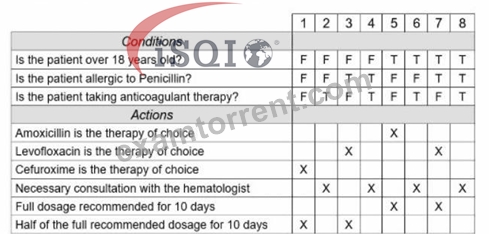
Based only on the given information, which of the following statements is true?
- A. Columns 1 and 3 can be merged into a single column
- B. Columns 2, 4. 6 and 8 can be merged into a single column
- C. Columns 5 and 7 can be merged into a single column
- D. Column 7 represents an impossible situation and thus can be deleted
Answer: D
Explanation:
In the given decision table, Column 7 represents the following conditions and actions:
* The patient is over 18 years old: True
* The patient is allergic to Penicillin: True
* The patient is taking anticoagulant therapy: True
When analyzing this column:
* If the patient is over 18 years old, allergic to Penicillin, and taking anticoagulant therapy, the decision table suggests consultation with a hematologist and prescribing half of the full recommended dosage for
10 days.
This column does not represent an impossible situation based on the conditions provided. However, upon deeper inspection and understanding of medical practices, it can be argued that such a specificcombination of conditions could be highly unlikely, making it appear unnecessary or an edge case that might be considered for deletion.
Given the constraints of the conditions and the requirements of the decision table, the provided answer needs to be verified against real-world medical guidelines to confirm if this scenario is indeed impossible or just
NEW QUESTION # 92
The tests at the bottom layer of the test pyramid:
- A. are defined as 'Ul Tests' or 'End-To-End tests' in the different models of the pyramid
- B. are unscripted tests produced by experience-based test techniques
- C. run faster than the tests at the top layer of the pyramid
- D. cover larger pieces of functionalities than the tests at the top layer of the pyramid
Answer: C
Explanation:
The tests at the bottom layer of the test pyramid run faster than the tests at the top layer of the pyramid because they are more focused, isolated, and atomic. They usually test individual units or components of the software system, such as classes, methods, or functions. They are also easier to maintain and execute, as they have fewer dependencies and interactions with other parts of the system. The tests at the top layer of the test pyramid, on the other hand, are slower because they cover larger pieces of functionalities, such as user interfaces, workflows, or end-to-end scenarios. They also have more dependencies and interactions with other systems, such as databases, networks, or external services. They are more complex and costly to maintain and execute, as they require more setup and teardown procedures, test data, and test environments. References:
ISTQB Certified Tester Foundation Level (CTFL) v4.0 sources and documents:
* ISTQB Certified Tester Foundation Level Syllabus v4.0, Chapter 3.2.1, Test Pyramid1
* ISTQB Glossary of Testing Terms v4.0, Test Pyramid2
NEW QUESTION # 93
Which of the following statements about the shift-left approach is true?
- A. Performance testing performed during component testing, is a form of shift-left in testing that avoids planning and executing costly end-to-end testing at the system test level in a production-like environment
- B. Shift-left in testing can be implemented only in Agile/DevOps frameworks, as it relies completely on automated testing activities performed within a continuous integration process
- C. Shift-left in testing can be implemented in several ways to find functional defects early in the lifecycle, but it cannot be relied upon to find defects associated with non-functional characteristics
- D. Continuous integration supports shift-left in testing as it can reduce the time between the introduction of a defect and its detection, thereby reducing the cost to fix it
Answer: D
Explanation:
This answer is correct because shift-left in testing is an approach that aims to perform testing activities as early as possible in the software development lifecycle, in order to find and fix defects faster and cheaper, and to improve the quality of the software product. Continuous integration is a practice that supports shift-left in testing, as it involves integrating and testing the software components frequently, usually several times a day, using automated tools and processes. Continuous integration can reduce the time between the introduction of a defect and its detection, thereby reducing the cost to fix it and the risk of accumulating defects that could affect the functionality or performance of the software product. References: ISTQB Foundation Level Syllabus v4.0, Section 3.1.1.3, Section 3.2.1.3
NEW QUESTION # 94
Which ONE of the following activities TYPICALLY belongs to the planning phase of the review process?
- A. The purpose and scope of the review are defined, as well as the work product to be reviewed and the exit criteria.
- B. Each reviewer conducts an individual review to identify anomalies, recommendations, and questions.
- C. The reviewers analyze and discuss the anomalies found during the review in a joint meeting.
- D. A separate defect report is created for each identified defect so that corrective actions can be tracked.
Answer: A
Explanation:
Theplanning phase of the review process(C) includes defining thereview's purpose, scope, and exit criteriato ensure alignment.Option Ais part of the defect management phase,Bhappens during individual preparation, andDtakes place in the review meeting.
NEW QUESTION # 95
Which of the following statements about static testing and dynamic testing is true?
- A. Unlike dynamic testing, which focuses on detecting potential defects, static testing focuses on detecting failures which may be due to actual defects
- B. Unlike dynamic testing, which can be also performed manually, static testing cannot be performed without specialized tools
- C. Both static testing and dynamic testing can be used to highlight issues associated with non-functional characteristics
- D. Static testing is usually much less cost-effective than dynamic testing
Answer: C
Explanation:
Explanation
This answer is correct because static testing and dynamic testing are both types of testing that can be used to highlight issues associated with non-functional characteristics, such as usability, performance, security, reliability, etc. Static testing is a type of testing that involves the analysis of software work products, such as requirements, design, code, or test cases, without executing them. Dynamic testing is a type of testing that involves the execution of software work products, such as code or test cases, using inputs and verifying outputs. Both static testing and dynamic testing can be applied to different test levels and test types, and can use different test techniques and tools, to evaluate the non-functional characteristics of the software product. References: ISTQB Glossary of Testing Terms v4.0, ISTQB Foundation Level Syllabus v4.0, Section
2.2.1.1, Section 2.2.1.2
NEW QUESTION # 96
Which ONE of the following options BEST describes Behavior-Driven Development (BDD)?
- A. Defines test cases at a low level, close to the implementation, using unit test frameworks.
- B. Requires testing to be performed after development is completed to validate software functionality.
- C. Is primarily focused on non-functional testing techniques to ensure system reliability and performance.
- D. Expresses the desired behavior of an application with test cases written in a simple form of natural language that is easy to understand by stakeholders-usually using the Given/When/Then format. Test cases are then automatically translated into executable tests.
Answer: D
Explanation:
BDD emphasizes collaboration between developers, testers, and business stakeholders to define system behavior in a readable format (A). It typically uses theGiven-When-Thensyntax. Unlike unit testing (B), BDD is at a higher level of abstraction. It does not focus solely on non-functional testing (C) and encourages early testing rather than post-development validation (D).
NEW QUESTION # 97
The acceptance criteria associated with a user story:
- A. are often documented following in rule-oriented format using the following template: "As a [role], I want [feature], so that I can [benefit]"
- B. can be written in different formats and represent an aspect of a user story referred to as confirmation' of the so called "3 C's"
- C. are often written in a rule-oriented format using the template referred to as "Given/When/Then"
- D. must be written in one of the two following formats: scenario-oriented or rule-oriented
Answer: B
Explanation:
The acceptance criteria associated with a user story are the conditions that must be met for the user story to be considered done and to deliver the expected value to the user. They are often written in different formats, such as rule-oriented, scenario-oriented, or table-oriented, depending on the nature and complexity of the user story. They represent an aspect of a user story referred to as confirmation, which is one of the so called "3 C's" of user stories. The other two aspects are card and conversation. Card refers to the concise and informal description of the user story, usually following the template: "As a [role], I want [feature], so that I can [benefit]". Conversation refers to the ongoing dialogue between the stakeholders and the team members to clarify and refine the user story and its acceptance criteria. Therefore, option C is the correct answer.
NEW QUESTION # 98
What type of testing measures its effectiveness by tracking which lines of code were executed by the tests?
- A. Exploratory testing
- B. Acceptance testing
- C. Structural testing
- D. Integration testing
Answer: C
Explanation:
Structural testing is a type of testing that measures its effectiveness by tracking which lines of code were executed by the tests. Structural testing, also known as white-box testing or glass-box testing, is based on the internal structure, design, or implementation of the software. Structural testing aims to verify that the software meets the specified quality attributes, such as performance, security, reliability, or maintainability, by exercising the code paths, branches, statements, conditions, or data flows. Structural testing uses various coverage metrics, such as function coverage, line coverage, branch coverage, or statement coverage, to determine how much of the code has been tested and to identify any untested or unreachable parts of the code. Structural testing can be applied at any level of testing, such as unit testing, integration testing, system testing, or acceptance testing, but it is more commonly used at lower levels, where the testers have access to the source code.
The other options are not correct because they are not types of testing that measure their effectiveness by tracking which lines of code were executed by the tests. Acceptance testing is a type of testing that verifies that the software meets the acceptance criteria and the user requirements. Acceptance testing is usually performed by the end-users or customers, who may not have access to the source code or the technical details of the software. Acceptance testing is more concerned with the functionality, usability, or suitability of the software, rather than its internal structure or implementation. Integration testing is a type of testing that verifies that the software components or subsystems work together as expected. Integration testing is usually performed by the developers or testers, who may use both structural and functional testing techniques to check the interfaces, interactions, or dependencies between the components or subsystems. Integration testing is more concerned with the integration logic, data flow, or communication of the software, rather than its individual lines of code. Exploratory testing is a type of testing that involves simultaneous learning, test design, and test execution. Exploratory testing is usually performed by the testers, who use their creativity, intuition, or experience to explore the software and discover any defects, risks, or opportunities for improvement. Exploratory testing is more concerned with the behavior, quality, or value of the software, rather than its internal structure or implementation. Reference = ISTQB Certified Tester Foundation Level (CTFL) v4.0 syllabus, Chapter 4: Test Techniques, Section 4.3: Structural Testing Techniques, Pages 51-54; Chapter 1: Fundamentals of Testing, Section 1.4: Testing Throughout the Software Development Lifecycle, Pages 11-13; Chapter 3: Static Testing, Section 3.4: Exploratory Testing, Pages 40-41.
NEW QUESTION # 99
In a two-hour uninterrupted test session, performed as part of an iteration on an Agile project, a heuristic checklist was used to help the tester focus on some specific usability issues of a web application.
The unscripted tests produced by the tester's experience during such session belong to which one of the following testing quadrants?
- A. Q1
- B. Q3
- C. Q2
- D. Q4
Answer: B
Explanation:
The unscripted tests produced by the tester's experience during the two-hour test session belong to the testing quadrant Q3. The testing quadrants are a classification of testing types based on two dimensions: the test objectives (whether the testing is focused on supporting the team or critiquing the product) and the test basis (whether the testing is based on the technology or the business). The testing quadrants are labeled as Q1, Q2, Q3, and Q4, and each quadrant represents a different testing perspective, such as unit testing, acceptance testing, usability testing, or performance testing. The testing quadrant Q3 corresponds to the testing types that have the objective of critiquing the product from the business perspective, such as exploratory testing, usability testing, user acceptance testing, alpha testing, beta testing, etc. The unscripted tests performed by the tester in the given scenario are examples of exploratory testing and usability testing, as they are based on the tester's experience, intuition, and learning of the web application, and they focus on some specific usability issues, such as the user interface, the user satisfaction, the user feedback, etc. The other options are incorrect, because:
The testing quadrant Q1 corresponds to the testing types that have the objective of supporting the team from the technology perspective, such as unit testing, component testing, integration testing, system testing, etc. These testing types are usually performed by developers or testers who have access to the source code, the design, the architecture, or the configuration of the software system, and they aim to verify the functionality, the quality, and the reliability of the software system at different levels of integration.
The testing quadrant Q2 corresponds to the testing types that have the objective of supporting the team from the business perspective, such as functional testing, acceptance testing, story testing, scenario testing, etc. These testing types are usually performed by testers or customers who have access to the requirements, the specifications, the user stories, or the business processes of the software system, and they aim to validate that the software system meets the expectations and the needs of the users and the stakeholders.
The testing quadrant Q4 corresponds to the testing types that have the objective of critiquing the product from the technology perspective, such as performance testing, security testing, reliability testing, compatibility testing, etc. These testing types are usually performed by testers or specialists who have access to the tools, the metrics, the standards, or the benchmarks of the software system, and they aim to evaluate the non-functional aspects of the software system, such as the efficiency, the security, the reliability, or the compatibility of the software system under different conditions or environments. Reference: ISTQB Certified Tester Foundation Level (CTFL) v4.0 sources and documents:
ISTQB® Certified Tester Foundation Level Syllabus v4.0, Chapter 1.3.1, Testing in Software Development Lifecycles ISTQB® Glossary of Testing Terms v4.0, Testing Quadrant, Exploratory Testing, Usability Testing, Unit Testing, Component Testing, Integration Testing, System Testing, Functional Testing, Acceptance Testing, Story Testing, Scenario Testing, Performance Testing, Security Testing, Reliability Testing, Compatibility Testing
NEW QUESTION # 100
Consider an estimation session in which a six-member Agile team (Membl,..., Memb6) uses the planning poker technique to estimate a user story (in story points). The team members will use a set of cards with the following values: 1. 2, 3, 5, 8,13, 21. Below is the outcome of the first round of estimation for this session:
Membl = 3 Memb2 = 3 Memb3 = 3
Memb4 = 21 Memb5 = 3 Memb6 = 1
Which of the following answers best describes how the estimation session should proceed?
- A. Further estimation rounds should be performed until all team members will pick the card having the same value: this value will represent the final estimate of the user story in story points
- B. The final estimate of the user story in story points is determined by calculating the average value between the most optimistic estimate of 21 story points (Memb4) and the most pessimistic estimate of 1 story point (Memb6)
- C. Memb6 and Memb4 which have produced the most pessimistic and the most optimistic estimates respectively, should explain the reasons of their choices to stimulate a discussion between all members before to proceed to another estimation round
- D. The final estimate of the user story in story points is determined by applying the three-point estimation technique with the following input values: most optimistic estimate = 1, most likely estimate = 3, and most pessimistic estimate = 21
Answer: C
Explanation:
Planning poker is a consensus-based estimation technique used in Agile. It involves team members selecting cards with their estimate for a user story, then discussing the differences in estimates.
* Option A: Incorrect. While three-point estimation is valid, planning poker focuses on team consensus rather than individual estimation techniques.
* Option B: Incorrect. The goal of planning poker is not to force unanimity but to reach a reasonable consensus.
* Option C: Incorrect. Averaging estimates is not how planning poker works.
* Option D: Correct. The members with the highest and lowest estimates discuss their reasoning to foster understanding and adjust estimates accordingly in subsequent rounds.
NEW QUESTION # 101
Which of the following statements about exploratory testing is true?
- A. Exploratory testing is an experience-based test technique used by testers during informal code reviews to find defects by exploring the source code
- B. When exploratory testing is conducted following a session-based approach, the issues detected by the testers can be documented in session sheets
- C. Exploratory testing is an experience-based test technique in which testers explore the requirements specification to detect non testable requirements
- D. In exploratory testing, testers usually produce scripted tests and establish bidirectional traceability between these tests and the items of the test basis
Answer: B
Explanation:
Explanation
Exploratory testing is an experience-based test technique in which testers dynamically design and execute tests based on their knowledge, intuition, and learning of the software system, without following predefined test scripts or test cases. Exploratory testing can be conducted following a session-based approach, which is a structured way of managing and measuring exploratory testing. In a session-based approach, the testers perform uninterrupted test sessions, usually lasting between 60 and 120 minutes, with a specific charter or goal, and document the issues detected, the test coverage achieved, and the time spent in session sheets.
Session sheets are records of the test activities, results, and observations during a test session, which can be used for reporting, debriefing, and learning purposes. The other statements are false, because:
Exploratory testing is not a test technique in which testers explore the requirements specification to detect non testable requirements, but rather a test technique in which testers explore the software system to detect functional and non-functional defects, as well as to learn new information, risks, or opportunities. Non testable requirements are requirements that are ambiguous, incomplete, inconsistent, or not verifiable, which can affect the quality and effectiveness of the testing process. Non testable requirements can be detected by applying static testing techniques, such as reviews or inspections, to the requirements specification, before the software system is developed or tested.
Exploratory testing is not a test technique used by testers during informal code reviews to find defects by exploring the source code, but rather a test technique used by testers during dynamic testing to find defects by exploring the behavior and performance of the software system, without examining the source code. Informal code reviews are static testing techniques, in which the source code is analyzed by one or more reviewers, without following a formal process or using a checklist, to identify defects, violations, or improvements. Informal code reviews are usually performed by developers or peers, not by testers.
In exploratory testing, testers usually do not produce scripted tests and establish bidirectional traceability between these tests and the items of the test basis, but rather produce unscripted tests and adapt them based on the feedback and the findings of the testing process. Scripted tests are tests that are designed and documented in advance, with predefined inputs, outputs, and expected results, and are executed according to a test plan or a test procedure. Bidirectional traceability is the ability to trace both forward and backward the relationships between the items of the test basis, such as the requirements, the design, therisks, etc., and the test artifacts, such as the test cases, the test results, the defects, etc.
Scripted tests and bidirectional traceability are usually associated with more formal and structured testing approaches, such as specification-based or structure-based test techniques, not with exploratory testing. References: ISTQB Certified Tester Foundation Level (CTFL) v4.0 sources and documents:
ISTQB Certified Tester Foundation Level Syllabus v4.0, Chapter 2.2.3, Experience-based Test Design Techniques1 ISTQB Glossary of Testing Terms v4.0, Exploratory Testing, Session-based Testing, Session Sheet, Non Testable Requirement, Static Testing, Informal Review, Dynamic Testing, Scripted Testing, Bidirectional Traceability2
NEW QUESTION # 102
Which of the following statements about exploratory testing is true?
- A. Exploratory testing is an experience-based test technique used by testers during informal code reviews to find defects by exploring the source code
- B. When exploratory testing is conducted following a session-based approach, the issues detected by the testers can be documented in session sheets
- C. Exploratory testing is an experience-based test technique in which testers explore the requirements specification to detect non testable requirements
- D. In exploratory testing, testers usually produce scripted tests and establish bidirectional traceability between these tests and the items of the test basis
Answer: B
Explanation:
Exploratory testing is an experience-based test technique in which testers dynamically design and execute tests based on their knowledge, intuition, and learning of the software system, without following predefined test scripts or test cases. Exploratory testing can be conducted following a session-based approach, which is a structured way of managing and measuring exploratory testing. In a session-based approach, the testers perform uninterrupted test sessions, usually lasting between 60 and 120 minutes, with a specific charter or goal, and document the issues detected, the test coverage achieved, and the time spent in session sheets.
Session sheets are records of the test activities, results, and observations during a test session, which can be used for reporting, debriefing, and learning purposes. The other statements are false, because:
* Exploratory testing is not a test technique in which testers explore the requirements specification to detect non testable requirements, but rather a test technique in which testers explore the software system to detect functional and non-functional defects, as well as to learn new information, risks, or opportunities. Non testable requirements are requirements that are ambiguous, incomplete, inconsistent, or not verifiable, which can affect the quality and effectiveness of the testing process. Non testable requirements can be detected by applying static testing techniques, such as reviews or inspections, to the requirements specification, before the software system is developed or tested.
* Exploratory testing is not a test technique used by testers during informal code reviews to find defects by exploring the source code, but rather a test technique used by testers during dynamic testing to find defects by exploring the behavior and performance of the software system, without examining the source code. Informal code reviews are static testing techniques, in which the source code isanalyzed by one or more reviewers, without following a formal process or using a checklist, to identify defects, violations, or improvements. Informal code reviews are usually performed by developers or peers, not by testers.
* In exploratory testing, testers usually do not produce scripted tests and establish bidirectional traceability between these tests and the items of the test basis, but rather produce unscripted tests and adapt them based on the feedback and the findings of the testing process. Scripted tests are tests that are designed and documented in advance, with predefined inputs, outputs, and expected results, and are executed according to a test plan or a test procedure. Bidirectional traceability is the ability to trace both forward and backward the relationships between the items of the test basis, such as the requirements, the design, the risks, etc., and the test artifacts, such as the test cases, the test results, the defects, etc.
Scripted tests and bidirectional traceability are usually associated with more formal and structured testing approaches, such as specification-based or structure-based test techniques, not with exploratory testing. References: ISTQB Certified Tester Foundation Level (CTFL) v4.0 sources and documents:
* ISTQB Certified Tester Foundation Level Syllabus v4.0, Chapter 2.2.3, Experience-based Test Design Techniques1
* ISTQB Glossary of Testing Terms v4.0, Exploratory Testing, Session-based Testing, Session Sheet, Non Testable Requirement, Static Testing, Informal Review, Dynamic Testing, Scripted Testing, Bidirectional Traceability2
NEW QUESTION # 103
You are working on creating test cases for a user story -
As a customer, I want to be able to book an ISTQB exam for a particular date, so that I can find choose my time slot and pay the correct amount, including discounts, if any.
The acceptance criteria for this :
1.The dates shown should be from the current date to 2 years in future
2.Initially there should be 10 timeslots available for each day, 1 hour each, starting at 8 AM GMT
3.Maximum 5 persons should be able to select a time slot after which that time slot should become unavailable
4.First timeslot should have a 10% discount.
Which of the following is the BEST example of a test case for this user story?
- A. Logon to the site. Book an exam for the current date. Expected result: timeslots should be shown.Change the time to any other date prior to the selected date. Expected result: New slot should become visible.
- B. Logon to the site and book an exam for the 8 AM (GMT) timeslot. Expected result: You should get 10% discounted price. Change the time to any other timeslot. Expected result: Discount should be removed
- C. Logon to the site. Book 5 exams for the current date. Expected result: Exams should be booked. Book
6th timeslot for the same date. Expected result: The exam should be booked but no discount should be given. - D. Logon to the site. Expected result: Default 8 AM (GMT) timeslot should be selected. Change the time to any other timeslot. Expected result: New slot should be booked
Answer: B
Explanation:
The best example of a test case for this user story should cover the acceptance criteria comprehensively.
Option A addresses the critical aspects of the acceptance criteria:
* Verifying the discount for the first timeslot (8 AM GMT) - ensuring it provides a 10% discount.
* Verifying that changing the time slot removes the discount - ensuring the discount logic is correctly applied.
This test case effectively validates the functionality related to both the discount and the ability to change time slots, which are key parts of the user story's requirements.
NEW QUESTION # 104
Which of the following are the phases of the ISTQB fundamental test process?
- A. Test planning. Test specification and design. Test implementation and execution. Evaluating exit criteria and reporting. Retesting and test closure activities
- B. Test planning and control, Test specification and design. Test implementation and execution, Evaluating test coverage and reporting, Retesting and regression testing, Test closure activities
- C. Test planning and control, Test analysis and design, Test implementation and execution, Evaluating ex t criteria and reporting. Test closure activities
- D. Test planning, Test analysis and design. Test implementation and control. Checking test coverage and reporting, Test closure activities
Answer: C
Explanation:
The ISTQB fundamental test process consists of five main phases, as described in the ISTQB Foundation Level Syllabus, Version 4.0, 2018, Section 2.2, page 15:
* Test planning and control: This phase involves defining the test objectives, scope, strategy, resources, schedule, risks, and metrics, as well as monitoring and controlling the test activities and results throughout the test process.
* Test analysis and design: This phase involves analyzing the test basis (such as requirements, specifications, or user stories) to identify test conditions (such as features, functions, or scenarios) that need to be tested, and designing test cases and test procedures (such as inputs, expected outcomes, and execution steps) to cover the test conditions. This phase also involves evaluating the testability of the test basis and the test items (such as software or system components), and selecting and implementing test techniques (such as equivalence partitioning, boundary value analysis, or state transition testing) to achieve the test objectives and optimize the test coverage and efficiency.
* Test implementation and execution: This phase involves preparing the test environment (such as hardware, software, data, or tools) and testware (such as test cases, test procedures, test data, or test scripts) for test execution, and executing the test procedures or scripts according to the test plan and schedule. This phase also involves logging the outcome of test execution, comparing the actual results with the expected results, and reporting any discrepancies as incidents (such as defects, errors, or failures).
* Evaluating exit criteria and reporting: This phase involves checking if the planned test activities have been completed and the exit criteria (such as quality, coverage, or risk levels) have been met, and reporting the test results and outcomes to the stakeholders. This phase also involves making recommendations for the release or acceptance decision based on the test results and outcomes, and identifying any residual risks (such as known defects or untested areas) that need to be addressed or mitigated.
* Test closure activities: This phase involves finalizing and archiving the testware and test environment for future reuse, and evaluating the test process and the test project against the test objectives and the test plan. This phase also involves identifying any lessons learned and best practices, and communicating the findings and suggestions for improvement to the relevant parties.
References = ISTQB Certified Tester Foundation Level Syllabus, Version 4.0, 2018, Section 2.2, page 15; ISTQB Glossary of Testing Terms, Version 4.0, 2018, pages 37-38; ISTQB CTFL 4.0 - Sample Exam - Answers, Version 1.1, 2023, Question 88, page 32.
NEW QUESTION # 105
The tests at the bottom layer of the test pyramid:
- A. are defined as 'Ul Tests' or 'End-To-End tests' in the different models of the pyramid
- B. are unscripted tests produced by experience-based test techniques
- C. run faster than the tests at the top layer of the pyramid
- D. cover larger pieces of functionalities than the tests at the top layer of the pyramid
Answer: C
Explanation:
The tests at the bottom layer of the test pyramid run faster than the tests at the top layer of the pyramid because they are more focused, isolated, and atomic. They usually test individual units or components of the software system, such as classes, methods, or functions. They are also easier to maintain and execute, as they have fewer dependencies and interactions with other parts of the system. The tests at the top layer of the test pyramid, on the other hand, are slower because they cover larger pieces of functionalities, such as user interfaces, workflows, or end-to-end scenarios. They also have more dependencies and interactions with other systems, such as databases, networks, or external services. They are more complex and costly to maintain and execute, as they require more setup and teardown procedures, test data, and test environments. Reference: ISTQB Certified Tester Foundation Level (CTFL) v4.0 sources and documents:
ISTQB® Certified Tester Foundation Level Syllabus v4.0, Chapter 3.2.1, Test Pyramid1 ISTQB® Glossary of Testing Terms v4.0, Test Pyramid2
NEW QUESTION # 106
In a review, which of the following is the responsibility of the manager?
- A. Ensuring that sufficient time is available for review
- B. Organizing the logistics of the review meeting
- C. Performing detailed review based on past experience
- D. Measuring the performance of each reviewer
Answer: A
Explanation:
In a review process, the manager's responsibility is to ensure that sufficient time is allocated for the review activities. This includes planning and scheduling the review sessions, making sure that the team has enough time to conduct a thorough and effective review.
References:
* ISTQB CTFL Syllabus V4.0, Section 3.2.3 on the roles and responsibilities in a review process, specifically mentioning the manager's role in ensuring adequate time for reviews.
NEW QUESTION # 107
Consider the following simplified version of a state transition diagram that specifies the behavior of a video poker game: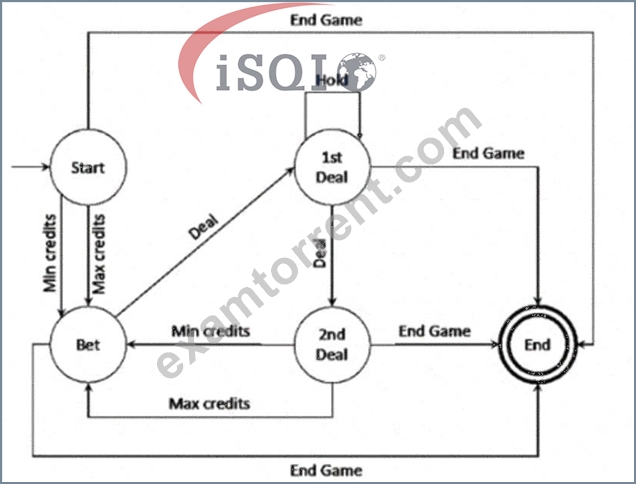
What Is the minimum number of test cases needed to cover every unique sequence of up to 3 states/2 transitions starting In the "Start" state and ending In the "End" state?
- A. 0
- B. 1
- C. 2
- D. 3
Answer: C
Explanation:
The minimum number of test cases needed to cover every unique sequence of up to 3 states/2 transitions starting in the "Start" state and ending in the "End" state is 4. This is because there are 4 unique sequences of up to 3 states/2 transitions starting in the "Start" state and ending in the "End" state:
* Start -> Bet -> End
* Start -> Deal -> End
* Start -> 1st Deal -> End
* Start -> 2nd Deal -> End References: ISTQB Certified Tester Foundation Level (CTFL) v4.0 sources and documents.
NEW QUESTION # 108
Which of the following is a test-first approach, where tests that express a shared understanding from stakeholders of how the application is expected to work, are first written in business-readable language (following the Given/When/Then format), and then made executable to drive development?
- A. Behavior-Driven Development (BDD)
- B. Acceptance Test-Driven Development (ATDD)
- C. Test-Driven Development (TDD)
- D. Domain-Driven Design (DDD)
Answer: A
Explanation:
This answer is correct because Behavior-Driven Development (BDD) is a test-first approach, where tests that express a shared understanding from stakeholders of how the application is expected to work, are first written in business-readable language (following the Given/When/Then format), and then made executable to drive development. BDD is a collaborative approach that involves testers, developers, business analysts, product owners, and other stakeholders in defining the expected behavior of the application using scenarios that describe the preconditions, actions, and outcomes of the application. BDD scenarios are written using a domain-specific language (DSL) that can be translated into executable test cases using tools such as Cucumber or SpecFlow. BDD aims to improve communication, collaboration, and feedback among the team members, and to deliver software that meets the customer's needs and expectations. Reference: ISTQB Glossary of Testing Terms v4.0, ISTQB Foundation Level Syllabus v4.0, Section 3.1.1.4
NEW QUESTION # 109
Which of the following statements correctly describe the business facing quadrant that supports the team?
- A. Exploratory tests are generally used for this quadrant
- B. It is the quadrant that deals with tests created on the basis of user stories.
- C. It is the quadrant that component testing.
- D. It is the quadrant that Non-functional testing such as performance and the tests are created on the basis of user scenarios
Answer: B
Explanation:
The business-facing quadrant that supports the team is focused on tests that validate the system against user stories. These tests ensure that the system delivers the value and functionality described by the user stories, which are central to agile methodologies.
References:
* ISTQB CTFL Syllabus V4.0, Section 5.1.7 on the testing quadrants, particularly the business-facing tests that support the team and are based on user stories.
NEW QUESTION # 110
Which of the following statements is true?
- A. Bugs are defects found during component testing, while failures are defects found at higher test levels
- B. A defect may cause a failure which, when occurring, always causes an error
- C. A defect does not always produce a failure, while a bug always produces a failure
- D. Failures can be caused by defects, but also by environmental conditions
Answer: D
Explanation:
Failures can be caused by defects, but also by environmental conditions. A failure is an event in which the software system does not perform a required function or performs a function incorrectly, according to the expected behavior. A defect is a flaw in the software system or a deviation from the requirements or the specifications, that may cause a failure. However, not all failures are caused by defects, as some failures may be caused by environmental conditions, such as hardware malfunctions, network interruptions, power outages, incompatible configurations, etc. Environmental conditions are factors that affect the operation of the software system, but are not part of the software system itself. The other statements are false, because:
A defect does not always produce a failure, while a bug always produces a failure. This statement is false, because a defect may or may not produce a failure, depending on the inputs, the outputs, the states, or the scenarios of the software system, and a bug is just another term for a defect, so it has the same possibility of producing a failure as a defect. For example, a defect in a rarely used feature or a hidden branch of the code may never produce a failure, while a defect in a frequently used feature or a critical path of the code may produce a failure often. A bug is not a different concept from a defect, but rather a synonym or a colloquial term for a defect, so it has the same definition and implications as a defect.
A defect may cause a failure which, when occurring, always causes an error. This statement is false, because an error is not a consequence of a failure, but rather a cause of a defect. An error is a human action or a mistake that produces a defect in the software system, such as a typo, a logic flaw, a requirement misunderstanding, etc. An error is not observable in the software system, but rather in the human mind or the human work products, such as the code, the design, the documentation, etc. A failure is not a cause of an error, but rather a result of a defect, which is a result of an error. For example, an error in the code may cause a defect in the software system, which may cause a failure in the software behavior.
Bugs are defects found during component testing, while failures are defects found at higher test levels. This statement is false, because bugs and failures are not different types of defects, but rather different terms for defects and their manifestations. As mentioned before, bugs are just another word for defects, and failures are the events in which the software system does not perform as expected due to defects. Bugs and failures can be found at any test level, not only at component testing or higher test levels. Test levels are the stages of testing that correspond to the levels of integration of the software system, such as component testing, integration testing, system testing, and acceptance testing. Defects and failures can occur and be detected at any test level, depending on the test objectives, the test basis, the test techniques, and the test environment. Reference: ISTQB Certified Tester Foundation Level (CTFL) v4.0 sources and documents:
ISTQB® Certified Tester Foundation Level Syllabus v4.0, Chapter 1.1.2, Testing and Quality1 ISTQB® Certified Tester Foundation Level Syllabus v4.0, Chapter 1.2.1, Testing Principles1 ISTQB® Certified Tester Foundation Level Syllabus v4.0, Chapter 1.3.1, Testing in Software Development Lifecycles1 ISTQB® Glossary of Testing Terms v4.0, Failure, Defect, Bug, Environmental Condition, Error, Test Level2
NEW QUESTION # 111
In branch testing, what is the significance of a conditional branch in a software program?
- A. It represents a programming error and therefore a conditional branch should be avoided.
- B. It signifies a comment or documentation within the code and it doesn't indicate a defect.
- C. It marks a point where the program's execution will terminate bringing the program to a halt.
- D. It indicates a decision point where the program can follow different paths based on specific conditions.
Answer: D
Explanation:
In branch testing, a conditional branch represents a decision point in the software program where the flow of execution can take different paths based on specific conditions. For example, this could be an "if-else" statement, a "switch-case" statement, or loops where different execution paths are taken depending on the evaluated condition. This type of testing ensures that all possible paths and conditions are executed at least once, which helps in identifying any potential defects in different branches of the code.
NEW QUESTION # 112
......
Get Latest [Nov-2025] Conduct effective penetration tests using ExamTorrent CTFL_Syll_4.0: https://prep4sure.examtorrent.com/CTFL_Syll_4.0-exam-papers.html
