

Pass Your NSE 6 Network Security Specialist NSE6_FSR-7.3 Exam on Jul 14, 2025 with 41 Questions
NSE6_FSR-7.3 Free Exam Study Guide! (Updated 41 Questions)
Fortinet NSE6_FSR-7.3 Exam Syllabus Topics:
| Topic | Details |
|---|---|
| Topic 1 |
|
| Topic 2 |
|
| Topic 3 |
|
| Topic 4 |
|
| Topic 5 |
|
NEW QUESTION # 22
Refer to the exhibit.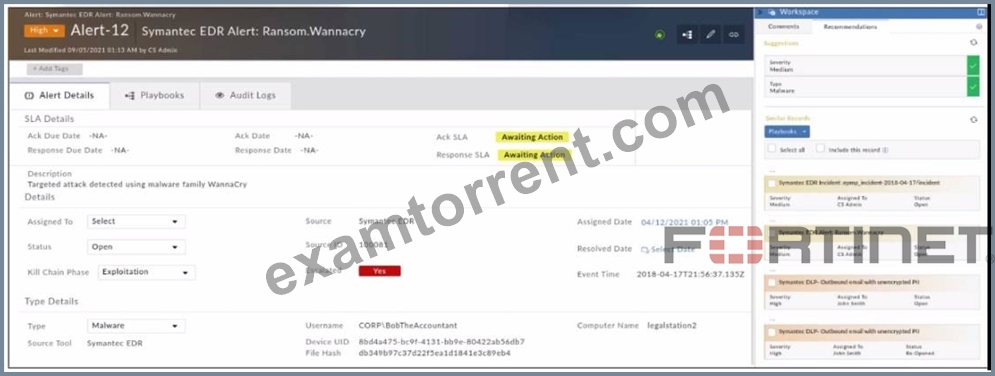
Which two statements about the recommendation engine are true? (Choose two.)
- A. The recommendation engine is set to automatically accept suggestions.
- B. There are no playbooks that can be run on the recommended alerts using the recommendation panel
- C. The alert severity is High, but the recommendation is for it to be set to Medium
- D. The dataset is trained to predict the Severity and Type fields.
Answer: C,D
Explanation:
The Recommendation Engine in FortiSOAR is designed to assist in alert triage by suggesting values for certain fields based on historical data and machine learning models. In this case, the engine is trained to predict both the Severity and Type fields, suggesting values that align with past incidents and threat intelligence. Although the current alert severity is High, the recommendation engine has suggested adjusting it to Medium based on the pattern of similar past alerts, indicating a less critical threat level than initially perceived. This functionality helps analysts by providing data-driven insights, which can optimize alert handling and resource allocation.
NEW QUESTION # 23
Refer to the exhibit.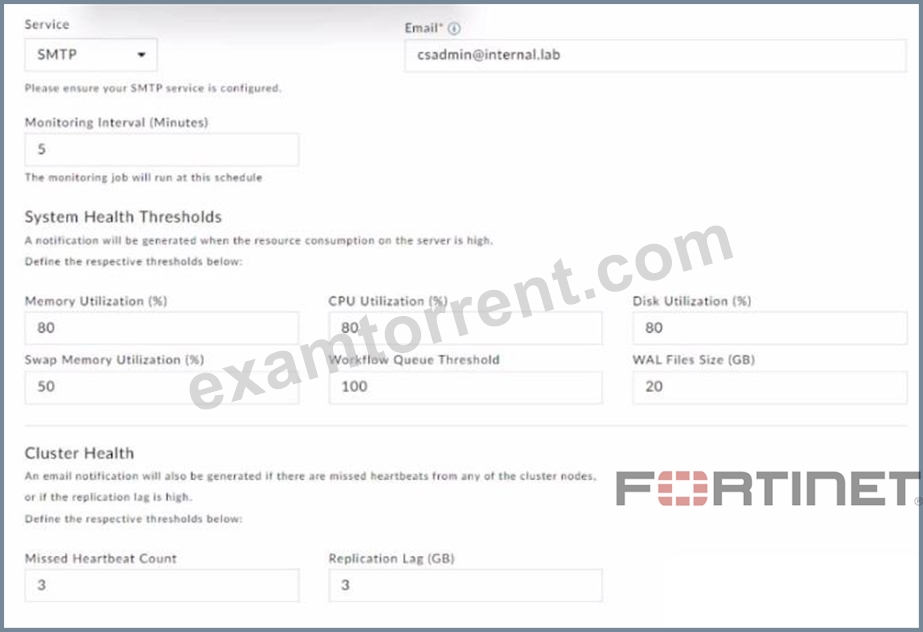
How long after the syops-ha service goes down will the heartbeat missed notification be sent to the administrator?
- A. 3 minutes
- B. 60 minutes
- C. 15 minutes
- D. 5 minutes
Answer: B
Explanation:
In FortiSOAR's high availability (HA) setup, if the cyops-ha service becomes unresponsive, the system is configured to send a "heartbeat missed" notification after a specified period, which in this case is 60 minutes. This delay allows for transient issues to be resolved without triggering immediate alerts, while also ensuring that administrators are informed of prolonged service disruptions. Timely notifications about the cyops-ha service's status help maintain the reliability and responsiveness of the HA environment.
NEW QUESTION # 24
Which log file contains license synchronization logs on FortiSOAR?
- A. beat.log
- B. celery.log
- C. fdn.log
- D. falcon.log
Answer: C
Explanation:
The fdn.log file in FortiSOAR contains logs related to license synchronization activities. This log file records events and errors associated with license checks and synchronization with Fortinet's licensing servers, ensuring that the FortiSOAR instance remains compliant with licensing requirements. Monitoring fdn.log can help administrators troubleshoot issues related to license synchronization and ensure the system operates within the licensed limits.
NEW QUESTION # 25
What are two system-level logs that can be purged using application configuration? (Choose two.)
- A. Reporting logs
- B. Connector logs
- C. Executed Playbook logs
- D. Audit togs
Answer: C,D
Explanation:
In FortiSOAR, system-level logs that can be purged include both "Audit logs" and "Executed Playbook logs." These types of logs can be configured to be purged periodically to free up storage space and ensure that unnecessary logs do not impact system performance. The application configuration allows administrators to schedule automatic purges, which can be especially useful in high-activity environments where log data accumulates quickly. Purging these logs helps maintain a cleaner and more efficient system.
NEW QUESTION # 26
Select two statements that are true about FortiSOAR themes.
(Choose two.)
- A. There are three theme options available: Dark, Light, and Sky.
- B. Non-administrator users can change the theme by editing their user profile.
- C. Selecting Revert Theme allows the user to revert the user profile theme.
- D. FortiSOAR theme can be configured to apply to all users on the system.
Answer: B,D
NEW QUESTION # 27
What are two different services that you can configure for monitoring system and cluster health statuses on FortiSOAR?
(Choose two.)
- A. Exchange
- B. POP
- C. IMAP
- D. SMTP
Answer: A,D
NEW QUESTION # 28
Refer to the exhibit.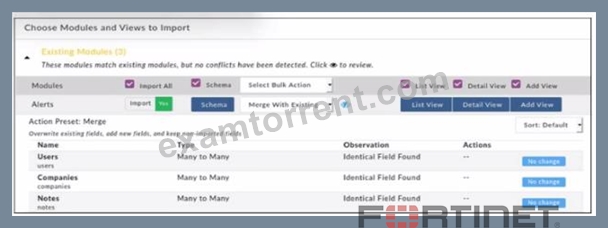
When importing modules to FortiSOAR using the configuration wizard, what actions are applied to fields it you select Merge with Existing as the Bulk action?
- A. Existing Holds are overwritten, now fields are added, and non-imported fields are deleted.
- B. Existing fields are kept, new fields are added, and non-imported fields are kept.
- C. Existing fields are kept, new fields are added, and non-imported fields are deleted.
- D. Existing fields are overwritten, new fields are added, and non-Imported fields are kept.
Answer: D
Explanation:
When importing modules into FortiSOAR using the configuration wizard and selecting "Merge with Existing" as the bulk action, the behavior for field handling is as follows: any fields that already exist in the system are overwritten with the imported values. New fields from the imported module are added to the system, while fields that are not part of the imported module remain unaffected and are retained in the system. This option ensures that existing data structures are updated with new information without losing existing, but non-imported, fields.
NEW QUESTION # 29
An administrator wants to collect and review all FortiSOAR log tiles to troubleshoot an issue. Which two methods can they use to accomplish this? (Choose two.)
- A. Download the logs from the GUI.
- B. Review the contents of /var/log/messages.
- C. Enter the csacta services -status command, and then copy the output.
- D. Enter the caacta log -collect directory command.
Answer: A,D
Explanation:
Administrators can collect and review FortiSOAR logs for troubleshooting in two primary ways. First, they can download logs directly from the GUI, which provides access to various logs through an intuitive interface. Secondly, using the command-line interface, the csacta log --collect command can be used to gather all logs within a specified directory, enabling more detailed offline analysis. Both methods offer comprehensive log collection to aid in diagnosing and resolving issues.
NEW QUESTION # 30
Which three actions can be performed from within the war room? (Choose three)
- A. Investigate issues by tagging results as evidence.
- B. Change the room's status to Escalated to enforce hourly updates.
- C. Use the Task Manager tab to create, manage, assign, and track tasks.
- D. Integrate a third-party instant messenger directly into the collaboration workspace.
- E. View graphical representation of all records linked to an incident in the Artifacts lab
Answer: A,C,E
Explanation:
In FortiSOAR's War Room, users can perform several actions to manage incidents effectively. They can view a graphical representation of records linked to an incident in the Artifacts lab, which helps visualize connections and dependencies. Additionally, the War Room supports tagging investigation results as evidence, allowing for a structured approach to incident documentation. Users can also manage tasks via the Task Manager tab, facilitating task creation, assignment, and tracking within the incident response workflow.
NEW QUESTION # 31
When deleting a user account on FortiSOAR, you must enter the user ID in which file on FortiSOAR?
- A. userDelete.txt.
- B. usersToDelete.txt
- C. config_yml
- D. scripts
Answer: B
Explanation:
When deleting a user account in FortiSOAR, the user ID must be entered into the usersToDelete.txt file. This file is specifically used to list users that are marked for deletion. Once the user IDs are listed in this file, the system can process the deletion of these accounts as part of its user management operations. This method ensures that only specified users are deleted, as referenced in FortiSOAR's administrative controls.
NEW QUESTION # 32
Refer to the exhibit.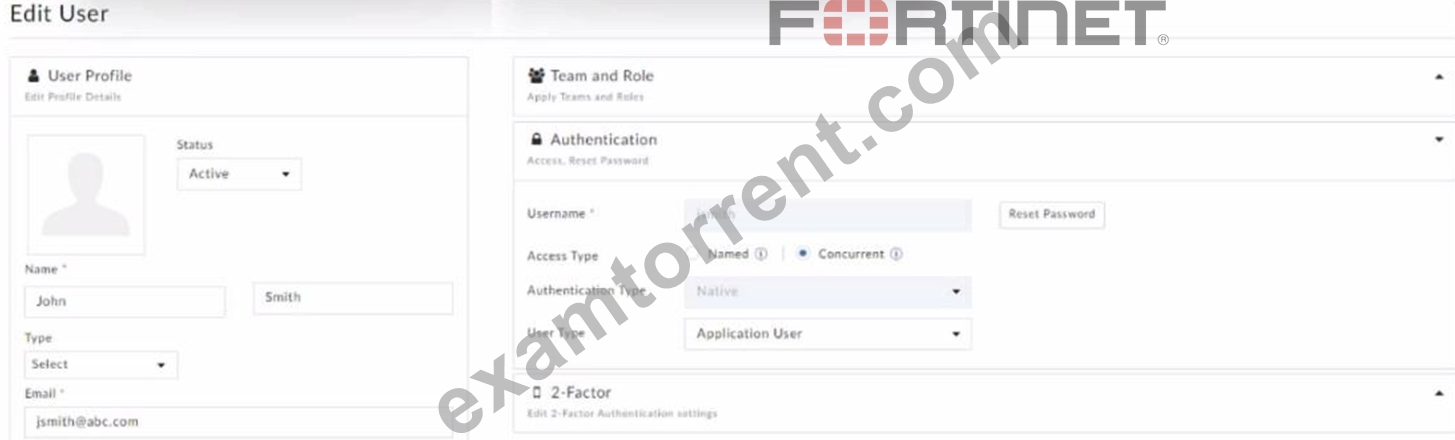
Which statement correctly describes the user's login behavior?
- A. The user has an active concurrent session that does not time out.
- B. The user is sent to a waiting queue if there are named users logged in.
- C. The user can log in only if there are enough seats available.
- D. The user will always be able to draw from the concurrent pool and log in.
Answer: C
Explanation:
In FortiSOAR, when a user is configured with "Concurrent" access type, their ability to log in depends on the availability of concurrent user seats. This means the user can only log in if there are available seats in the concurrent pool. If all seats are occupied, the user must wait until a seat becomes free. This configuration allows multiple users to share a pool of licenses, making it suitable for environments where not all users need constant access.
NEW QUESTION # 33
On FortiSOAR. which default role is used to assign privileges to other teams and is recommended to not be removed?
- A. Security Administrator
- B. Playbook Administrator
- C. Full App Permissions
- D. Application Administrator
Answer: D
Explanation:
In FortiSOAR, the "Application Administrator" role is a default role that holds broad privileges, including the ability to assign permissions to other teams. This role is fundamental to system administration and is recommended not to be removed as it provides crucial administrative capabilities. Removing or modifying this role could impact FortiSOAR's ability to manage user roles and permissions effectively, which could hinder system operations and user management.
NEW QUESTION # 34
Which two statements about upgrading a FortiSOAR HA cluster are true7 (Choose two.)
- A. It is recommended that the passive secondary node be upgraded first, and then the active primary node.
- B. Upgrading a FortiSOAR HA cluster requires no downtime.
- C. The upgrade procedure for an active-active cluster and an active-passive cluster are the same.
- D. Nodes can be upgraded while the primary node or secondary node are in the HA cluster.
Answer: A,C
Explanation:
Upgrading a FortiSOAR HA cluster follows the same procedure regardless of whether it is configured in an active-active or active-passive setup. The process generally involves upgrading one node at a time to minimize service disruption. Best practices recommend upgrading the passive secondary node first before moving to the active primary node. This sequence helps maintain cluster stability and ensures that at least one node remains operational during the upgrade.
NEW QUESTION # 35
Which three activities can be achieved using the FortiSOAR queue and shift management feature? (Choose three)
- A. Set up queue meeting rooms
- B. Create queue rules based on matching conditions
- C. Initiate shift handovers
- D. Generate shift leads and shift members
- E. Designate a coordinator to monitor queues and shifts
Answer: B,C,D
Explanation:
The FortiSOAR queue and shift management feature enables several key activities for managing shifts and queues. Administrators can initiate shift handovers, allowing for smooth transitions between shift leads and members. They can also designate specific roles within shifts, including shift leads and members, to define responsibilities. Additionally, queue rules can be established based on certain conditions, ensuring that incidents and tasks are assigned according to predefined criteria, which helps streamline operations and improve response times.
NEW QUESTION # 36
Which SMS vendor does FortiSOAR support for two-factor authentication?
- A. Twilio
- B. Telesign
- C. Google Authenticator
- D. 2factor
Answer: B
Explanation:
For two-factor authentication (2FA) via SMS, FortiSOAR supports integration with Telesign. This vendor provides SMS-based 2FA services, enabling FortiSOAR to leverage Telesign's API for sending verification codes as part of its security features. Telesign's service is compatible with FortiSOAR, ensuring secure user authentication when accessing the platform or certain features.
NEW QUESTION # 37
......
NSE6_FSR-7.3 Dumps for NSE 6 Network Security Specialist Certified Exam Questions and Answer: https://prep4sure.examtorrent.com/NSE6_FSR-7.3-exam-papers.html
