

Conducting Forensic Analysis & Incident Response Using Cisco Technologies for CyberOps Practice Tests 2026 | Pass 300-215 with confidence!
Practice CyberOps Professional 300-215 exam. Online Exam Practice Tests with detailed explanations!
To prepare for the Cisco 300-215 exam, candidates can enroll in Cisco's official training courses or use self-study materials. The official training courses cover all the topics and skills required to pass the exam and provide hands-on experience with Cisco technologies used in cyber forensics and incident response. Self-study materials include books, practice exams, and online resources that provide a comprehensive overview of the exam topics and help candidates practice their skills.
Cisco 300-215 certification exam is designed for cybersecurity professionals who want to enhance their skills and knowledge in forensic analysis and incident response using Cisco technologies. 300-215 exam is part of the Cisco Certified CyberOps Professional certification program, which is aimed at providing professionals with the necessary skills to handle sophisticated cyber threats.
NEW QUESTION # 24
A cybersecurity analyst detects fileless malware activity on secure endpoints. What should be done next?
- A. Share the findings with other government agencies for collaborative threat analysis and response.
- B. Delete the suspicious files and monitor the endpoints for any further signs of compromise.
- C. Isolate the affected endpoints and conduct a detailed memory analysis to identify fileless malware execution.
- D. Immediately quarantine the endpoints containing the suspicious files and consider the issue resolved
Answer: C
Explanation:
Fileless malware resides in memory and does not leave traditional file artifacts, making it difficult for antivirus solutions to detect. The most effective next step is to isolate the endpoints to prevent lateral movement and perform memory forensics to capture volatile data and identify any running malicious processes.
NEW QUESTION # 25
The Linux system administrator of a company suspects that physical unauthorized access was granted to a local Linux terminal. The administrator wants to examine the suspected machine for potential unauthorized use and to get information about even/ account in this terminal including when the password last changed The administrator logs in as a root user Which file should be examined to get the information?
- A. /etc/shadow
- B. /etc/passwd
- C. /etc/users
- D. /etc/auth
Answer: A
Explanation:
* /etc/shadow: This file stores encrypted passwords and password aging information, including the date of the last password change (stored as the number of days since January 1, 1970). It is only readable by the root user, making it the primary source for forensic auditing of local password changes.
NEW QUESTION # 26
A security team received an alert of suspicious activity on a user's Internet browser. The user's anti-virus software indicated that the file attempted to create a fake recycle bin folder and connect to an external IP address. Which two actions should be taken by the security analyst with the executable file for further analysis? (Choose two.)
- A. Evaluate the process activity in Cisco Umbrella.
- B. Evaluate the behavioral indicators in Cisco Secure Malware Analytics (Threat Grid).
- C. Analyze the Magic File type in Cisco Umbrella.
- D. Analyze the TCP/IP Streams in Cisco Secure Malware Analytics (Threat Grid).
- E. Network Exit Localization in Cisco Secure Malware Analytics (Threat Grid).
Answer: B,D
Explanation:
Cisco Secure Malware Analytics (formerly Threat Grid) enables deep file behavior analysis, including TCP/IP stream analysis and behavioral indicators such as file system activity, process injection, registry changes, and command and control communication. These are essential in understanding what the suspicious file does post- execution, especially given the described behavior of creating a fake folder and outbound connection attempts.
-
NEW QUESTION # 27
What is a use of TCPdump?
- A. to view encrypted data fields
- B. to change IP ports
- C. to analyze IP and other packets
- D. to decode user credentials
Answer: C
NEW QUESTION # 28
Refer to the exhibit.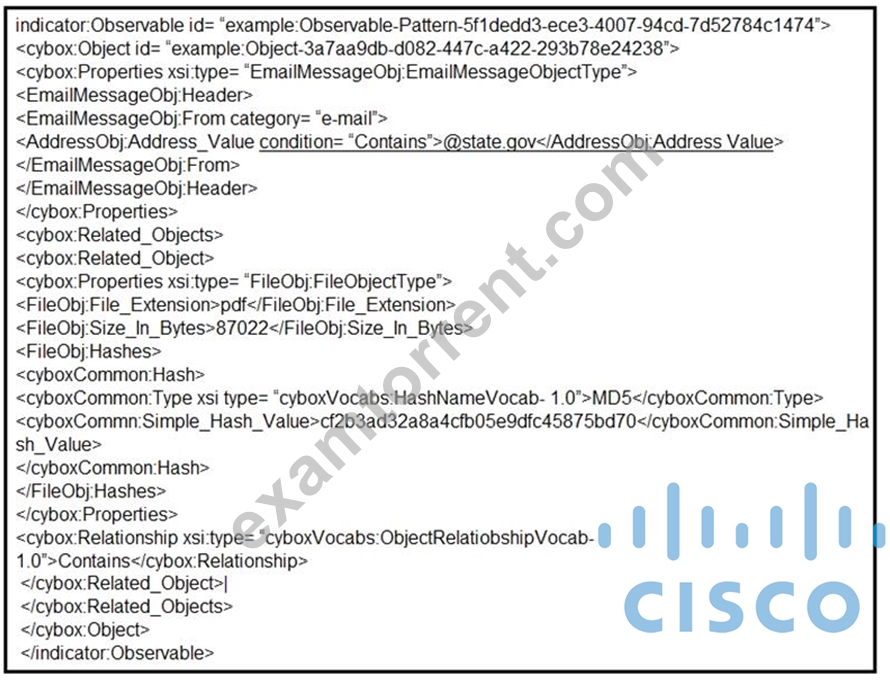
Which two actions should be taken as a result of this information? (Choose two.)
- A. Block emails sent from [email protected] with an attached pdf file with md5 hash "cf2b3ad32a8a4cfb05e9dfc45875bd70".
- B. Block all emails with subject containing "cf2b3ad32a8a4cfb05e9dfc45875bd70".
- C. Update the AV to block any file with hash "cf2b3ad32a8a4cfb05e9dfc45875bd70".
- D. Block all emails with pdf attachments.
- E. Block all emails sent from an @state.gov address.
Answer: C,E
NEW QUESTION # 29
An incident response team is recommending changes after analyzing a recent compromise in which:
a large number of events and logs were involved;
team members were not able to identify the anomalous behavior and escalate it in a timely manner; several network systems were affected as a result of the latency in detection; security engineers were able to mitigate the threat and bring systems back to a stable state; and the issue reoccurred shortly after and systems became unstable again because the correct information was not gathered during the initial identification phase.
Which two recommendations should be made for improving the incident response process? (Choose two.)
- A. Formalize reporting requirements and responsibilities to update management and internal stakeholders throughout the incident-handling process effectively.
- B. Allocate additional resources for the containment phase to stabilize systems in a timely manner and reduce an attack's breadth.
- C. Modify the incident handling playbook and checklist to ensure alignment and agreement on roles, responsibilities, and steps before an incident occurs.
- D. Improve the mitigation phase to ensure causes can be quickly identified, and systems returned to a functioning state.
- E. Implement an automated operation to pull systems events/logs and bring them into an organizational context.
Answer: C,E
NEW QUESTION # 30 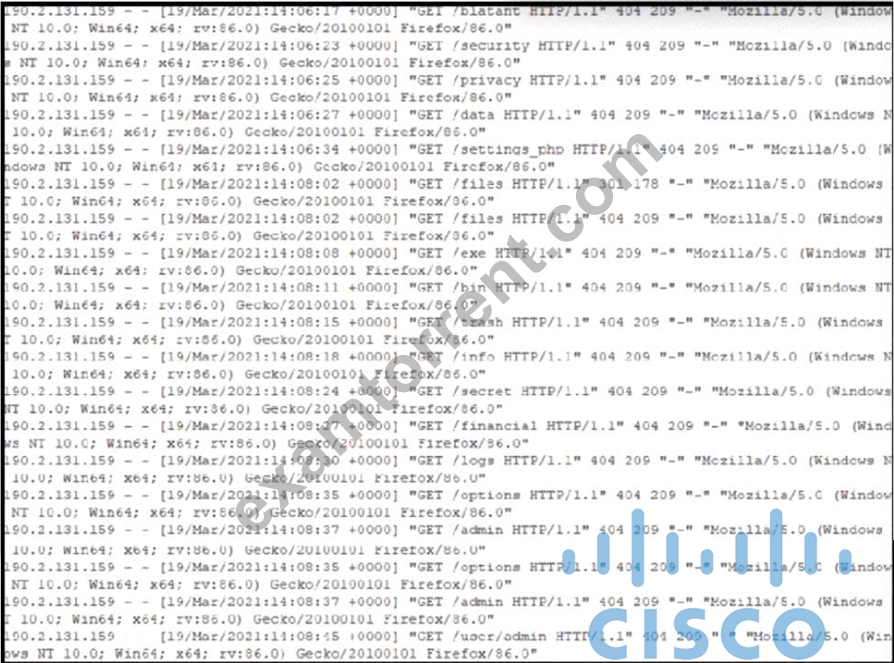
Refer to the exhibit. A security analyst notices that a web application running on NGINX is generating an unusual number of log messages. The application is operational and reachable. What is the cause of this activity?
- A. DDoS attack
- B. SQL injection
- C. botnet infection
- D. directory fuzzing
Answer: D
Explanation:
The provided log file contains multiple HTTP GET requests attempting to access various directories and files on the web server such as:
* /balance
* /security
* /finance
* /secret
* /opt
* /fuzzer/admin
These requests appear to be sequential, systematically targeting commonly used file and directory paths. The response codes are mostly 404 (Not Found) and a few 301s, indicating that the requester is trying different permutations of paths to discover hidden or vulnerable endpoints. This behavior is consistent with directory fuzzing, a reconnaissance technique used by attackers (or automated tools) to map out web directory structures by sending a high volume of crafted requests to guess hidden or unlinked directories and files.
This is distinct from DDoS (which would manifest as volume-based access issues), SQL injection (which targets specific parameters within requests), or botnet infection (which generally involves command-and- control communication or massive traffic floods).
Reference: CyberOps Technologies (CBRFIR) 300-215 study guide, Chapter on Web Attacks and Threat Identification - Directory Fuzzing Patterns.
NEW QUESTION # 31
What is a concern for gathering forensics evidence in public cloud environments?
- A. Timeliness: Gathering forensics evidence from cloud service providers typically requires substantial time.
- B. Multitenancy: Evidence gathering must avoid exposure of data from other tenants.
- C. High Cost: Cloud service providers typically charge high fees for allowing cloud forensics.
- D. Configuration: Implementing security zones and proper network segmentation.
Answer: B
Explanation:
One of the primary concerns when gathering forensic evidence in public cloud environments is the issue of multitenancy. In a shared cloud infrastructure, multiple tenants (organizations or users) operate on the same physical hardware, using virtualization to logically separate resources. This architecture poses a significant challenge for forensic investigations because:
* Forensic investigators must ensure that they do not inadvertently access or expose data belonging to other tenants while collecting evidence.
* This can limit access to low-level system data or hardware-level logs that might be essential for a thorough forensic analysis, since providers must enforce strict data isolation policies.
* This concern is recognized in industry practices and guidelines, including NIST SP 800-86, which underscores the need to collect data in a forensically sound and legally defensible manner-something made more complex in shared environments.
The Cisco CyberOps Associate guide emphasizes the challenges of evidence handling in cloud environments, stating that "gathering evidence in the cloud must be carefully performed to ensure compliance with legal standards and to respect the boundaries of other tenants' data".
Reference:CyberOps Technologies (CBRFIR) 300-215 study guide, Chapter on Digital Forensics and Cloud Environments, Section: Evidence Collection in Shared Infrastructure (Public Cloud).
NEW QUESTION # 32
A threat actor has successfully attacked an organization and gained access to confidential files on a laptop.
What plan should the organization initiate to contain the attack and prevent it from spreading to other network devices?
- A. incident response
- B. root cause
- C. intrusion prevention
- D. attack surface
Answer: A
Explanation:
Once an incident has occurred, the appropriate course of action is to engage the organization's Incident Response (IR) plan. This is a structured approach to contain, analyze, and eradicate threats before they spread across the network.
The Cisco CyberOps Associate study guide emphasizes:
* "Incident response and handling are essential within an organization... The main objective of implementing an incident handling process is to reduce the impact of a cyber-attack, ensure the damages caused are assessed, and implement recovery procedures".
* In particular, the containment phase of IR is focused on isolating the threat and preventing lateral movement or further compromise.
Options such as "root cause" or "attack surface" are relevant at later stages of analysis and mitigation, not immediate containment. Therefore, the correct answer is C.
NEW QUESTION # 33
Refer to the exhibit.
What does the exhibit indicate?
- A. The new file is created under the Software\Classes disk folder.
- B. The shell software is modified via PowerShell.
- C. A UAC bypass is created by modifying user-accessible registry settings.
- D. A scheduled task named "DelegateExecute" is created.
Answer: C
Explanation:
The exhibit shows a PowerShell script that modifies registry keys under:
* HKCU:\Software\Classes\Folder\shell\open\command
This technique is commonly associated with aUAC (User Account Control) bypass. Specifically:
* It creates a new custom shell command path for opening folders.
* The key registry property"DelegateExecute"is set, which is a known bypass method. If set without a value, it may cause Windows to run commands with elevated privileges without showing the UAC prompt.
The use ofHKCU(HKEY_CURRENT_USER) rather thanHKLM(HKEY_LOCAL_MACHINE) allows the attacker to bypass permissions since HKCU is writable by the current user. This registry hijack can be leveraged by a malicious actor to execute arbitrary commands with elevated rights.
This is identified in the Cisco CyberOps study material under "UAC bypass techniques," which describes:
"Attackers often create or modify registry keys like DelegateExecute to hijack the default behavior of applications and elevate privileges".
Thus, option B is correct: the exhibit demonstrates a UAC bypass using user-accessible registry modification.
NEW QUESTION # 34
Refer to the exhibit.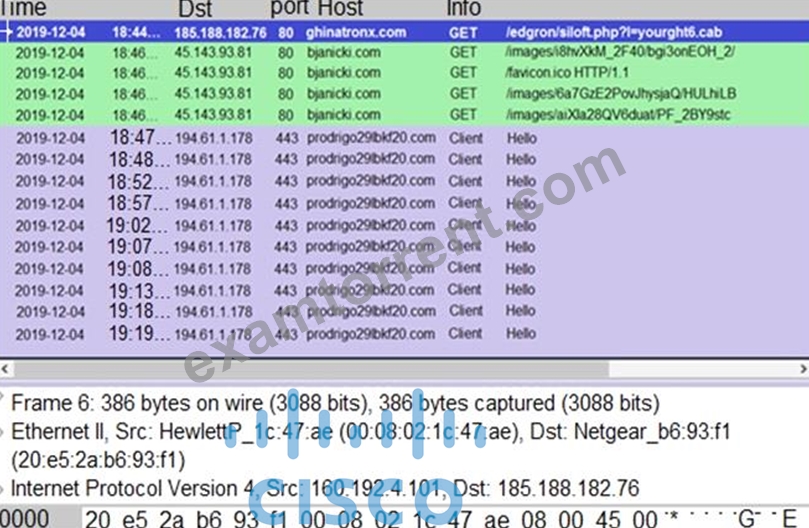
A network engineer is analyzing a Wireshark file to determine the HTTP request that caused the initial Ursnif banking Trojan binary to download. Which filter did the engineer apply to sort the Wireshark traffic logs?
- A. tcp.port eq 25
- B. tls.handshake.type ==1
- C. tcp.window_size ==0
- D. http.request.un matches
Answer: B
Explanation:
Reference:
https://www.malware-traffic-analysis.net/2018/11/08/index.html https://unit42.paloaltonetworks.com/wireshark-tutorial-examining-ursnif-infections/
NEW QUESTION # 35
Data has been exfiltrated and advertised for sale on the dark web. A web server shows:
* Database unresponsiveness
* PageFile.sys changes
* Disk usage spikes with CPU spikes
* High page faults
Which action should the IR team perform on the server?
- A. Analyze the PageFile.sys file in the System Drive and the Virtual Memory configuration
- B. Examine the system.cfg file in the Windows directory for improper system configurations
- C. Check the Memory.dmp file in the Windows directory for memory leak indications
- D. Review the database.log file in the program files directory for database errors
Answer: A
Explanation:
The combination of CPU spikes, disk usage peaks, and fluctuating PageFile.sys indicates excessive virtual memory paging, which may be a sign of malicious memory or file access behavior. PageFile.sys is part of the virtual memory system, and analyzing it can reveal which processes or payloads are consuming unusual amounts of memory, especially during exfiltration events.
NEW QUESTION # 36
Refer to the exhibit.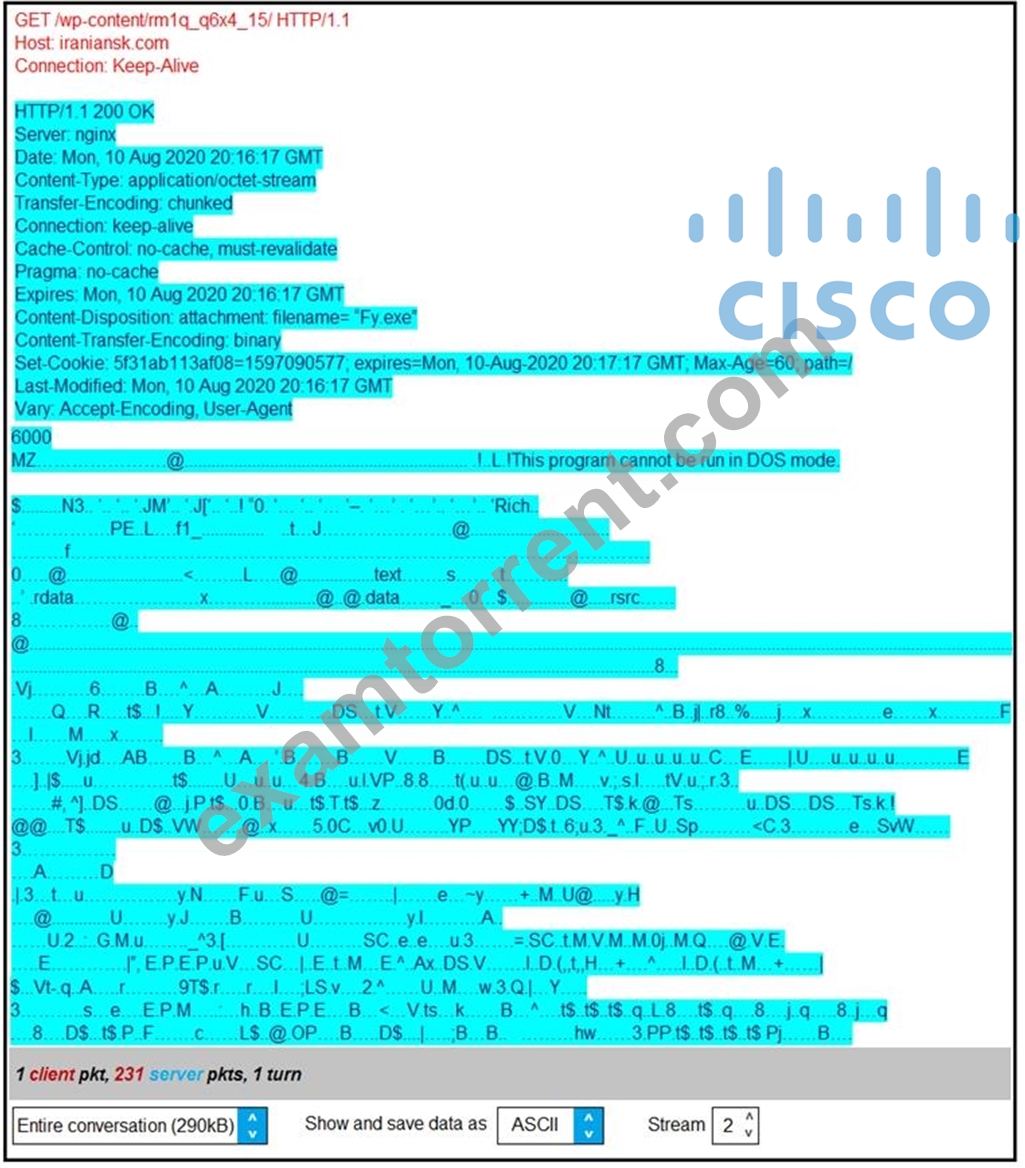
According to the Wireshark output, what are two indicators of compromise for detecting an Emotet malware download? (Choose two.)
- A. Content-Type: application/octet-stream
- B. Hash value: 5f31ab113af08=1597090577
- C. Server: nginx
- D. filename= "Fy.exe"
- E. Domain name: iraniansk.com
Answer: D,E
Explanation:
From the Wireshark capture:
* A (iraniansk.com): This domain isnot a known legitimate resourceand is hosting a suspicious file named "Fy.exe," strongly indicative of amalware distribution domain.
* D (Fy.exe): TheContent-Disposition: attachment; filename="Fy.exe"header explicitly signals abinary executabledownload, a key indicator in Emotet campaigns.
WhileContent-Type: application/octet-stream(E) is typical of binary data transfers, it isnot uniqueto malware and cannot by itself serve as a strong IoC. Thenginx server (B)andcookie/hash string (C)similarly do not uniquely indicate compromise.
NEW QUESTION # 37
A threat intelligence report identifies an outbreak of a new ransomware strain spreading via phishing emails that contain malicious URLs. A compromised cloud service provider, XYZCloud, is managing the SMTP servers that are sending the phishing emails. A security analyst reviews the potential phishing emails and identifies that the email is coming from XYZCloud. The user has not clicked the embedded malicious URL.
What is the next step that the security analyst should take to identify risk to the organization?
- A. Delete email from user mailboxes and update the incident ticket with lessons learned.
- B. Reset the reporting user's account and enable multifactor authentication.
- C. Find any other emails coming from the IP address ranges that are managed by XYZCloud.
- D. Create a detailed incident report and share it with top management.
Answer: C
Explanation:
Since the phishing email originates from a known compromised cloud provider (XYZCloud), the correct immediate action for the security analyst is to determine the broader scope of exposure. This involves checking whether other users in the organization received similar emails from the same potentially malicious source. Therefore, querying for emails from theIP address rangesorSMTP domainslinked to XYZCloud is essential for identifying other possible attack vectors.
This step aligns with the containment phase of the incident response lifecycle, as outlined in theCyberOps Technologies (CBRFIR) 300-215 study guide, where threat hunting and log analysis are used to determine the extent of compromise and prevent lateral movement or further exposure. Only after the scope is understood should remediation or reporting actions follow.
Reference:CyberOps Technologies (CBRFIR) 300-215 study guide, Chapter: Email-Based Threats and Containment Strategy during Incident Response.
NEW QUESTION # 38
Refer to the exhibit.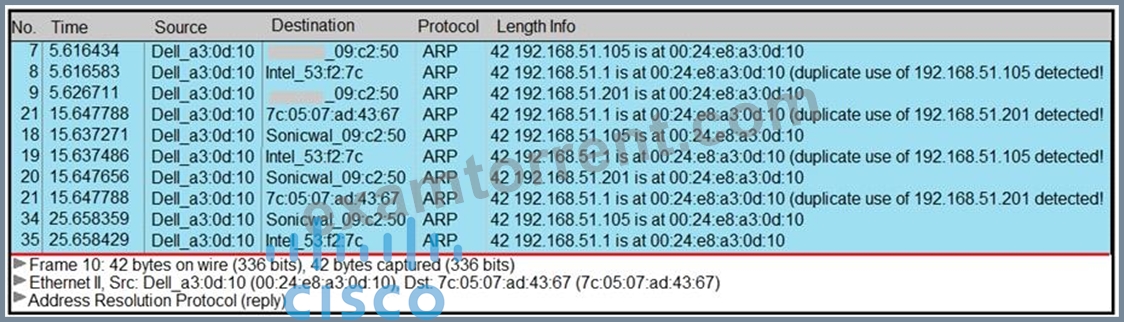
A security analyst notices unusual connections while monitoring traffic. What is the attack vector, and which action should be taken to prevent this type of event?
- A. ARP spoofing; configure port security
- B. DNS spoofing; encrypt communication protocols
- C. MAC flooding; assign static entries
- D. SYN flooding, block malicious packets
Answer: A
NEW QUESTION # 39 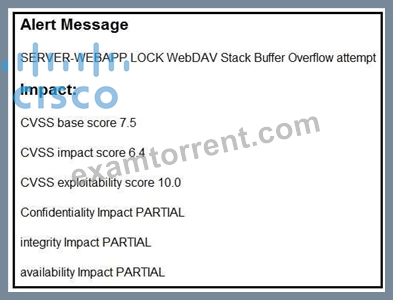
Refer to the exhibit. After a cyber attack, an engineer is analyzing an alert that was missed on the intrusion detection system. The attack exploited a vulnerability in a business critical, web-based application and violated its availability. Which two migration techniques should the engineer recommend? (Choose two.)
- A. heap-based security
- B. address space randomization
- C. encapsulation
- D. data execution prevention
- E. NOP sled technique
Answer: B,D
NEW QUESTION # 40
Refer to the exhibit.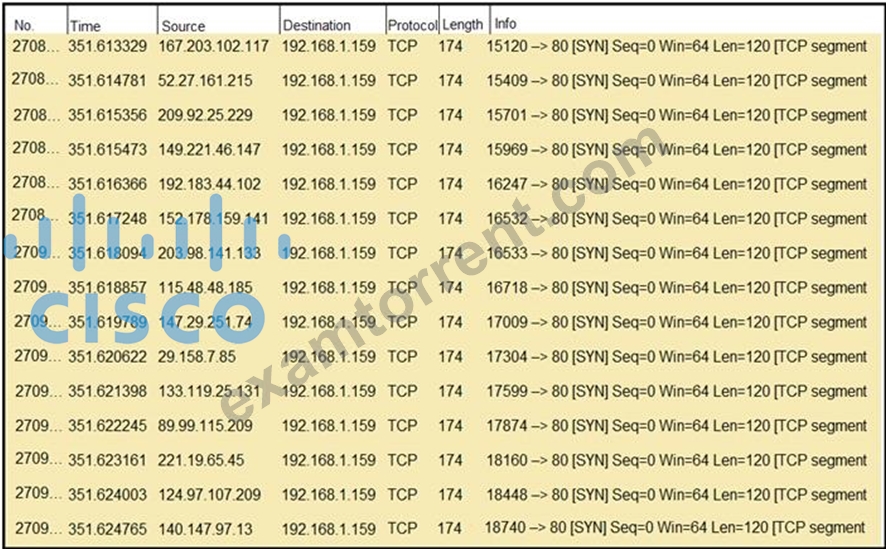
What should an engineer determine from this Wireshark capture of suspicious network traffic?
- A. There are signs of ARP spoofing, and the engineer should use Static ARP entries and IP address-to-MAC address mappings as a countermeasure.
- B. There are signs of a DNS attack, and the engineer should hide the BIND version and restrict zone transfers as a countermeasure.
- C. There are signs of a malformed packet attack, and the engineer should limit the packet size and set a threshold of bytes as a countermeasure.
- D. There are signs of SYN flood attack, and the engineer should increase the backlog and recycle the oldest half-open TCP connections.
Answer: D
NEW QUESTION # 41
An organization fell victim to a ransomware attack that successfully infected 256 hosts within its network. In the aftermath of this incident, the organization's cybersecurity team must prepare a thorough root cause analysis report. This report aims to identify the primary factor or factors that led to the successful ransomware attack and to develop strategies for preventing similar incidents in the future. In this context, what should the cybersecurity engineer include in the root cause analysis report to demonstrate the underlying cause of the incident?
- A. complete threat intelligence report shared by the National CERT Association
- B. log files from each of the 256 infected hosts
- C. method of infection employed by the ransomware
- D. detailed information about the specific team members involved in the incident response effort
Answer: C
Explanation:
According to the Cisco CyberOps Associate guide, the goal of a root cause analysis is to determine how an attacker successfully exploited a system so that similar vulnerabilities can be mitigated in the future. The
"method of infection" (e.g., phishing email with malicious attachment, drive-by download, credential compromise, etc.) is the most relevant factor in understanding the initial access vector and subsequent spread of ransomware across the network.
-
NEW QUESTION # 42
......
The best 300-215 exam study material and preparation tool is here: https://prep4sure.examtorrent.com/300-215-exam-papers.html
