

Verified FCP_ZCS_AD-7.4 dumps Q&As - Pass Guarantee or Full Refund [Nov-2025]
FCP_ZCS_AD-7.4 PDF Dumps | Nov 29, 2025 Recently Updated Questions
NEW QUESTION # 25
What are the primary types of VPN connections supported by Azure for site-to-site connectivity?
(Choose Two)
Response:
- A. Site-to-Site (S2S)
- B. Direct Connect
- C. ExpressRoute
- D. Point-to-Site (P2S)
Answer: A,D
NEW QUESTION # 26
Which aspect of FortiWeb deployment in Azure is critical for ensuring security compliance?
Response:
- A. Data loss prevention
- B. User authentication
- C. SSL offloading
- D. Application layer encryption
Answer: D
NEW QUESTION # 27
What primary security function does FortiWeb serve when deployed in Azure?
Response:
- A. Network traffic management
- B. Web application firewall
- C. Intrusion detection system
- D. Email security
Answer: B
NEW QUESTION # 28
You are deploying a site-to-site IPsec VPN connection between your on-premise subnet and your Azure VNets.
What is the most important advantage for using FortiGate at both ends of the tunnel?
- A. It allows scaling based on performance and capacity requirements
- B. It minimizes the need for encryption in transit
- C. It reduces the need for troubleshooting due to FortiGate automatic configuration
- D. It provides consistent security policies and configurations
Answer: D
Explanation:
Using FortiGate at both ends of a site-to-site IPsec VPN tunnel provides the advantage of applying consistent security policies, configurations, and management tools across both the on-premises and Azure environments. This simplifies policy enforcement, improves operational efficiency, and ensures uniform threat protection.
NEW QUESTION # 29
Refer to the exhibits.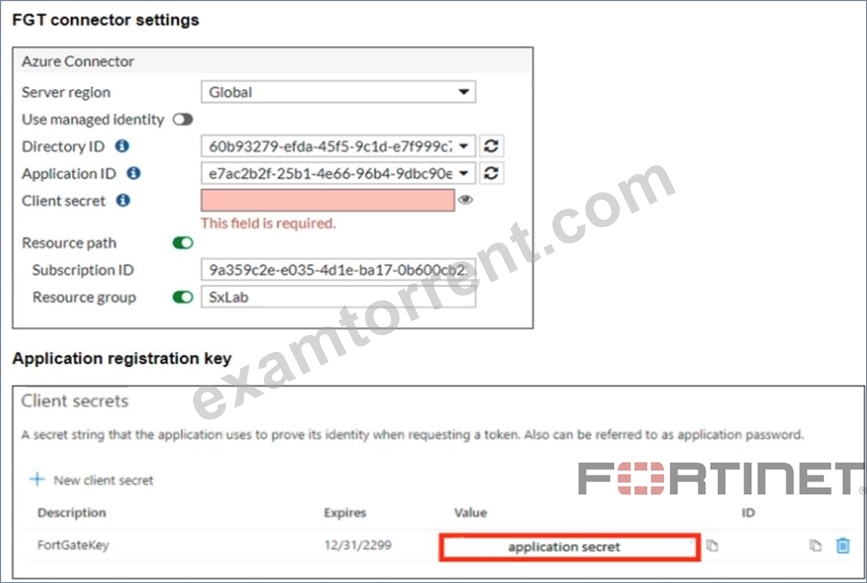
You are configuring an SDN connector for Azure on a FortiGate device You completed all the required steps on the Azure side. While configuring the FortiGate side, you notice that you did not save the client secret used in the Azure App Registration.
What is the quickest way to obtain the value of the client secret?
- A. Create a new external connector for Azure
- B. Create a new resource group
- C. Create a new app registration
- D. Create a new client secret
Answer: D
Explanation:
Azure does not allow you to view an existing client secret's value after creation for security reasons. If you did not save the client secret when it was first generated, the quickest and only option is to create a new client secret under the existing app registration and use the new value in your FortiGate configuration.
NEW QUESTION # 30
What role does Azure Resource Manager play in Azure?
Response:
- A. Provides software updates across different subscriptions
- B. Handles on-premises server integrations
- C. Manages hardware lifecycle
- D. Acts as a deployment and management service
Answer: D
NEW QUESTION # 31
Your organization is in the process of optimizing its Azure network architecture and wants to dynamically manage and exchange routing information between its virtual networks and on-premises networks.
Which Azure service would help to provide a centralized point for efficient route management and dynamic routing?
- A. Azure Route Server
- B. Azure Virtual WAN
- C. Azure ExpressRoute
- D. Azure VPN Gateway
Answer: A
Explanation:
Azure Route Server enables dynamic route exchange using BGP between your Azure virtual network and network virtual appliances (NVAs) or on-premises networks. It provides a centralized and scalable solution for route management, allowing seamless integration of routing updates without manual configuration changes.
NEW QUESTION # 32
After integrating a FortiGate VM with Azure Route Server, you detect that routes are not propagating successfully.
What initial step could you perform to diagnose the root cause?
- A. Examine the Azure Microsoft Entra ID permissions associated with the FortiGate VM to ensure that correct authentication is being used for BGP peering
- B. Monitor the network latency between the FortiGate VM and Azure Route Server to identify potential communication delays affecting route propagation
- C. Verify that the FortiGate VM is running the latest firmware version
- D. Verify the BGP peering status on both the FortiGate VM and Azure Route Server
Answer: D
Explanation:
The first and most direct diagnostic step is to verify the BGP peering status on both the FortiGate VM and Azure Route Server. If BGP peering is not established or is in an idle or down state, route propagation will fail. This check confirms whether the two systems are communicating and exchanging routes as expected.
NEW QUESTION # 33
What does Azure''s Platform as a Service (PaaS) offering eliminate the need for?
Response:
- A. Business analysis tools
- B. Management of underlying infrastructure
- C. Internet connectivity
- D. Application development frameworks
Answer: B
NEW QUESTION # 34
What are two characteristics of Azure standard public IP addresses? (Choose two.)
- A. They can be dynamic or static
- B. They support the use of availability zones
- C. They require the configuration of NSGs for inbound traffic
- D. They can be used with load balancers of any SKU
Answer: A,B
Explanation:
They support the use of availability zones - Standard public IP addresses are zone-redundant and support availability zone deployments for high availability.
They can be dynamic or static - Azure standard public IPs can be configured as static or dynamic, offering flexibility based on deployment needs.
NEW QUESTION # 35
Which component is essential for managing distributed applications across multiple Azure services?
Response:
- A. Azure Active Directory
- B. Azure Logic Apps
- C. Azure DevOps
- D. Azure Service Fabric
Answer: D
NEW QUESTION # 36
In the public cloud, which model incorporates the principle that both the cloud service provider and the cloud customer take care of different tasks in order to secure the environment?
Response:
- A. The shared responsibility model
- B. The cloud security model
- C. The cloud resilience architecture model
- D. The cloud dependency model
Answer: A
NEW QUESTION # 37
Which Azure service provides distributed denial of service (DDoS) protection by monitoring and mitigating potential threats?
Response:
- A. Azure Sentinel
- B. Azure DDoS Protection
- C. Azure Firewall
- D. Azure Application Gateway
Answer: B
NEW QUESTION # 38
What is the main purpose of Azure Virtual WAN?
Response:
- A. To provide decentralized web hosting
- B. To provide physical network security
- C. To manage Windows updates across enterprise networks
- D. To enhance global connectivity and network optimization
Answer: D
NEW QUESTION # 39
What is a requirement when you deploy a FortiGate active-active cluster in Azure?
- A. You must use unicast FGCP to synchronize the configurations.
- B. You must configure both load balancers to allow administrative access.
- C. You must assign the public IP address to an Azure load balancer.
- D. You must configure all FortiGate VMs with three or more interfaces.
Answer: C
Explanation:
In an active-active FortiGate cluster deployment in Azure, you must assign the public IP address to an Azure load balancer. This is required because Azure does not support multiple VMs sharing a single public IP directly. The Azure Load Balancer handles inbound traffic and distributes it to the active FortiGate instances.
NEW QUESTION # 40
What characterizes the branch-to-branch topology in an Azure virtual WAN?
- A. Improved scalability for branch offices connecting to Azure
- B. Enhanced security through centralized traffic management
- C. Increased redundancy through multiple connections to the central hub
- D. Simplified network architecture with reduced hub dependencies
Answer: A
Explanation:
The branch-to-branch topology in Azure Virtual WAN is characterized by direct connectivity between branches through the Virtual WAN backbone, which reduces dependency on centralized hubs. This results in a simplified network architecture, lowering latency and optimizing routing between branch locations.
NEW QUESTION # 41
Which load balancing method should be used in Azure to ensure optimal distribution of traffic across multiple servers?
Response:
- A. IP Hash
- B. Geographic
- C. Least Connections
- D. Round Robin
Answer: C
NEW QUESTION # 42
How does Azure support high-availability in VPN deployments?
Response:
- A. Through automatic scaling
- B. Through geo-redundancy
- C. By allowing multiple VPN gateways per subscription
- D. By using redundant VPN devices
Answer: D
NEW QUESTION # 43
What capabilities does Azure Virtual WAN offer?
(Choose Three)
Response:
- A. Reduced latency for Azure services
- B. Centralized network and policy management
- C. Integrated security with native firewalls and security controls
- D. Automated route management across VPN, ExpressRoute, and Azure connections
- E. Direct on-premises connection via private links
Answer: B,C,D
NEW QUESTION # 44
What does Azure Sentinel primarily manage within the scope of Azure security services?
Response:
- A. Device management
- B. Threat intelligence and analytics
- C. Digital key protection
- D. VPN configurations
Answer: B
NEW QUESTION # 45
......
Fortinet FCP_ZCS_AD-7.4 Exam Syllabus Topics:
| Topic | Details |
|---|---|
| Topic 1 |
|
| Topic 2 |
|
| Topic 3 |
|
FCP_ZCS_AD-7.4 Exam Questions – Valid FCP_ZCS_AD-7.4 Dumps Pdf: https://prep4sure.examtorrent.com/FCP_ZCS_AD-7.4-exam-papers.html
