

The 1Z1-591 PDF Dumps Greatest for the Oracle Exam Study Guide!
Read Online 1Z1-591 Test Practice Test Questions Exam Dumps
NEW QUESTION # 58
Which variable does not use initialization blocks to initialize its values?
- A. Non System Variable
- B. Dynamic Repository Variable
- C. Static Repository Variable
- D. System Variable
Answer: C
Explanation:
Explanation
The value of a static repository value is initialized in the Variable dialog box. This value persists, and does not change until an Oracle BI Administrator decides to change it.
NEW QUESTION # 59
Which option describes how OBIEE Integrates with Planning?
- A. OBIEE primarily accesses Planning using standard Essbase integration techniques.
- B. OBIEE integrates with Planning directly through relational database access.
- C. OBIEE provides complete access to all Planning data through the Analytic Data Model (ADM) layer.
- D. Planning is not a supported OBIEE source.
Answer: A
Explanation:
A:
*Combining Relational and OLAP Data Sources: Oracle's Common Enterprise Information Model allows users to combine data from a relational system and an OLAP source in a single calculation.
For example, a user can compare sales forecasts from an Oracle CRM System with budget data from an Oracle Essbase planning application. To clients of the Common Enterprise Information Model, the forecast and budget data appear to be from the same logical source.
*The Essbase server provides advanced multi-user read and write capabilities, including data update and multi-user recalculation. Business users with front-end tools can write data back to a server and recalculate the data on a server using calculation scripts-key functionality to support sophisticated modeling and planning applications.
*Using aggregate storage, Essbase serves a wide range of analytic needs-financial analysis, planning, budgeting, sales analysis, marketing analysis, supply-chain analysis, and profitability analytics-all from a single analytic infrastructure.
Note 2: Data model for business intelligence The most important component of business intelligence is the concept of 'data model'. data model determinde what kind of analysis that end user could do with the data. It is also an independant concept that could span across different vendor 's product.
Unlike data model of the transaction system, the typical analytic data model is often denormalized and store extra data for analytic query and better query performance while transaction data model use is often normalized and optimized for a few data read and write, which is implemented by jointing many tables.
The most common used analytic data model in business intelligence is call the 'Star schema' data model.
With the Oracle business intelligence system, We could define star schema and dimension data model in the 'logical layer' in the admin tools. The data model in OBIEE could span different data source in physical layer, which means OBIEE have the capability of building one logical data model which is actually connect to different database in the backend
NEW QUESTION # 60
Which three components are part of a cluster server?
- A. Primary Cluster Controller
- B. Web Server
- C. Repository Publishing Directory
- D. Server request Controller
- E. Master Server
Answer: A,B,E
Explanation:
Explanation/Reference:
Oracle BI Cluster Server Components
* Oracle Business Intelligence Cluster Controller: The Cluster Controller determines which BI Server works in the cluster. It monitors the operation of servers in the cluster. The Cluster Controller is deployed in active-passive mode.
* Clustered BI Servers: The BI Cluster Server feature supports up to 16 BI Servers in a network domain to act as a single server. BI Servers in the cluster share requests from multiple Oracle BI clients.
* Master BI Server: A clustered Oracle Business Intelligence Server is designated as the Master BI Server.
The Oracle Business Intelligence Administration Tool connects to the master BI Server for online repository changes.
* Cluster Manager: The Cluster Manager is available in the Administration Tool when a repository is opened in online mode. The Cluster Manager enables Oracle BI Server clustered instances.
NEW QUESTION # 61
In the Oracle Data Warehouse Reference Architecture, which term is not a layer in the data warehouse?
- A. Presentation Data Layer
- B. Master Data Layer
- C. Staging Data Layer
- D. Access and Performance Layer
Answer: A
NEW QUESTION # 62
Which installation option is used to install into an existing Fusion Middleware Home?
- A. Software Only Install
- B. Cannot install into an existing Fusion Middleware Home
- C. Enterprise Install
- D. Simple Install
Answer: A
Explanation:
Explanation
The Software Only Install type installs the Oracle Business Intelligence software binary files in an Oracle home for later configuration as part of a Fusion Middleware deployment.
NEW QUESTION # 63
Oracle BI Server cache setup information is configured by using Enterprise Manager Fusion Middleware control. Which component stores the configuration Information?
- A. Cache table in OBIEE repository
- B. Web Catalogue
- C. NQSConfig.ini
- D. Instanceconfig.xml
Answer: C
Explanation:
Explanation/Reference:
NQSConfig.ini is the main configuration file of Bi Server and contains a lot of parameters.
The parameters in the Query Result Cache Section provide configuration information for Oracle BI Server caching. The query cache is enabled by default. After deciding on a strategy for flushing outdated entries, you should configure the cache storage parameters in Fusion Middleware Control and in the NQSConfig.INI file.
Incorrect answers:
D: On 10g, Instanceconfig.xml is THE parameter file of the BI Presentation server. With the advent of 11g, instanceconfig.xml is also the configuration file of Oracle BI Scheduler The instanceconfig.xml file stores the configuration settings that affect Oracle BI Presentation Services.
NEW QUESTION # 64
To add multiple sources to on existing logical table dimension in the Business Model and Mapping layer, the source of the data must first exist in which option?
- A. Business Aggregate Layer
- B. Presentation Layer
- C. Physical Layer
- D. Web Catalog
Answer: C
Explanation:
Note:
At the highest level, an OBIEE Metadata Repository includes three layers of information:
1.
First, a Physical layer is defined. The metadata layer identifies the source data.
2.Second, a Business Model and Mapping layer is defined. This metadata layer organizes the physical layer into logical categories and records the appropriate metadata for access to the source data.
3.Finally, the Presentation layer is defined. This metadata layer exposes the business model entities for end- user access.
NEW QUESTION # 65
Permissions for Presentation layer objects and Business layer objects that restrict users is configured in which software component?
- A. Oracle Enterprise Manager
- B. WebLogic Server Administration Component
- C. BI Administration Tool
- D. Oracle HTTP Server
Answer: C
Explanation:
Explanation/Reference:
Oracle Business Intelligence Enterprise Edition (OBIEE) Security is managed through:
a) BI Server Security Manager accessed through the BI Server Administration Tool.
* Set permission to business model, tables, columns and subject areas
* Specify filters to limit data accessible by users
* Set authentication options
b) BI Presentation administration accessed through Presentation Web Services.
* Manage Web groups and users
* Set Permissions for Web Catalog items
* Manage privileges and rights given to groups and users
* Control access to dashboards
c) Catalog Manager.
* Set permission for Web Catalog items (Dashboards and Dashboards pages)
NEW QUESTION # 66
What must be done before you can run the Oracle Business Intelligence 11g Installer?
- A. Create required Oracle Business Intelligence schemas in a database
- B. Ensure system meets installation requirements for Fusing Middleware, Oracle Business Intelligence, AND Repository Creation Utility
- C. Obtain BI installation media
- D. Install the WLS Admin Server
- E. Select installation components - OBIEE, BIP, RTD
Answer: A,B,C
Explanation:
Before you can run Oracle Business Intelligence 11g Installer, you must first create required Oracle Business Intelligence schemas in an unhardened database. You use a tool called the Repository Creation Utility (RCU) to create these schemas with the appropriate permissions and data.
Reference: Installation Guide for Oracle Business Intelligence, Additional Oracle Business Intelligence 11g Installer Requirements
NEW QUESTION # 67
An organization has re-implemented one of its systems but has not moved history. One database has data for all years up to 2010 and the other has data for years from 2011 to the present. The organization needs data from the years 2010 and 2011 on a single report. How can you model this in the RPD?
- A. By creating joins in the physical model so it looks like a single table
- B. By creating one logical table sources and checking the "This Source should be combined with other sources at this level" box
- C. By creating two logical table sources and checking the "This Source should be combined with other sources at this level" box leaving the Fragmentation content area blank.
- D. By creating two Logical Fact Tables for each database
- E. By creating two logical table sources, that specify in Content tab using the Fragmentation content areas to specify the years for each source
Answer: E
Explanation:
Explanation
Note: This source should be combined with other sources at this level (check box) Description: Check this box when data sources at the same level of aggregation do not contain overlapping information. In this situation, all sources must be combined to get a complete picture of information at this level of aggregation.
Note 2: To use a source correctly, the Analytics Server has to know what each source contains in terms of the business model. Therefore, you need to define aggregation content for each logical table source of a fact table.
The aggregation content rule defines at what level of granularity the data is stored in this fact table.
Use the Content tab of the Logical Table Source dialog box to define any aggregate table content definitions, fragmented table definitions for the source, and Where clauses (if you want to limit the number of rows returned).
NEW QUESTION # 68
What must be done before you can run the Oracle Business Intelligence 11g Installer?
- A. Obtain BI installation media
- B. Create required Oracle Business Intelligence schemas in a database
- C. Ensure system meets installation requirements for Fusing Middleware, Oracle Business Intelligence, AND Repository Creation Utility
- D. Install the WLS Admin Server
- E. Select installation components - OBIEE, BIP, RTD
Answer: B
Explanation:
Explanation/Reference:
Before you can run Oracle Business Intelligence 11g Installer, you must first create required Oracle Business Intelligence schemas in an unhardened database. You use a tool called the Repository Creation Utility (RCU) to create these schemas with the appropriate permissions and data.
Reference: Installation Guide for Oracle Business Intelligence, Additional Oracle Business Intelligence 11g Installer Requirements
NEW QUESTION # 69
Query limits tab can be accessed through________.
- A. Security Manager, Query tab, Application role dialog box, Permissions
- B. Security Manager, Application Roles tab, Application role dialog box, Permissions
- C. Security Manager, Application Roles tab, Query dialog box, Permissions
- D. Security Manager, Application Roles tab, Application role dialog box, Query Properties
Answer: B
Explanation:
Query environment can be managed by setting query limits (governors) in the Repository (RPD) for particular Application Roles. You should always set query limits for particular application roles rather than for individual users. Steps:
1.Login to Repository using OBIEE Admin Tool
2.Navigate to Manage > Identity
3.Go to Application Role tab, choose the role and double click on it to open.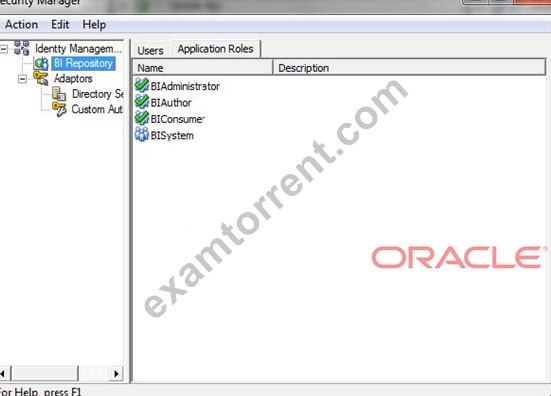
4. Click on Permissions tab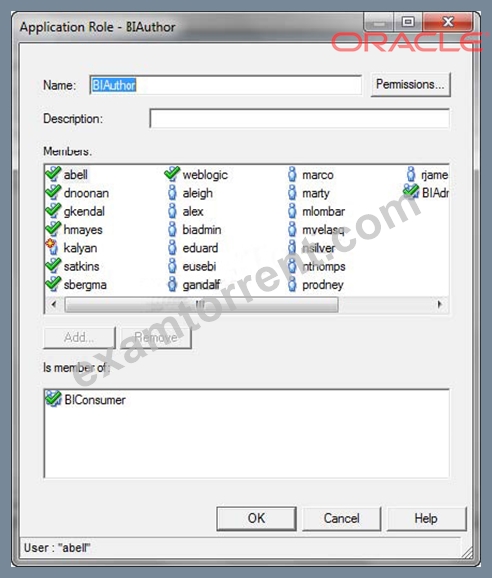
5. Set the Query Limits. You can limit queries by the number of rows received, by maximum run time, and by restricting to particular time periods. You can also allow or disallow direct database requests or the Populate privilege.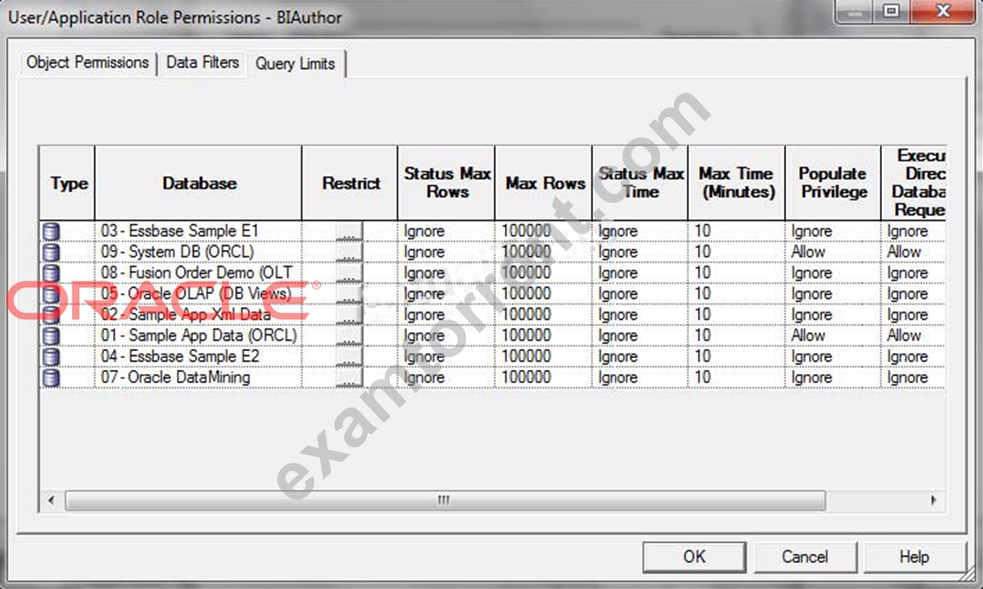
NEW QUESTION # 70
When creating a Security Realm in the WebLogic Console, which object is created?
- A. Server Password
- B. Row Level Filters
- C. Single Sign On
- D. Groups
Answer: D
Explanation:
Explanation/Reference:
Security Realms are an Oracle Platform Security Services concept and bring together sets of users, groups, providers and so on for a WebLogic domain.
NEW QUESTION # 71
When creating an initialization Block, which BI Administration function is used?
- A. Projects Manager
- B. Variable Manager
- C. Job Manager
- D. Identity Manager
Answer: B
Explanation:
Explanation/Reference:
Open up the Administration tool, go to Manage then variables.
See screenshot below.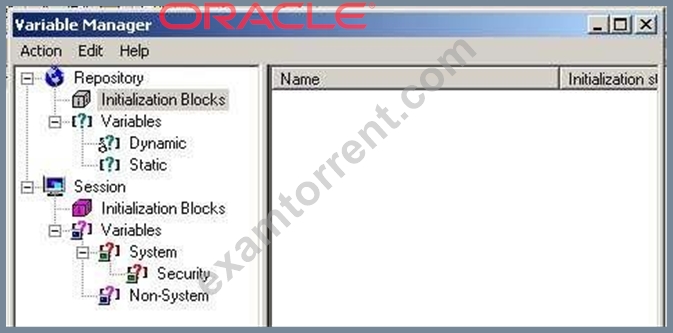
Then follow this picture to create a new Initialization Block.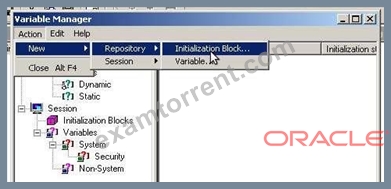
Name your Initialization block init_block_test.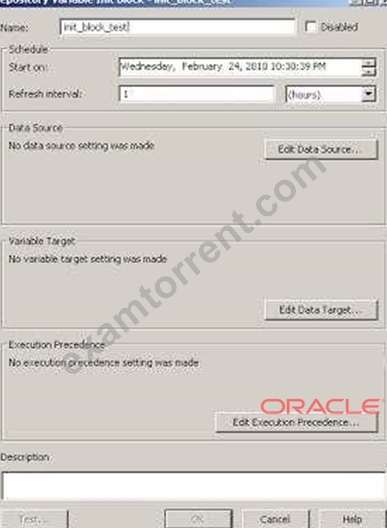
NEW QUESTION # 72
There is a logical fact table that contains Item number, store, time, and revenue. How would you add Number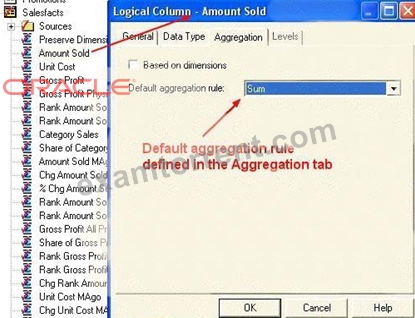
of items sold?
- A. By creating a derived measure based on the physical column item number and changing the aggregation method to count
- B. By creating a derived measure on the logical column item number and using the count distinct function
- C. By creating a derived measure on the logical column Item number and using the count Function
- D. By creating a derived metric by using the Expression Builder
Answer: A
Explanation:
Explanation
A measure column is a column unlike the baseline column that has a default aggregation rule defined in the Aggregation tab of the Logical Column dialog in the repository.
Measure columns always calculate the aggregation with which they are defined.
Measures need to be defined in a logical fact. Any column with an aggregation rule is a measure.
http://gerardnico.com/wiki/_media/dat/obiee/bi_server/design/obiee_measure_column.jpg
NEW QUESTION # 73
The customer is questioning the necessity to have a data warehouse in place. They want to run OBIEE against various transactional systems. Identify the two limitations.
- A. Operational system might be overburdened with analytical requests resulting in had performance for transactional processes.
- B. Dataquality issues might emerge, due to missing data cleansing.
- C. TheBIserver cannot integrate various sourcesin one metadata model.
- D. Business issues are depending on real-time data.
Answer: A,B
NEW QUESTION # 74
The highest sales amount for this year is $10,000. If you create a rank measure for sales this year and display it on a report, the value will be________.
- A. 0
- B. $10,000
- C. 1
- D. Year
Answer: C
Explanation:
Explanation
The rank measure is numbered from 1. The highest sales amount will be ranked 1.
NEW QUESTION # 75
......
1Z1-591 Certification All-in-One Exam Guide Sep-2025: https://prep4sure.examtorrent.com/1z1-591-exam-papers.html
