

UiPath-ADPv1 Dumps PDF 2026 Program Your Preparation EXAM SUCCESS
Get Perfect Results with Premium UiPath-ADPv1 Dumps Updated 206 Questions
UiPath UiPath-ADPv1 Exam Syllabus Topics:
| Topic | Details |
|---|---|
| Topic 1 |
|
| Topic 2 |
|
| Topic 3 |
|
| Topic 4 |
|
NEW QUESTION # 28
When developing a process, you were provided with two data tables, "DT1" and "DT2", as shown below: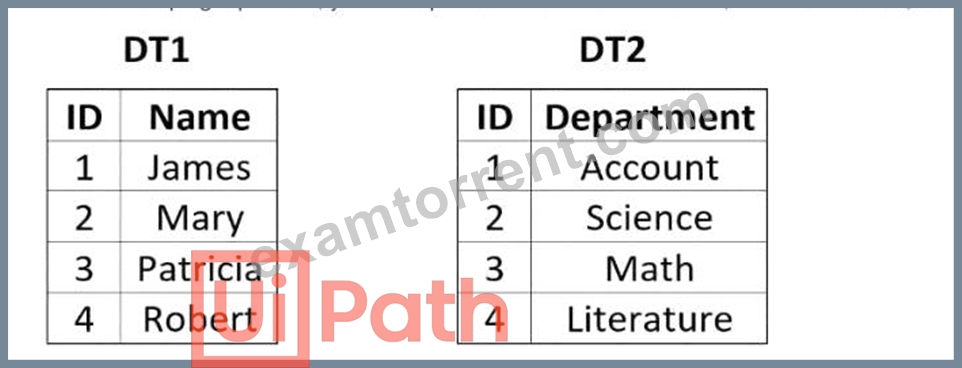
The process documentation specifies that the two data tables need to be manipulated in order to reflect the following "DT2":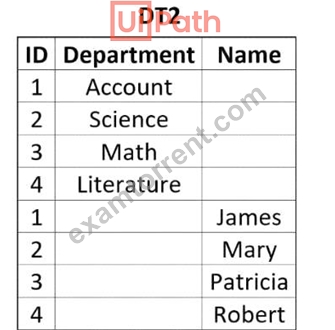
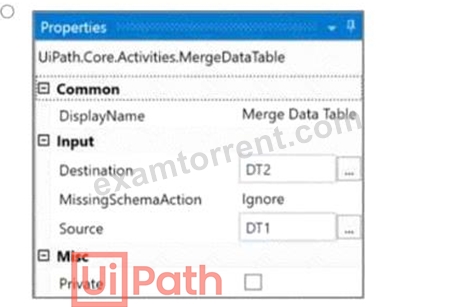
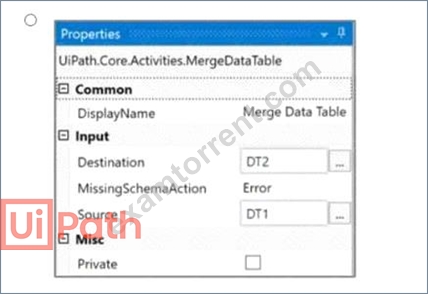
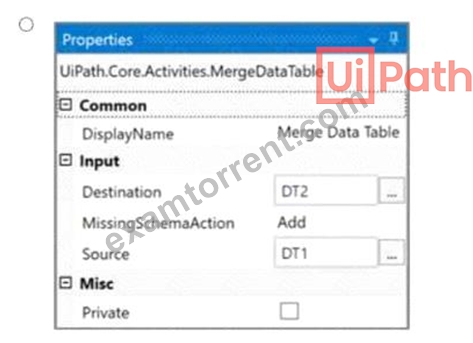
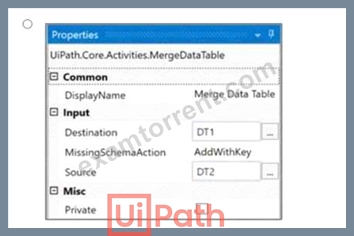
How should the properties of the Merge Data Table activity be configured?
- A.
- B.
- C.
- D.
Answer: D
Explanation:
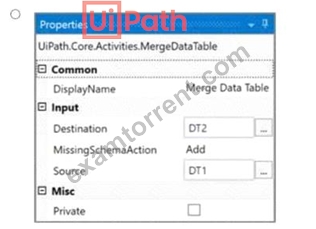
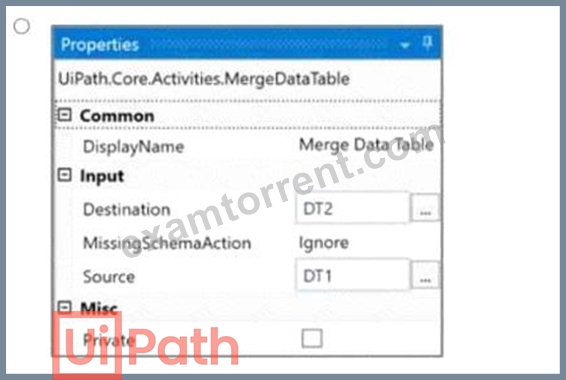
Given the two data tables DT1 and DT2, to achieve the desired result where DT2 contains both the department and the names, the Merge Data Table activity should be configured to merge DT1 into DT2. This configuration requires specifying DT1 as the source table and DT2 as the destination table. The MissingSchemaAction should be set to AddWithKey which ensures that if the source table (DT1) contains columns that are not found in the destination table (DT2), they will be added to the destination table with the primary key information preserved.
Option A shows the correct configuration for the Merge Data Table activity to achieve this result:
Destination: DT1
Source: DT2
MissingSchemaAction: AddWithKey
This setup correctly adds the "Name" column from DT1 to DT2 based on the shared "ID" column, which acts as the key. Since both tables have an "ID" column with matching values, the names will be added to the corresponding IDs in DT2, resulting in a merged table with ID, Department, and Name columns.
NEW QUESTION # 29
A developer needs to design a process using the REFramework. but without Orchestrator Queues. Which Is the correct order of actions the developer needs to do in the Get Transaction Data state in this case?
- A. 1. Remove the Get Transaction Item activity from GetTransactionData workflow
2. Add a Read Range activity in GetTransactionData workflow to read the data from a local Excel file.
3. Add the logic required to read the data source only one time.
4. Add the logic required to retrieve only one row from read data each time. - B. 1. Remove the Get Transaction Item activity from GetTransactionData workflow.
2. Add a Read Range activity in GetTransactionData workflow to read the data from a local Excel file.
3. Add the logic required to read the data source only one time.
4 Add the logic required to retrieve only one row from read data each time
5. Add the logic required to check if all rows/transaction items from the read data have been processed. - C. 1. Remove the Get Transaction Item activity from GetTransactionData workflow.
2. Add a Read Row activity in GetTransactionData workflow to read the data from a local Excel file.
3. Add the logic required to read the data source only one time.
4. Add the logic required to check if all rows/transaction items from the read data have been processed - D. 1. Remove the Get Transaction Item activity from GetTransactionData workflow.
2. Add a Read Row activity in GetTransactionData workflow to read the data from a local Excel file.
3. Add the logic required to read the data source only one time.
4. Add the logic required to retrieve only one row from read data each time.
5. Add the logic required to check if all rows/transaction items from the read data have been processed.
Answer: B
Explanation:
* The correct order of actions in the Get Transaction Data state is:
* Remove the Get Transaction Item activity from the GetTransactionData workflow.
* Add a Read Range activity in the GetTransactionData workflow to read the data from a local Excel file.
* Add the logic required to read the data source only one time.
* Add the logic required to retrieve only one row from read data each time.
* Add the logic required to check if all rows/transaction items from the read data have been processed.
* This sequence ensures that the data is read once, processed row by row, and checks for completion.
NEW QUESTION # 30
Which of the following best describes the Alerts panel?
- A. A panel that displays alerts as they occur.
- B. A panel that displays summaries of the alerts you subscribed to, received as error reports every ten minutes, or as daily reports.
- C. A panel that displays the most severe five alerts, accessible from the Alerts bell.
- D. A panel that displays a more comprehensive list of all alerts.
Answer: B
Explanation:
The Alerts panel in UiPath is a feature designed to notify users about different types of alerts or events that occur within the UiPath ecosystem, especially within the Orchestrator. These can range from job failures, trigger notifications, to queue item alerts.
The best description of the Alerts panel, considering typical functionality within such systems, would be:
B: A panel that displays summaries of the alerts you subscribed to, received as error reports every ten minutes, or as daily reports.
This option suggests that the Alerts panel provides a curated view of alerts based on subscriptions, which can be configured for error reports at specified intervals or for aggregate daily reports, making it a more proactive and user-specific feature.
The other options either describe a panel with too broad a scope (A), suggest real-time alerting without the context of user subscriptions (C), or limit the display to only the most severe alerts without mention of subscription or reporting features (D).
NEW QUESTION # 31
A developer designed a process in the REFramework using Orchestrator queues. In which state(s) will be the status updated for each Transaction Item in the queue?
- A. Initialization and Process Transaction.
- B. Get Transaction Data and Process Transaction.
- C. Process Transaction only.
- D. Initialization and Get Transaction Data.
Answer: B
Explanation:
In the REFramework using Orchestrator queues, the status of each Transaction Item in the queue is updated in two states: 'Get Transaction Data' and 'Process Transaction'. This ensures proper tracking and processing of each item.
NEW QUESTION # 32
Which major sections can be added or modified in the State activity of a UiPath project that uses State Machines?
- A. Entry actions, Exit actions, Guard conditions, and Transitions.
- B. Entry actions, Exit actions, Guard and Trigger attributes, and Transitions.
- C. Entry actions. Exit actions, Conditional expressions, and Transitions.
- D. Entry actions. Exit actions, Trigger conditions, and Transitions.
Answer: A
Explanation:
The State activity is a container for using State Machine specific activities. It can be added or modified in the State Machine activity, which is a type of automation that uses a finite number of states in its execution1. The State activity contains three major sections: Entry, Exit, and Transition(s)2.
The Entry section enables the user to add entry actions for the selected state, which are executed when the state is entered.
The Exit section enables the user to add exit actions for the selected state, which are executed when the state is exited.
The Transition(s) section displays all the transitions linked to the selected state, which are represented by arrows or branches between states. Each transition can be expanded to view or edit its three subsections: Trigger, Condition, and Action2.
The Trigger subsection enables the user to add a trigger for the next state, which is an activity that initiates the transition.
The Condition subsection enables the user to add a guard condition for the transition, which is a Boolean expression that must be true for the transition to occur.
The Action subsection enables the user to add an action for the transition, which is an activity or sequence that is executed before the transition occurs.
Option D is the correct answer, as it lists the major sections that can be added or modified in the State activity of a UiPath project that uses State Machines. Option A is incorrect, as there is no Conditional expressions section in the State activity. Option B is incorrect, as there are no Guard and Trigger attributes sections in the State activity, but rather subsections in the Transition(s) section. Option C is incorrect, as there is no Trigger conditions section in the State activity, but rather a subsection in the Transition(s) section.
References: 1: State Machine 2: State
NEW QUESTION # 33
What is the correct execution order of the State activity sections?
instructions: Drag the Description found on the "Left" and drop on the correct Execution Order found on the
"Right"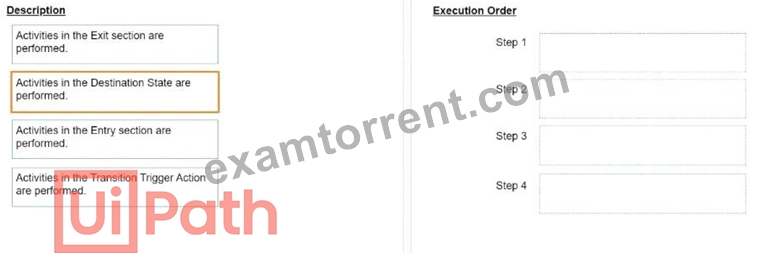
Answer:
Explanation: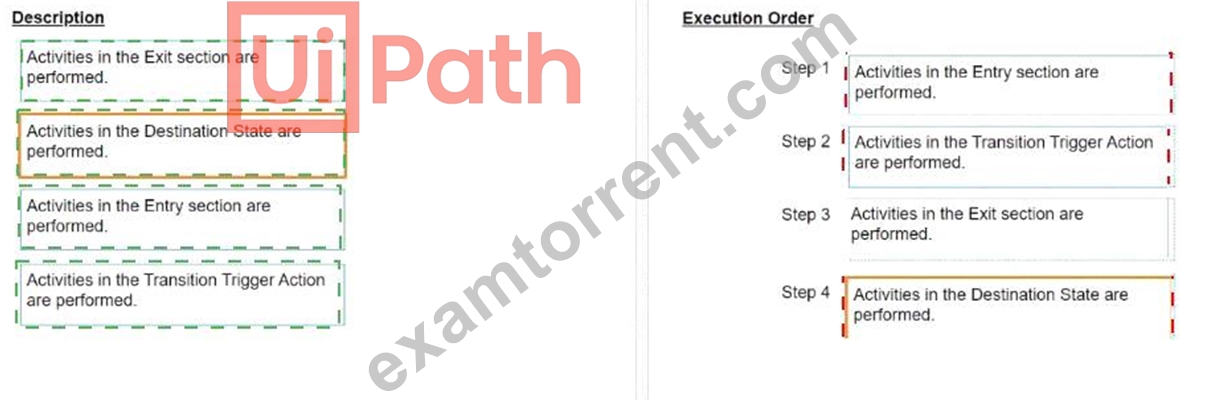
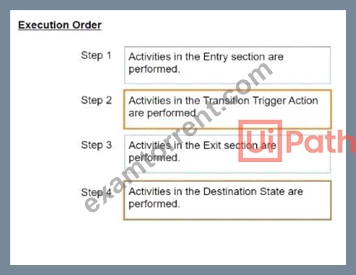
NEW QUESTION # 34
What functionality does the Step Out action offer when a developer Is reviewing a process during debugging, as shown in the exhibit?
- A. Executes only one activity at a time and then pauses the execution
- B. Steps out and stops current execution.
- C. Executes activities in the current container and then pauses the execution
- D. Re-executes the activity which threw an exception.
Answer: C
Explanation:
The "Step Out" action in UiPath Studio's debugging tools allows the developer to finish executing the current container (such as a sequence, loop, or workflow) and returns to the next higher level in the call stack.
Essentially, it continues the execution of activities within the current container without stepping into any invoked workflows or activities.
The correct functionality provided by the "Step Out" action is:
D: Executes activities in the current container and then pauses the execution after stepping out to the next higher level in the call stack.
NEW QUESTION # 35
Which of the following is a tag in a selector?
- A. id='selMonth'
- B. <html app-msedge.exe' title-Find Unicorn Name' />
- C. class-down-chevron set-font'
- D. aaname='FirstName'
Answer: B
Explanation:
A tag in a selector is a node that represents a UI element or a container of UI elements. A tag has the following format: <ui_system attr_name_1='attr_value_1' ... attr_name_N='attr_value_N'/>. A tag can have one or more attributes that help identify the UI element uniquely and reliably1. For example, the tag <html app-msedge.exe' title-Find Unicorn Name' /> represents the HTML document of a web page opened in Microsoft Edge browser, with the title "Find Unicorn Name". The attributes app-msedge.exe and title-Find Unicorn Name help distinguish this tag from other HTML documents.
The other options are not tags, but attributes. An attribute is a property of a UI element that has a name and a value. For example, id='selMonth' is an attribute that indicates the ID of a UI element is
"selMonth". Attributes are used inside tags to specify the UI element or container1.
References:
1: Studio - About Selectors - UiPath Documentation Portal
NEW QUESTION # 36
When developing a process, you were provided with two data tables, "DT1" and "DT2", as shown below: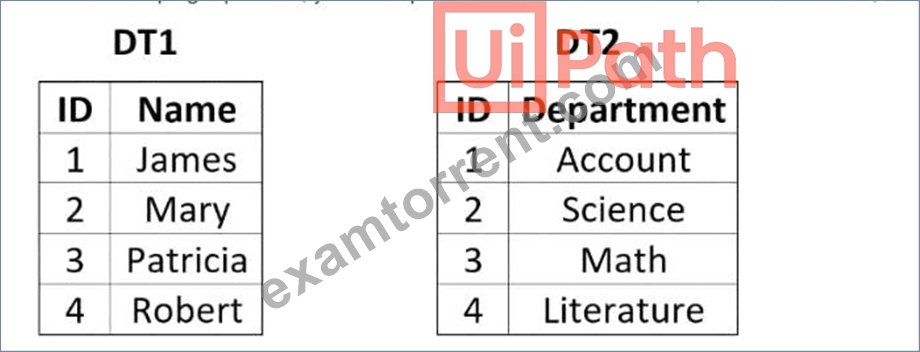
The process documentation specifies that the two data tables need to be manipulated in order to reflect the following "DT2":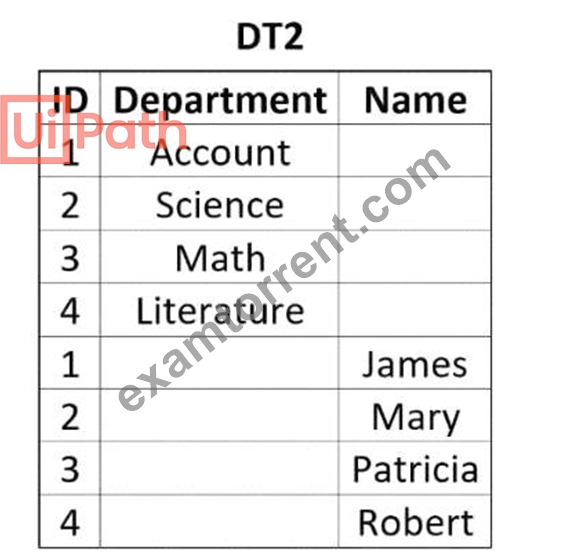
How should the properties of the Merge Data Table activity be configured?
- A.
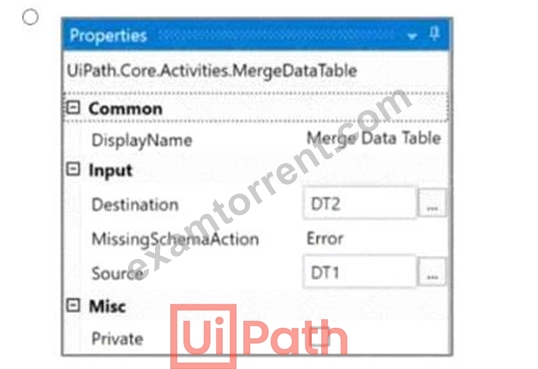
- B.
- C.
- D.
Answer: D
Explanation:
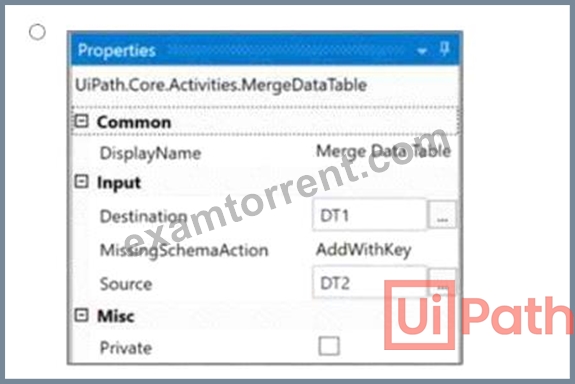
Given the two data tables DT1 and DT2, to achieve the desired result where DT2 contains both the department and the names, the Merge Data Table activity should be configured to merge DT1 into DT2. This configuration requires specifying DT1 as the source table and DT2 as the destination table. The MissingSchemaAction should be set to AddWithKey which ensures that if the source table (DT1) contains columns that are not found in the destination table (DT2), they will be added to the destination table with the primary key information preserved.
Option A shows the correct configuration for the Merge Data Table activity to achieve this result:
Destination: DT1
Source: DT2
MissingSchemaAction: AddWithKey
This setup correctly adds the "Name" column from DT1 to DT2 based on the shared "ID" column, which acts as the key. Since both tables have an "ID" column with matching values, the names will be added to the corresponding IDs in DT2, resulting in a merged table with ID, Department, and Name columns.
NEW QUESTION # 37
A developer implemented a process using the Robotic Enterprise Framework and an Orchestrator queue. The MaxRetryNumber from the "Config.xlsx" file is set to "1" and the Max # of retries from the Queue settings from Orchestrator is set to "2". At runtime, the first transaction item throws a Business Exception.
How many times will the transaction be retried?
- A. The transaction will be retried multiple times, until it will be processed successfully.
- B. The transaction will not be retried.
- C. The transaction will be retried only one time.
- D. The transaction will be retried 2 times.
Answer: C
Explanation:
The transaction will be retried only one time because the MaxRetryNumber from the "Config.xlsx" file is set to "1". This parameter determines how many times a transaction item is retried when it fails with an application or a business exception. The Max # of retries from the Queue settings from Orchestrator is set to
"2", but this parameter only applies to the queue items that are marked as "Retry" by the robot. In the Robotic Enterprise Framework, the SetTransactionStatus workflow marks the queue items as "Retry" only if the MaxRetryNumber is not reached. Therefore, the first transaction item will be retried once by the robot and then marked as "Failed" in the queue, regardless of the Orchestrator setting.
NEW QUESTION # 38
Which of the following is an outcome of converting a personal workspace into a folder in UiPath Orchestrator?
- A. The owner of the initial workspace and the admin user are added by default to the newly created folder and assigned the Personal Workspace Administrator role.
- B. The owner of the initial workspace loses access to the newly created folder and the existing admin users are added by default.
- C. The admin user is added by default to the newly created folder with the User Administrator role.
- D. The owner of the initial workspace is added by default to the newly created folder and assigned the Folder Administrator role.
Answer: D
NEW QUESTION # 39
What do the percentages from the Test Explorer panel represent?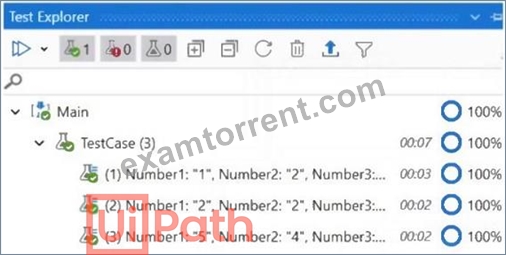
- A. Coverage percent.
- B. Percent of test data run.
- C. Correctness of the code percent.
- D. Passing percent.
Answer: D
NEW QUESTION # 40
A developer is using the REFramework template to automate a process. In "SetTransactionStatus" file, there is the following sequence of activities, where the last Log Message activity was added by the developer: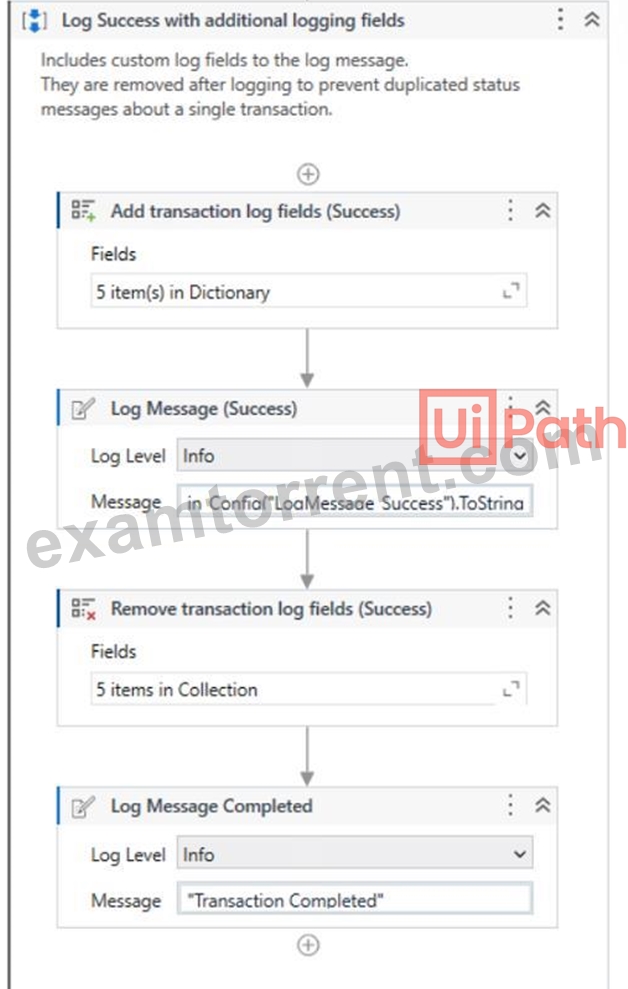
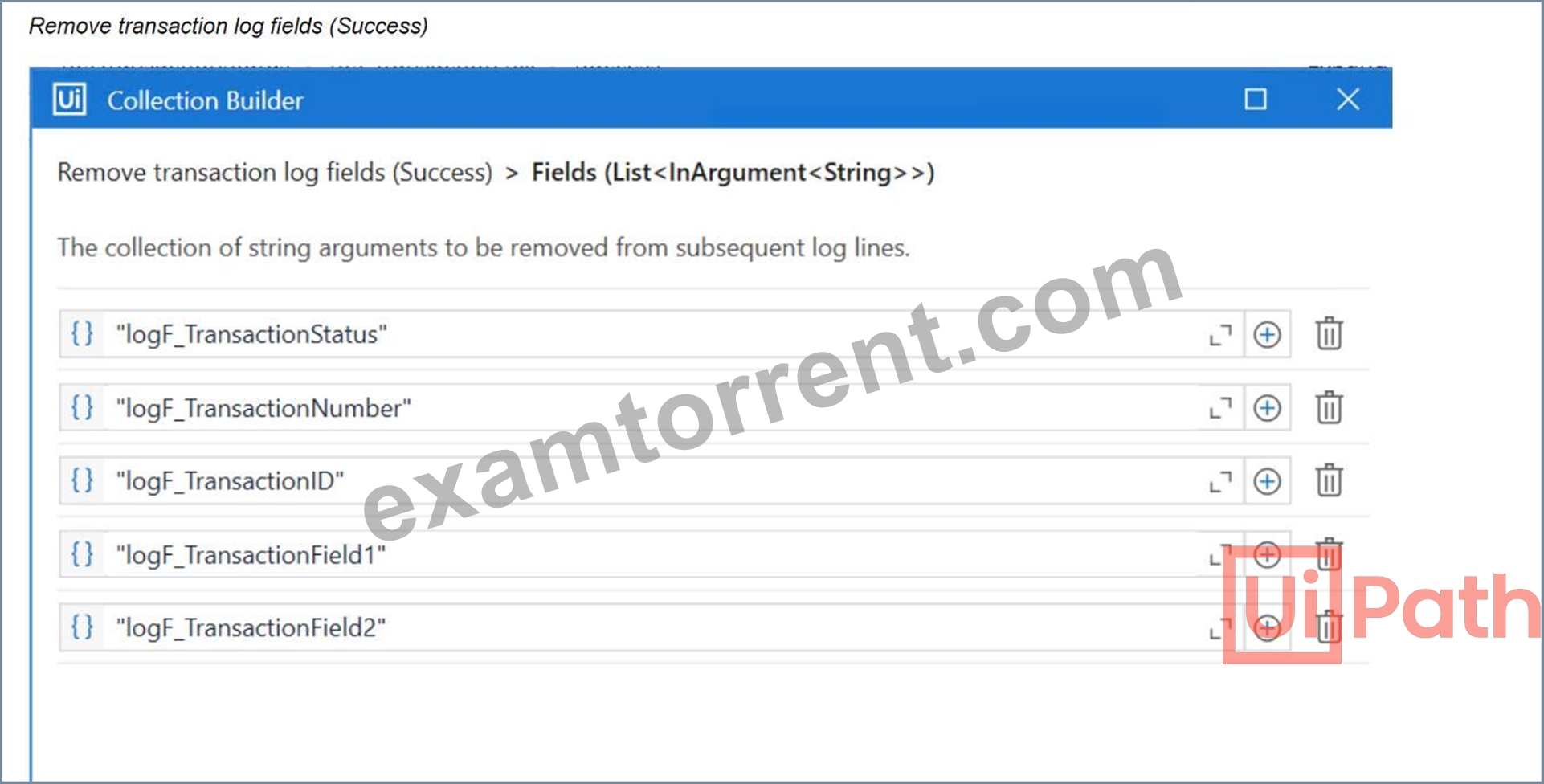
The configuration for Add Log Fields and Remove Log Fields activities are shown below:
Add transaction log fields (Success)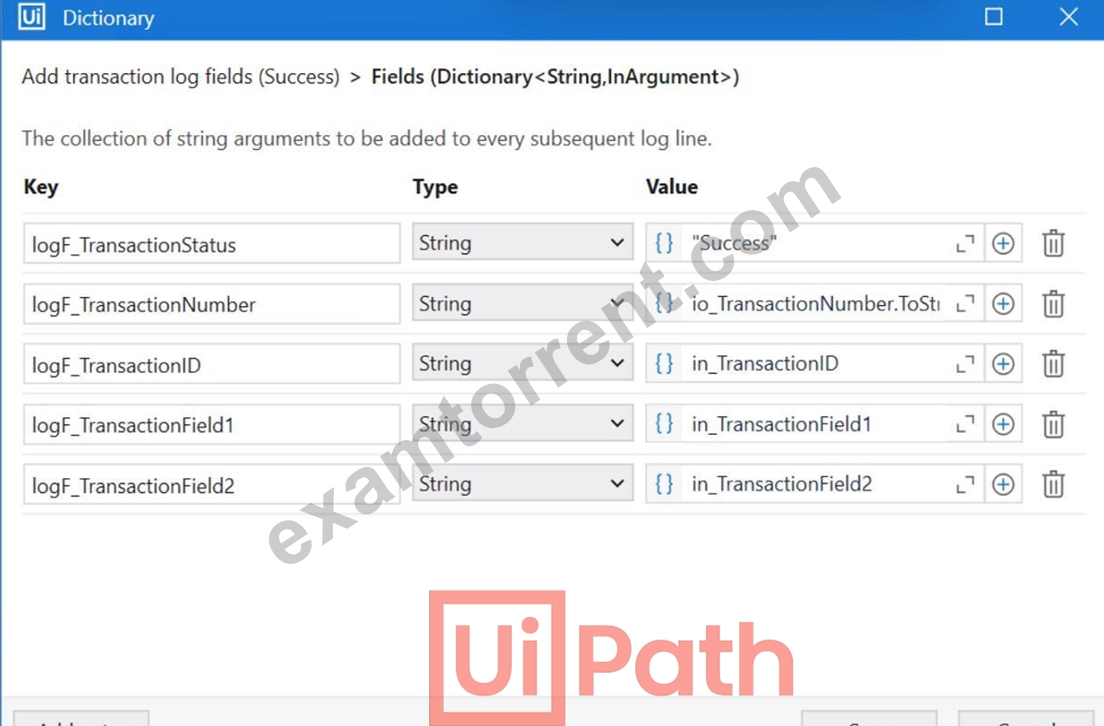
The developer runs the process and notices the argument values for the first transaction are:
in_TransactionID = "07/18/2023 10:27:29"
io_TransactionNumber = 1
in_TransactionField1 = "UI235-80"
in_TransactionField2 = "Update Request"
Which of the following Log Message Details will be displayed when executing the activity Log Message Completed for the first transaction, considering it is successful?
- A. {"message": "Transaction Completed","level": "Information","logType": "User","timeStamp": "10:30:
19","fileName": "SetTransactionStatus","processVersion": "1.0.0","jobId": "59325301-680a-4d55-a81b-
56ca1f369c12","robotName": "test.robot","machineId": 0,"logF_TransactionField2": empty," logF_TransactionStatus": empty,"logF_TransactionID": empty,"logF_BusinessProcessName":
"Framework","logF_TransactionNumber": empty,"logF_TransactionField1": empty} - B. {"message": "Transaction Completed","level": "Information","logType": "User","timeStamp": "10:30:
19","fileName": "SetTransactionStatus","processVersion": "1.0.0","jobId": "f8a36a46-8ebc-40df-8f71-
26b39087ebee","robotName": "test.robot","machineId": 0,"logF_BusinessProcessName":
"Framework"} - C. {"message": "Transaction Completed","level": "Information","logType": "User","timeStamp": "10:30:
19","fileName": "SetTransactionStatus","processVersion": "1.0.0","jobId": "cb865477-35f8-4c0a-93e9- e4f4246223f2","robotName": "test.robot","machineId": 0,"logF_TransactionField2": "Update Request","logF_TransactionID": "07/18/2023 10:27:29","logF_BusinessProcessName": "Framework"," logF_TransactionNumber": "1","logF_TransactionField1": "UI235-80","logF_TransactionStatus":
"Success"} - D. {"message": "Transaction Completed","level": "Information","logType": "User","timeStamp": "10:30:
19","fileName": "SetTransactionStatus","processVersion": "1.0.0","jobId": "59325301-680a-4d55-a81b-
56ca1f369c12","robotName": "test.robot","machineId": 0,"logF_TransactionField2": ""," logF_TransactionStatus": "","logF_TransactionID":"logF_BusinessProcessName": "Framework"," logF_TransactionNumber": "","logF_TransactionField1": ""}
Answer: B
Explanation:
In the REFramework, the Add Log Fields activity is used to append additional information to the log messages. This information is stored in the form of custom fields. In this scenario, Add Log Fields (Success) activity is adding several fields with the transaction details whenever a transaction is successful.
The Remove Log Fields activity is then used to delete these custom fields to prevent them from appearing in subsequent log messages. This is important to ensure that only relevant information is logged for each transaction and to avoid cluttering the logs with outdated information.
When the Log Message Completed activity is executed after the Remove Log Fields activity, it should log the message without the additional fields that were added by the Add Log Fields activity since they have been removed. This means that the log message should only include the standard fields like message, level, logType, timeStamp, fileName, processVersion, jobId, robotName, and machineId, without the custom fields like logF_TransactionStatus, logF_TransactionNumber, etc.
Based on the options provided and the understanding of the REFramework's logging mechanism, the correct answer should be:
D: { "message": "Transaction Completed", "level": "Information", "logType": "User", "timeStamp": "10:30:
19", "fileName": "SetTransactionStatus", "processVersion": "1.0.0", "jobId": "f8a36a46-8ebc-40df-8f71-
26b39087ebee", "robotName": "test.robot", "machineId": 0, "logF_BusinessProcessName": "Framework" } This option is correct because it shows a log message after the removal of custom fields, retaining only the logF_BusinessProcessName field, which wasn't specified to be removed according to the provided information.
NEW QUESTION # 41
While troubleshooting a process developed using the Robotic Enterprise (RE) Framework, you have placed a breakpoint at the "Invoke InitAllSettings" workflow activity.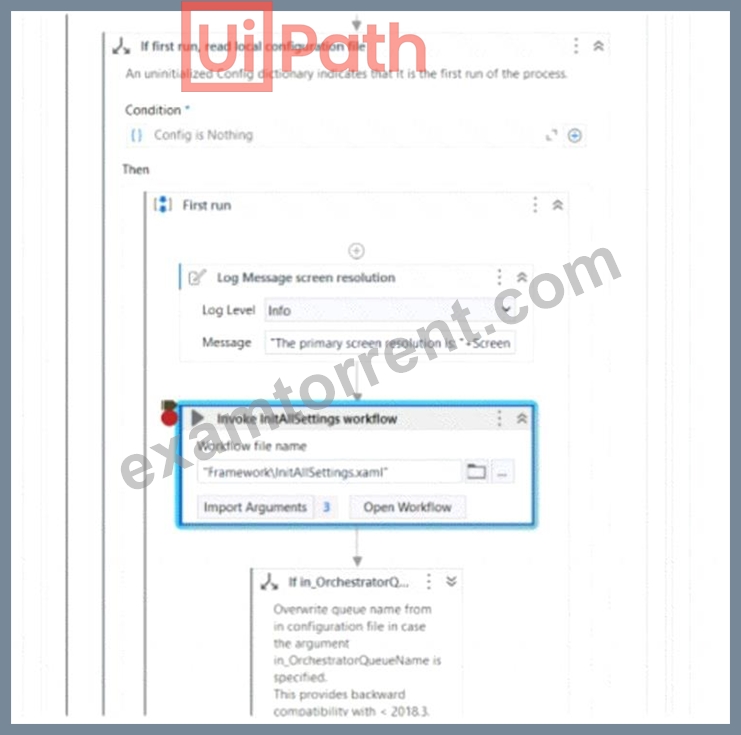
Given the current state of the Executor, what will occur when you click on the Step Over button?
Executor directs to the "If in_OrchestratorQ ... " activity
Executor directs to the first InitAllSettings workflow activity
Executor directs to the first activity outside "If first run, read local configuration" Executor directs to the "First Run" sequence Explanation:
Answer:
Explanation:
When a breakpoint is placed at a particular activity within the workflow and the Step Over function is used, the Executor will move to the next activity in the sequence. Given the context of the REFramework, after stepping over the "Invoke InitAllSettings" workflow, the next activity that would execute is the "If in_OrchestratorQueueName ..." activity, assuming there are no activities in between within the
"InitAllSettings" workflow itself. Step Over will not go into the invoked workflow but will move to the next activity at the same level of the workflow where the breakpoint was placed.References:
UiPath Studio Guide: Debugging
NEW QUESTION # 42
A developer configured the properties for a Click activity on an element inside a web page as shown in the following exhibit.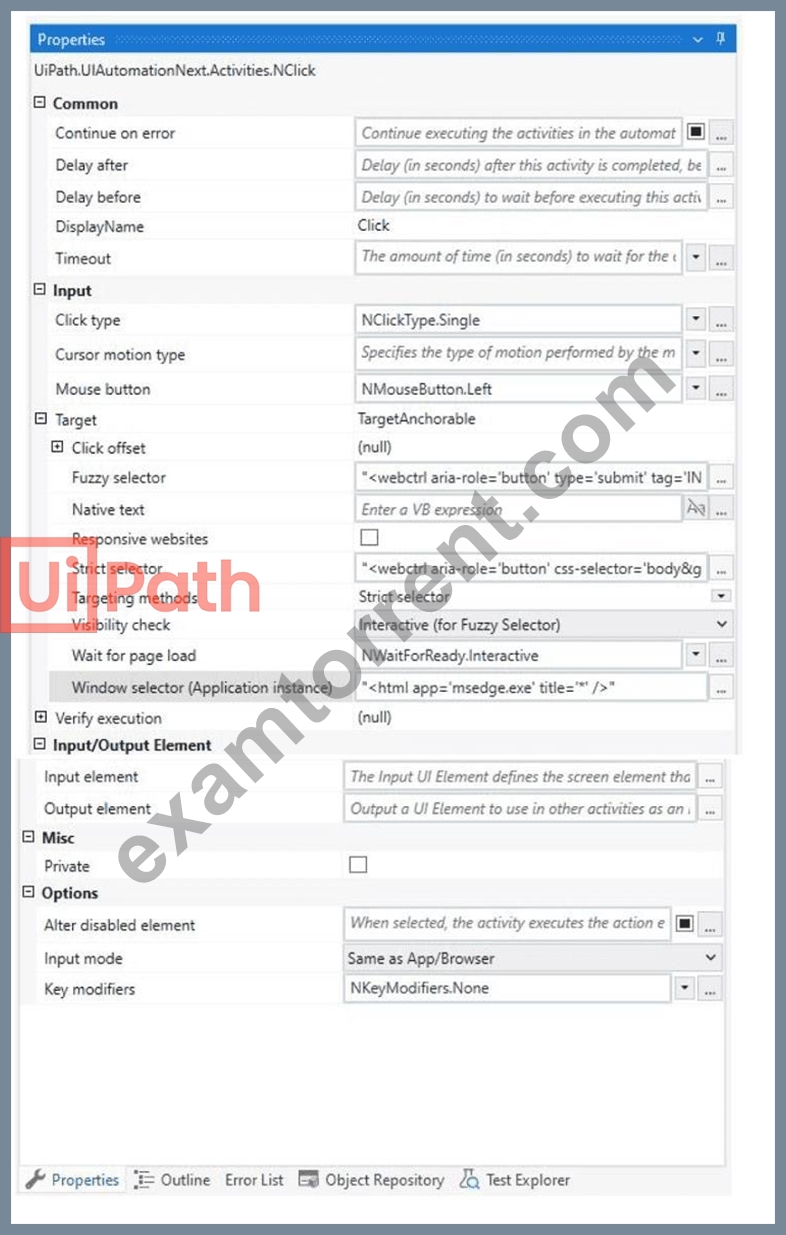
An animation on the web page never completely loads but the element indicated in the Click activity does load within the specified timeout duration. What occurs when this Click activity executes?
- A. Element is clicked once the element is fully loaded.
- B. Continues to the next activity after 30 seconds without clicking on the element.
- C. Timeout error occurs without clicking on the element.
- D. Waits 10 seconds before clicking on the element.
Answer: A
Explanation:
Click activity has the following properties:
*ClickType: Single
*MouseButton: Left
*Target.Timeout: 30000 ms (30 seconds)
*Target.WaitForReady: Interactive
The Target.Timeout property specifies the amount of time (in milliseconds) to wait for the activity to run before the SelectorNotFoundException error is thrown1. The default value is 30000 milliseconds (30 seconds)
2.
The Target.WaitForReady property determines how long the activity should wait for the target UI element to be ready before performing the action1. The following options are available:
*None: Does not wait for anything except the target UI element to exist before executing the action1.
*Interactive: Waits until only a part of the app is loaded1.
*Complete: Waits for the entire app to be loaded1.
The default value is Interactive2, which means that the activity will wait until the UI element is visible and can be interacted with3.
Therefore, based on these properties, the Click activity will wait for the element indicated by the selector to be loaded and clickable within 30 seconds. If the element is loaded before the timeout, the activity will click it and continue to the next activity. If the element is not loaded within the timeout, the activity will throw an error and stop the execution. The animation on the web page does not affect the Click activity, as long as the target element is loaded and visible. Hence, the correct answer is A. Element is clicked once the element is fully loaded.
NEW QUESTION # 43
A developer plans to build an automation process using the REFramework with Orchestrator queues. Based on UiPath best practice, what is the recommended sequence of steps to update the template and create/update Queues and Values?
Instructions: Drag the Description found on the left and drop on the correct Step Sequence found on the right.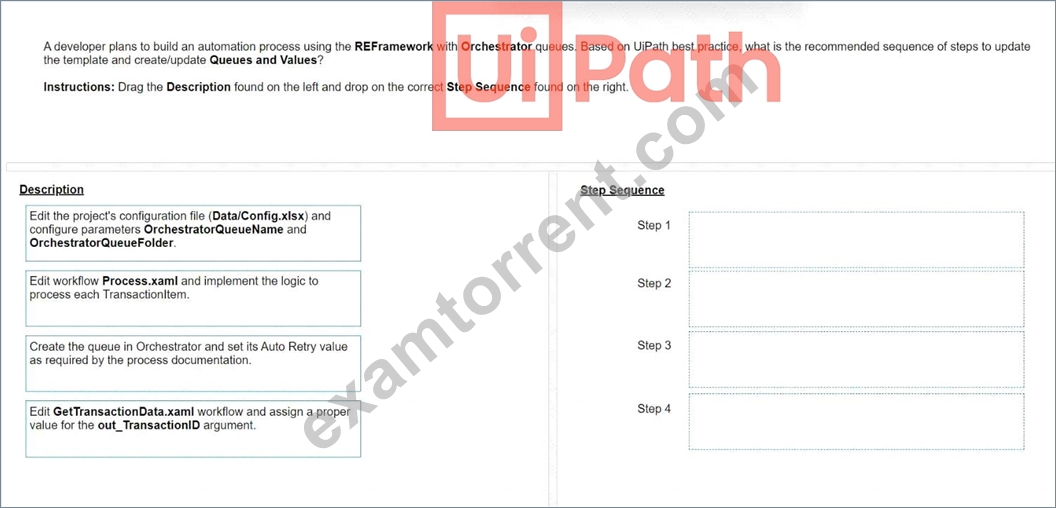
Answer:
Explanation: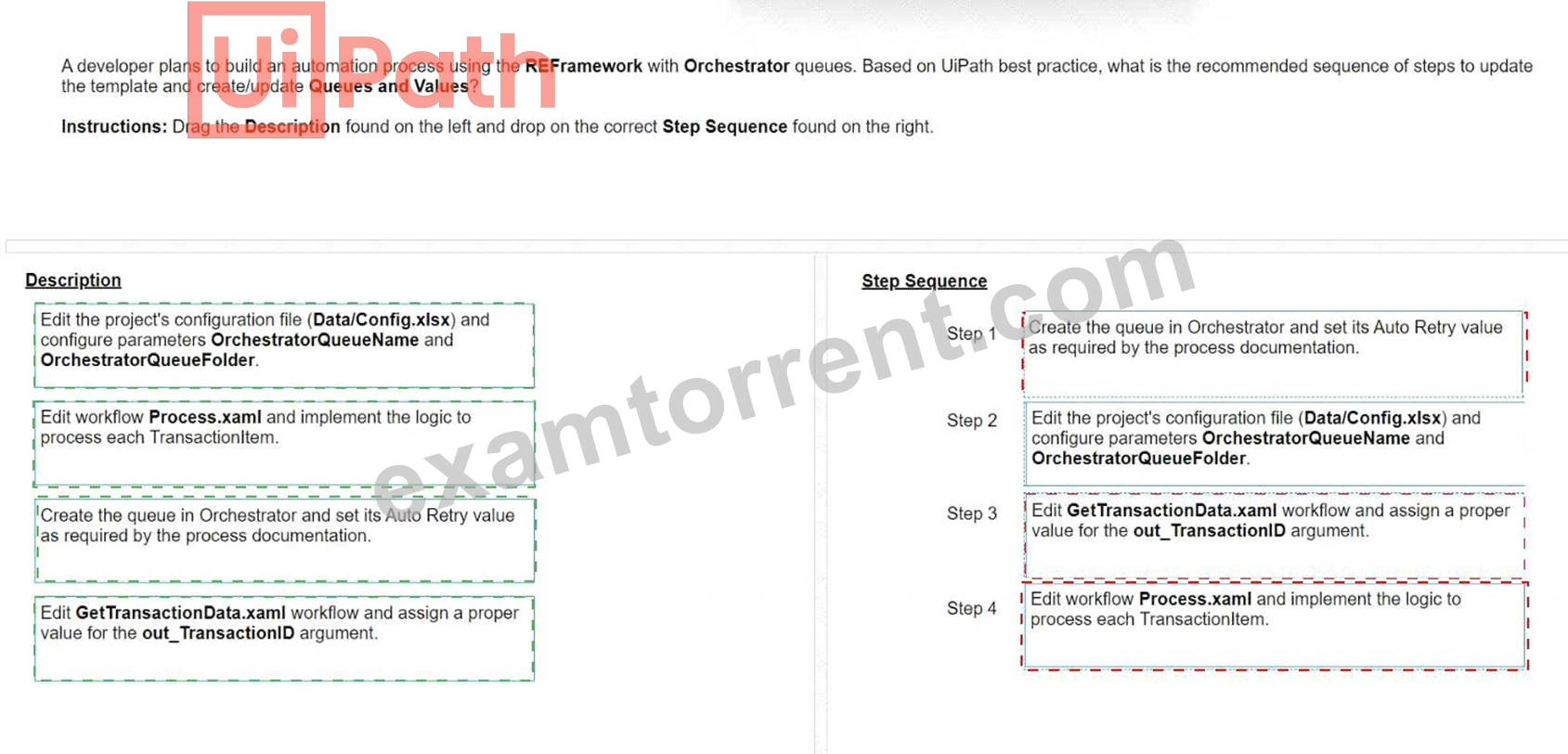
Explanation:
A screenshot of a computer program Description automatically generated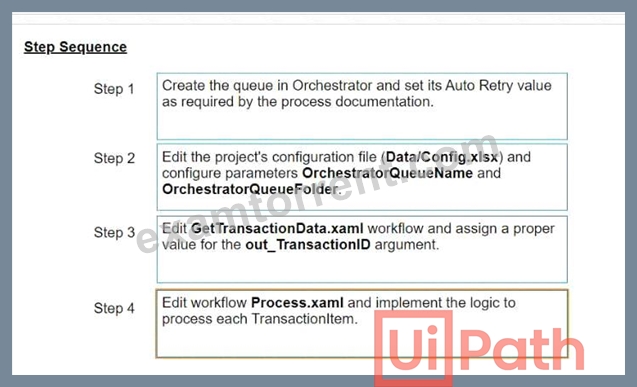
To align with UiPath's best practices when updating the REFramework template for use with Orchestrator queues, the sequence of steps should ensure proper setup of the queues in Orchestrator, configuration of the project to interact with these queues, and implementation of the business logic to process items from the queues.
Here's how the steps should be sequenced:
Step 1: Create the queue in Orchestrator and set its Auto Retry value as required by the process documentation.This step ensures that the queue is available in Orchestrator with the correct settings before the automation attempts to interact with it.
Step 2: Edit the project's configuration file (Data/Config.xlsx) and configure parameters OrchestratorQueueName and OrchestratorQueueFolder.Once the queue is created, the next step is to ensure that the automation project is configured to reference the correct queue and folder within Orchestrator.
Step 3: Edit GetTransactionData.xaml workflow and assign a proper value for the out_TransactionID argument.This configuration allows the workflow to correctly fetch transaction items from the Orchestrator queue for processing.
Step 4: Edit workflow Process.xaml and implement the logic to process each TransactionItem.Finally, the core processing logic that operates on each queue item is implemented, allowing the automation to perform the necessary actions for each transaction.
NEW QUESTION # 44
You have to create a testcase for an attended RPA process. At some point, the attended process asks the user to input a specific token for the execution to continue, as shown in the screenshot below.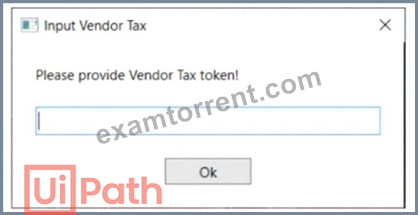
What testing concept (included in UiPath.Testing.Activities) can be used to isolate and replace the input part, without modifying the original workflow?
- A. Application Testing
- B. RPA Testing
- C. Data-Driven Testing
- D. Mock Testing
Answer: D
Explanation:
Mock Testing is a concept that allows you to isolate and replace the input part of an attended RPA process, without modifying the original workflow. Mock Testing enables you to create a mock file of your workflow by selecting Mock workflow under test in the Create Test Case window. This creates a copy of your workflow with the name workflowName_mock and stores it in Project > Mocks. This folder mirrors the source workflow file tree structure. In the mock file, you can use the Surround with mock option to insert a mock activity that replaces the original input activity. For example, instead of asking the user to input a specific token, you can use a mock activity that assigns a predefined token value to a variable. This way, you can test the specific function of the process without having to enter the token manually every time. Mock Testing is useful for tests that have permanent effects in production or require special resources1.
The other options are incorrect because:
Option A is incorrect because Application Testing is not a concept that can be used to isolate and replace the input part of an attended RPA process, without modifying the original workflow. Application Testing is a type of testing that focuses on verifying the functionality, usability, performance, and security of an application2.
Option B is incorrect because Data-Driven Testing is not a concept that can be used to isolate and replace the input part of an attended RPA process, without modifying the original workflow. Data-Driven Testing is a type of testing that uses external data sources, such as Excel files or databases, to provide input values and expected results for the test cases3.
Option D is incorrect because RPA Testing is not a concept that can be used to isolate and replace the input part of an attended RPA process, without modifying the original workflow. RPA Testing is a type of testing that involves using robots to automate the testing of other robots or applications.
References:
Studio - Mock Testing - UiPath Documentation Portal
Application Testing - UiPath Documentation Portal
Data-Driven Testing - UiPath Documentation Portal
[RPA Testing - UiPath Documentation Portal]
NEW QUESTION # 45
Suppose you have the following workflow that verifies if the text value of an element is equal to "Work Items":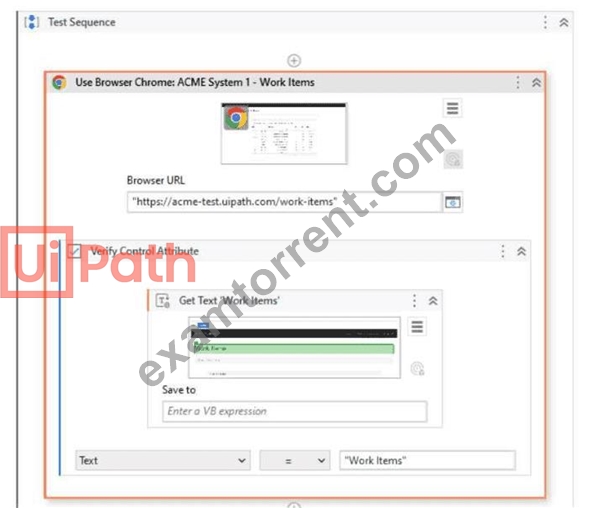
The configuration for the Verify Control Attribute and Get Text activities is shown below: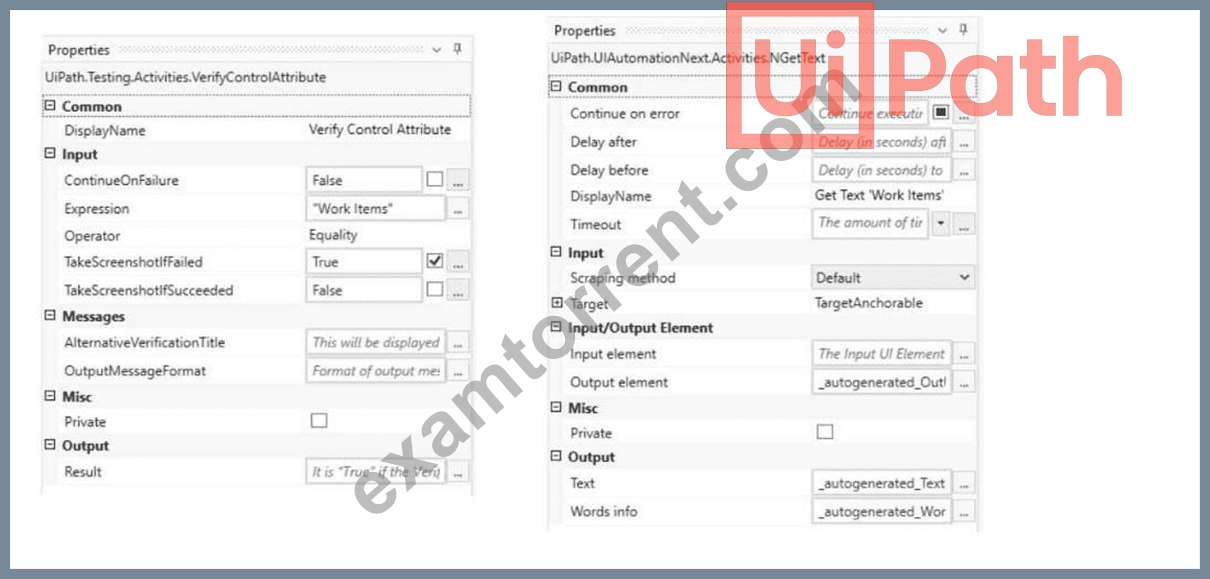
The element and its selector are highlighted in the image below: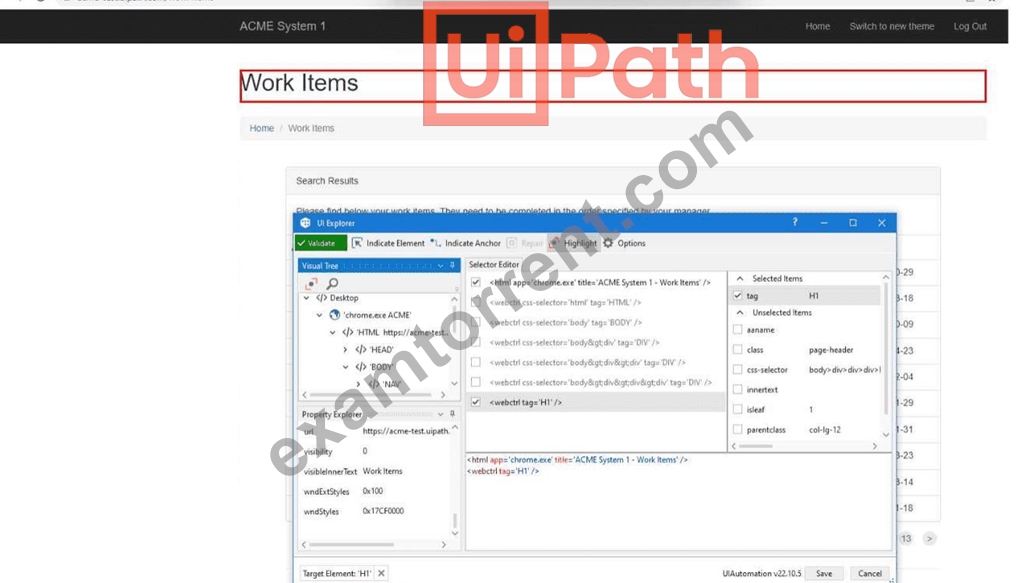
Taking into consideration that the page shown above will be present on screen at execution time, what will be the result of the Verify Control Attribute activity?
- A. Verification will be passed.
- B. An exception will be thrown because there is no variable set in the Save to property of the Get text activity.
- C. Verification will not be executed.
- D. Verification will be failed because the actual value is different than expected value.
Answer: A
Explanation:
The workflow in question uses a 'Verify Control Attribute' activity to check if the text value of a UI element is equal to "Work Items". The Get Text activity is used to retrieve the text from the specified UI element, and the result of this activity is compared against the expected value "Work Items".
From the provided information, the 'Verify Control Attribute' activity has been set up with the Expression
"Work Items" and the Operator set to Equality. The 'Get Text' activity is configured to extract the text from the UI element with the visible text "Work Items", as indicated by the selector shown in the image.
Since the actual value of the UI element's text is "Work Items" (which matches the expected value in the
'Verify Control Attribute' activity), and provided that the 'Get Text' activity successfully retrieves this value, the verification will pass. The configuration indicates that the activity should take a screenshot only if the verification fails (TakeScreenshotIfFailed is set to True), which will not be the case here.
Therefore, assuming that there are no other issues such as incorrect selectors or unexpected changes to the UI element at execution time, the result of the 'Verify Control Attribute' activity will be a pass.
References:
UiPath Documentation: Verify Control Attribute Activity
NEW QUESTION # 46
Given the following list of arguments: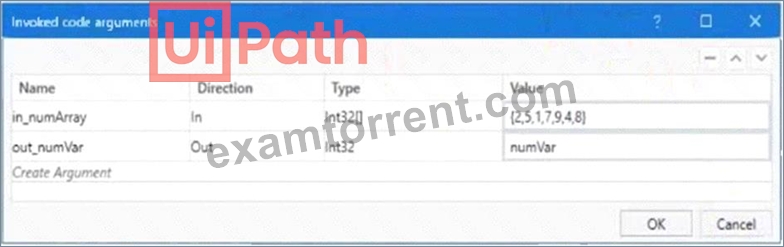
and the following code: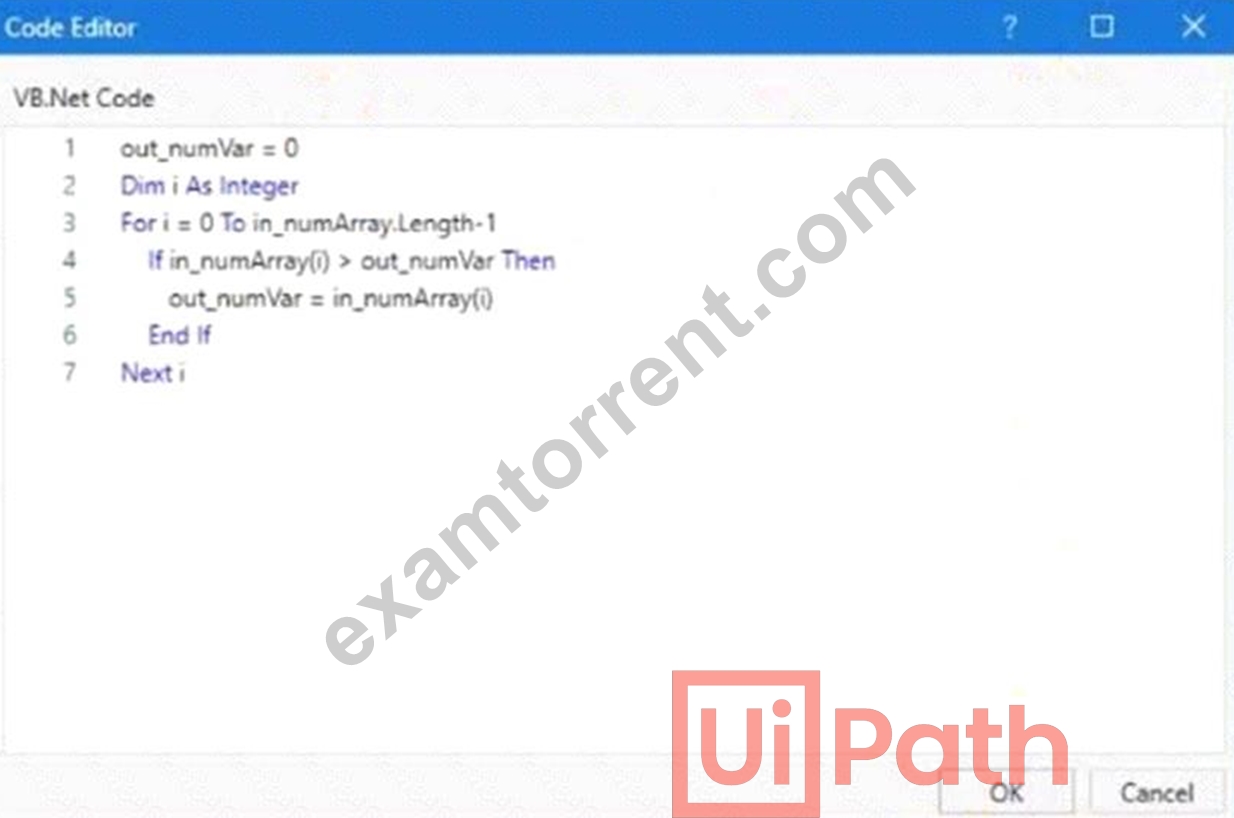
What is the value that will be displayed in the Output Panel at the end of the sequence below: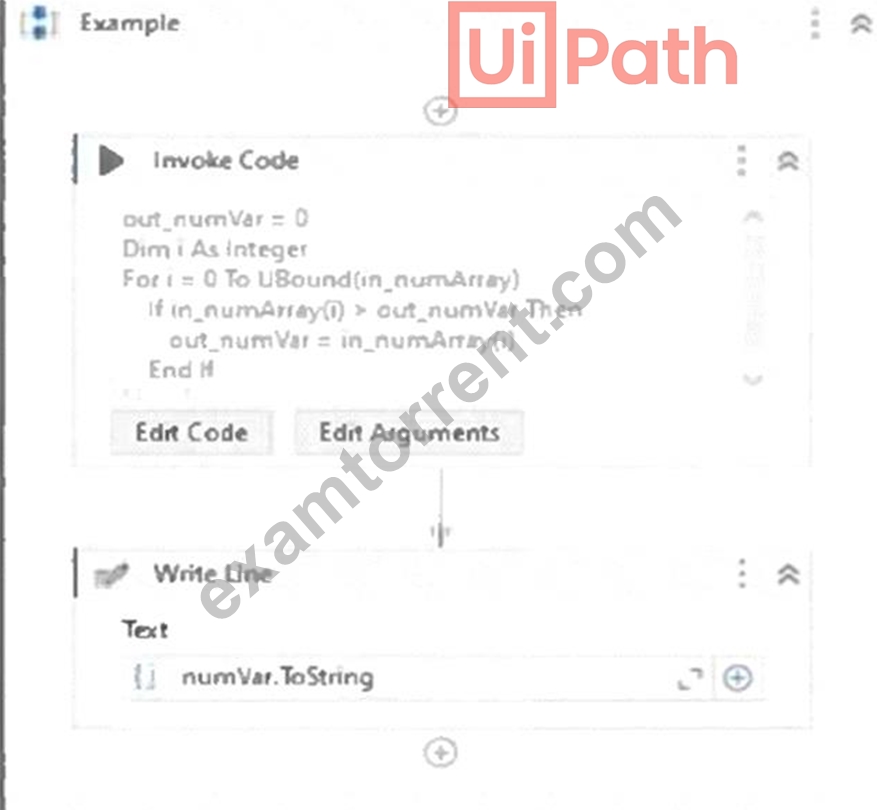
- A. 0
- B. 1
- C. 2
- D. 3
Answer: D
Explanation:
The value that will be displayed in the Output Panel at the end of the sequence is 9. This is because the code in the Invoke Code activity is looping through the array in_numArray and setting the variable out_numVar to the highest value in the array. The array in_numArray has the values {1, 2, 7, 9, 4} as shown in the list of arguments. The variable out_numVar is initialized to 0. The For loop iterates from 0 to the upper bound of the array, which is 4. In each iteration, the If condition checks if the current element of the array is greater than the current value of out_numVar. If it is, then out_numVar is assigned to the current element of the array.
Otherwise, out_numVar remains unchanged. Therefore, after the first iteration, out_numVar becomes 1. After the second iteration, out_numVar becomes 2. After the third iteration, out_numVar becomes 7. After the fourth iteration, out_numVar becomes 9. After the fifth iteration, out_numVar remains 9, since 4 is not greater than 9. The Write Line activity outputs the value of out_numVar to the console, which is
9. References: Invoke Code
NEW QUESTION # 47
What is the purpose of the Capture All Elements feature in Object Repository?
- A. To capture the selected elements of an application from multiple screens simultaneously using the Computer Vision technology.
- B. To capture the selected elements of an application using the Computer Vision technology.
- C. To capture all elements of an application from multiple screens simultaneously using the Computer Vision technology.
- D. To capture all the available elements of an application using the Computer Vision technology.
Answer: D
Explanation:
The Object Repository is a feature of UiPath Studio that allows you to store and manage UI elements that are used in your automation projects. You can create and edit UI descriptors for the UI elements, and reuse them across multiple workflows and projects. The Object Repository supports both the default UI framework and the Computer Vision framework for identifying UI elements.
The Computer Vision framework is a technology that uses artificial intelligence and machine learning to analyze the UI of any application and provide reliable selectors for the UI elements. The Computer Vision framework can handle complex and dynamic UIs that are not supported by the default UI framework, such as Citrix, SAP, or PDF applications.
The Capture All Elements feature in Object Repository is a feature that allows you to capture all the available elements of an application using the Computer Vision technology. You can use this feature to quickly and easily create UI descriptors for all the UI elements on the screen, without having to indicate each element individually. You can access this feature by clicking the Capture All Elements button on the Object Repository ribbon tab, or by using the Capture All Elements activity in the workflow.
The Capture All Elements feature has the following benefits:
It saves time and effort by capturing all the UI elements in one go, instead of indicating each element separately.
It ensures consistency and accuracy by using the same Computer Vision technology and selector logic for all the UI elements.
It allows you to edit, rename, or delete the UI descriptors after capturing them, and customize them according to your needs.
It enables you to reuse the UI descriptors across multiple workflows and projects, and share them with other developers.
The correct answer is C. To capture all the available elements of an application using the Computer Vision technology. This statement accurately describes the purpose of the Capture All Elements feature in Object Repository.
The other options are not correct statements. Option A is incorrect, because the Capture All Elements feature does not capture the selected elements of an application, but all the available elements. It also does not capture the elements from multiple screens simultaneously, but only from the current screen. Option B is incorrect, because the Capture All Elements feature does not capture the selected elements of an application, but all the available elements. Option D is incorrect, because the Capture All Elements feature does not capture the elements from multiple screens simultaneously, but only from the current screen.
References: Studio - Object Repository - UiPath Documentation Portal, Activities - Capture All Elements - UiPath Documentation Portal, Computer Vision - Introduction - UiPath Documentation Portal, Object Repository - UiPath Academy
NEW QUESTION # 48
When a developer runs a process using the REFramework, with the process utilizing Orchestrator queues and a queue already created with the Name provided and the Auto Retry function disabled, which states will be executed without errors?
- A. Initialization -> Get Transaction Data -> End Process
- B. Initialization -> End Process
- C. Initialization -> Process Transaction -> End Process
- D. Initialization -> Get Transaction Data -> Process Transaction -> End Process
Answer: D
Explanation:
The states that will be executed without errors when a developer runs a process using the REFramework, with the process utilizing Orchestrator queues and a queue already created with the Name provided and the Auto Retry function disabled, are Initialization, Get Transaction Data, Process Transaction, and End Process. The REFramework is a template that provides a robust and scalable structure for building automation processes.
The REFramework consists of four main states: Initialization, Get Transaction Data, Process Transaction, and End Process. The Initialization state is responsible for initializing the application, reading the configuration file, and logging in to the Orchestrator. The Get Transaction Data state is responsible for fetching the next transaction item from the Orchestrator queue and assigning it to the TransactionItem variable. The Process Transaction state is responsible for executing the main logic of the process for the current transaction item.
The End Process state is responsible for closing the application, logging out of the Orchestrator, and performing any cleanup actions. If the process utilizes Orchestrator queues and a queue already exists with the Name provided and the Auto Retry function disabled, then the process will be able to execute these states without errors, assuming that there are no other issues or exceptions in the workflow. References: [Robotic Enterprise Framework], [REFramework States]
NEW QUESTION # 49
The provided exhibit displays the representation of the "Deadline" field using the yyyy-mm-dd format.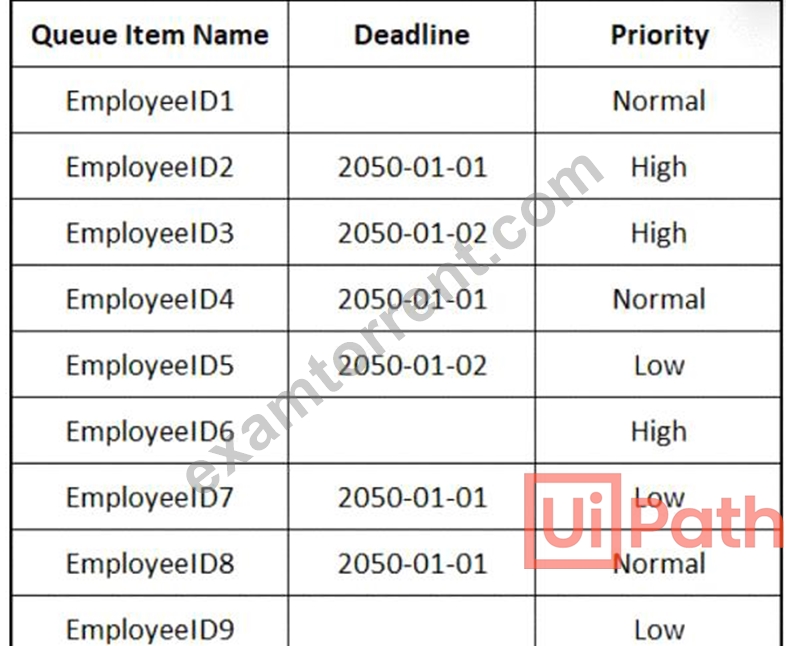
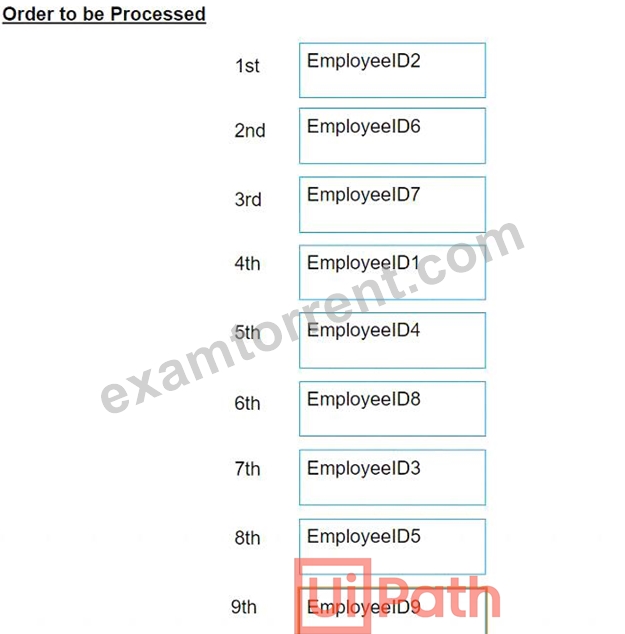
In what order should the Queue Items be processed by a single robot executing a Performer workflow?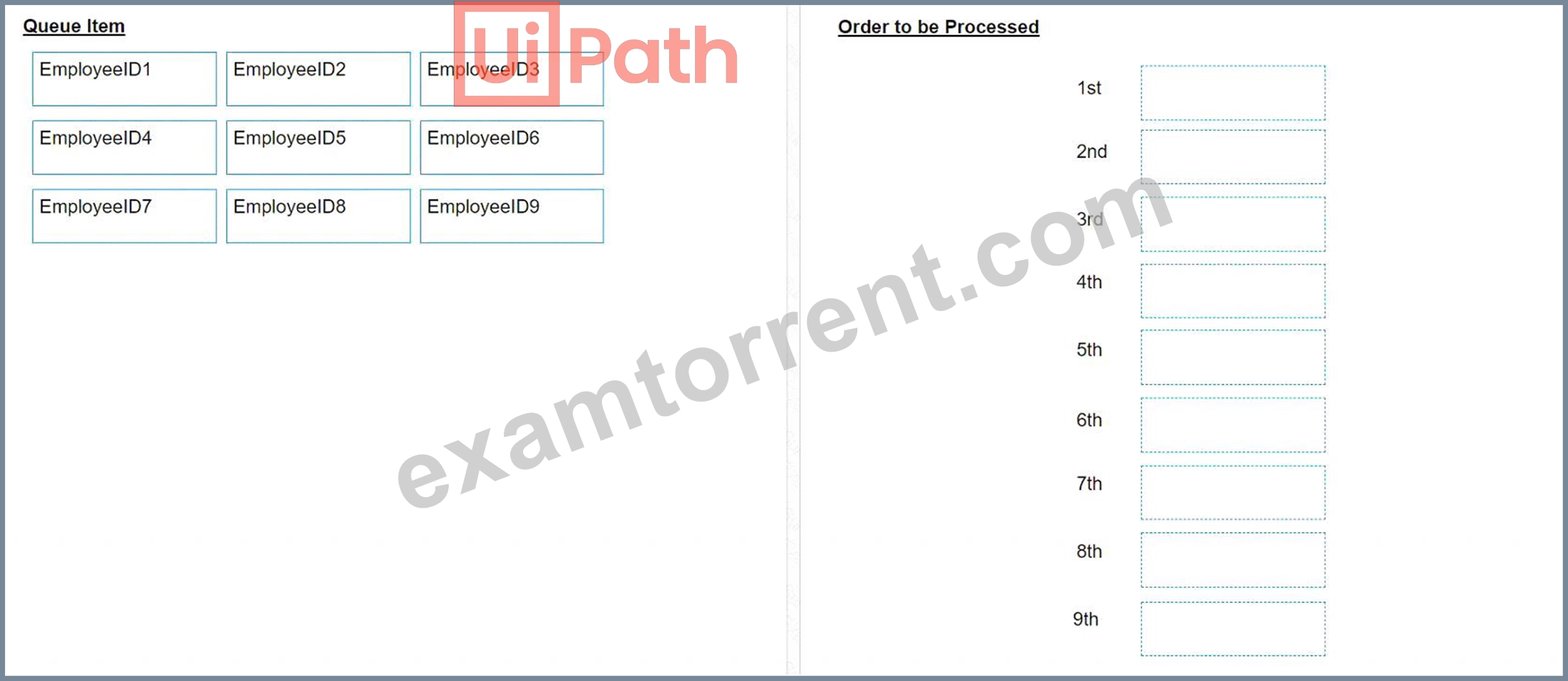
Answer:
Explanation: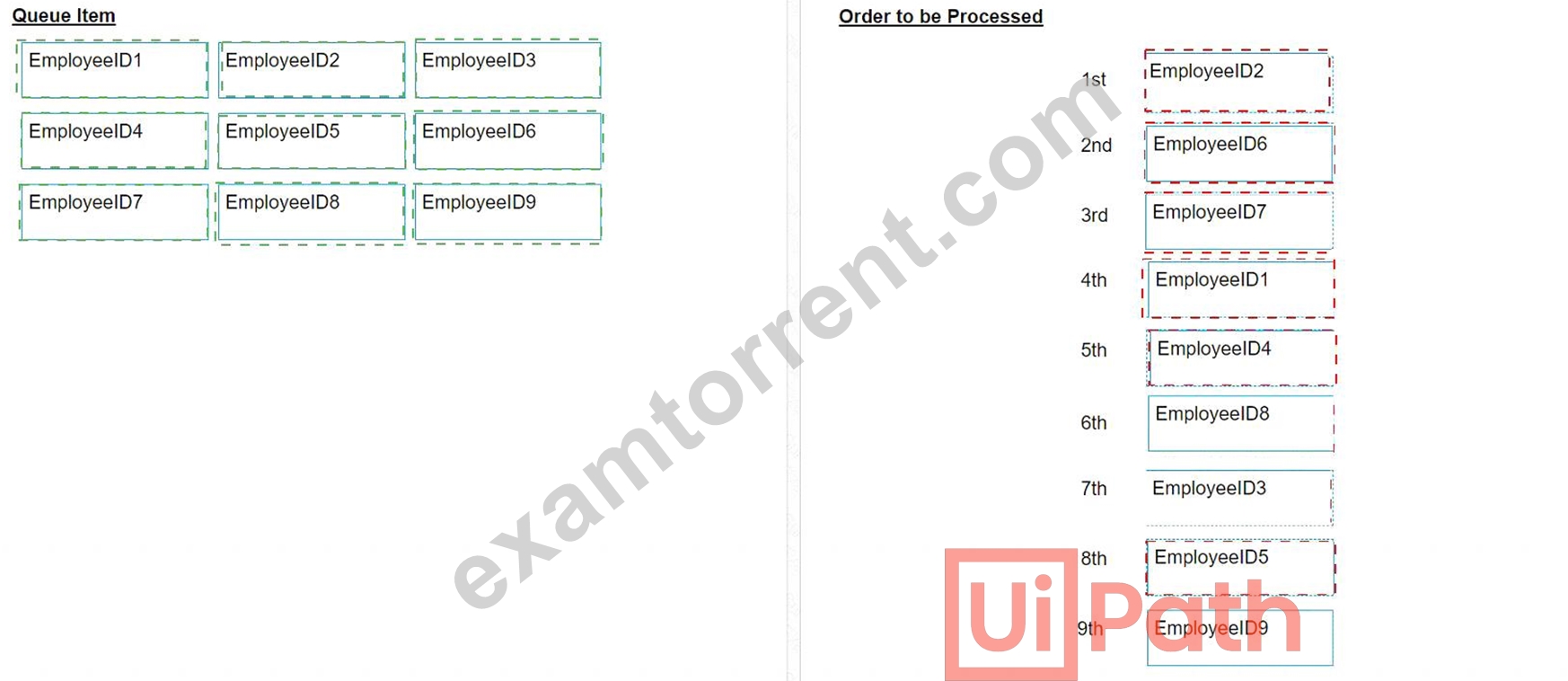
NEW QUESTION # 50
What is the output type returned when using a Get Test Data Queue Item activity?
- A. Dictionary
- B. Object
- C. Queueltem
Answer: C
NEW QUESTION # 51
......
UiPath-ADPv1 PDF Dumps Extremely Quick Way Of Preparation: https://prep4sure.examtorrent.com/UiPath-ADPv1-exam-papers.html
