

Ultimate Guide to Prepare DP-420 Certification Exam for Azure Cosmos DB Developer Specialty in 2023
Use Real DP-420 Dumps - Microsoft Correct Answers updated on 2023
A section outlining the topics of a Microsoft DP-420 Certification Exam
DP-420 Dumps cover the following topics of the Microsoft DP-420 Certification Exam:
- Maintain an Azure Cosmos DB solution: 20%
- Design and implement data distribution: 10%
- Optimize an Azure Cosmos DB solution: 20%
- Integrate an Azure Cosmos DB solution: 10%
- Design and execute information models: 40%
NEW QUESTION 10
You are creating a database in an Azure Cosmos DB Core (SQL) API account. The database will be used by an application that will provide users with the ability to share online posts. Users will also be able to submit comments on other users' posts.
You need to store the data shown in the following table.
The application has the following characteristics:
Users can submit an unlimited number of posts.
The average number of posts submitted by a user will be more than 1,000.
Posts can have an unlimited number of comments from different users.
The average number of comments per post will be 100, but many posts will exceed 1,000 comments.
Users will be limited to having a maximum of 20 interests.
For each of the following statements, select Yes if the statement is true. Otherwise, select No.
NOTE: Each correct selection is worth one point.
Answer:
Explanation:
NEW QUESTION 11
You are implementing an Azure Data Factory data flow that will use an Azure Cosmos DB (SQL API) sink to write a dataset. The data flow will use 2,000 Apache Spark partitions.
You need to ensure that the ingestion from each Spark partition is balanced to optimize throughput.
Which sink setting should you configure?
- A. Throughput
- B. Batch size
- C. Collection action
- D. Write throughput budget
Answer: B
Explanation:
Batch size: An integer that represents how many objects are being written to Cosmos DB collection in each batch. Usually, starting with the default batch size is sufficient. To further tune this value, note:
Cosmos DB limits single request's size to 2MB. The formula is "Request Size = Single Document Size * Batch Size". If you hit error saying "Request size is too large", reduce the batch size value.
The larger the batch size, the better throughput the service can achieve, while make sure you allocate enough RUs to empower your workload.
Incorrect Answers:
A: Throughput: Set an optional value for the number of RUs you'd like to apply to your CosmosDB collection for each execution of this data flow. Minimum is 400.
B: Write throughput budget: An integer that represents the RUs you want to allocate for this Data Flow write operation, out of the total throughput allocated to the collection.
D: Collection action: Determines whether to recreate the destination collection prior to writing.
None: No action will be done to the collection.
Recreate: The collection will get dropped and recreated
NEW QUESTION 12
You have an Azure Cosmos DB Core (SQL) API account named account1.
You have the Azure virtual networks and subnets shown in the following table.
The vnet1 and vnet2 networks are connected by using a virtual network peer.
The Firewall and virtual network settings for account1 are configured as shown in the exhibit.
For each of the following statements, select Yes if the statement is true. Otherwise, select No.
NOTE: Each correct selection is worth one point.
Answer:
Explanation:
NEW QUESTION 13
Note: This question is part of a series of questions that present the same scenario. Each question in the series contains a unique solution that might meet the stated goals. Some question sets might have more than one correct solution, while others might not have a correct solution.
After you answer a question in this section, you will NOT be able to return to it. As a result, these questions will not appear in the review screen.
You have an Azure Cosmos DB Core (SQL) API account named account 1 that uses autoscale throughput.
You need to run an Azure function when the normalized request units per second for a container in account1 exceeds a specific value.
Solution: You configure the function to have an Azure CosmosDB trigger.
Does this meet the goal?
- A. No
- B. Yes
Answer: A
Explanation:
Instead configure an Azure Monitor alert to trigger the function.
You can set up alerts from the Azure Cosmos DB pane or the Azure Monitor service in the Azure portal.
NEW QUESTION 14
You are troubleshooting the current issues caused by the application updates.
Which action can address the application updates issue without affecting the functionality of the application?
- A. Set the default consistency level of account1 to bounded staleness.
- B. Add a custom indexing policy to the con-product container.
- C. Enable time to live for the con-product container.
- D. Set the default consistency level of account1 to strong.
Answer: A
Explanation:
Bounded staleness is frequently chosen by globally distributed applications that expect low write latencies but require total global order guarantee. Bounded staleness is great for applications featuring group collaboration and sharing, stock ticker, publish-subscribe/queueing etc.
Scenario: Application updates in con-product frequently cause HTTP status code 429 "Too many requests". You discover that the 429 status code relates to excessive request unit (RU) consumption during the updates.
Reference:
https://docs.microsoft.com/en-us/azure/cosmos-db/consistency-levels
NEW QUESTION 15
You configure multi-region writes for account1.
You need to ensure that App1 supports the new configuration for account1. The solution must meet the business requirements and the product catalog requirements.
What should you do?
- A. Set the default consistency level of accountl to bounded staleness.
- B. Increase the number of request units per second (RU/s) allocated to the con-product and con-productVendor containers.
- C. Modify the connection policy of App1.
- D. Create a private endpoint connection.
Answer: B
Explanation:
App1 queries the con-product and con-productVendor containers.
Note: Request unit is a performance currency abstracting the system resources such as CPU, IOPS, and memory that are required to perform the database operations supported by Azure Cosmos DB.
Scenario:
Develop an app named App1 that will run from all locations and query the data in account1.
Once multi-region writes are configured, maximize the performance of App1 queries against the data in account1.
Whenever there are multiple solutions for a requirement, select the solution that provides the best performance, as long as there are no additional costs associated.
Reference:
https://docs.microsoft.com/en-us/azure/cosmos-db/consistency-levels
NEW QUESTION 16
You have an Azure Cosmos DB Core (SQL) API account.
You configure the diagnostic settings to send all log information to a Log Analytics workspace.
You need to identify when the provisioned request units per second (RU/s) for resources within the account were modified.
You write the following query.
AzureDiagnostics
| where Category == "ControlPlaneRequests"
What should you include in the query?
- A. | where OperationName startswith "MongoCollectionsThroughputUpdate"
- B. | where OperationName startswith "AccountUpdateStart"
- C. | where OperationName startswith "SqlContainersDelete"
- D. | where OperationName startswith "SqlContainersThroughputUpdate"
Answer: B
Explanation:
The following are the operation names in diagnostic logs for different operations:
RegionAddStart, RegionAddComplete
RegionRemoveStart, RegionRemoveComplete
AccountDeleteStart, AccountDeleteComplete
RegionFailoverStart, RegionFailoverComplete
AccountCreateStart, AccountCreateComplete
*AccountUpdateStart*, AccountUpdateComplete
VirtualNetworkDeleteStart, VirtualNetworkDeleteComplete
DiagnosticLogUpdateStart, DiagnosticLogUpdateComplete
NEW QUESTION 17
You have the indexing policy shown in the following exhibit.
Use the drop-down menus to select the answer choice that answers each question based on the information presented in the graphic.
NOTE: Each correct selection is worth one point.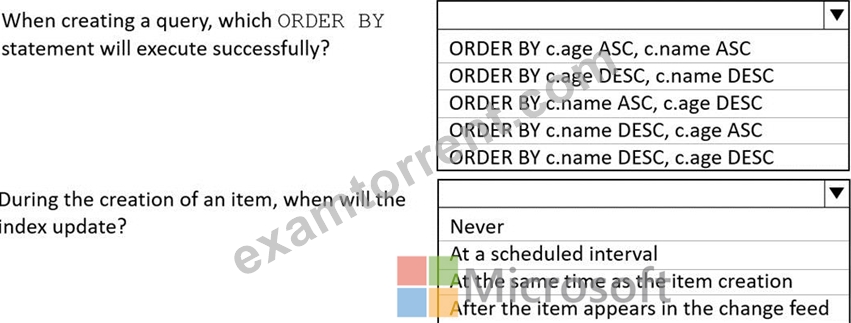
Answer:
Explanation:
NEW QUESTION 18
Note: This question is part of a series of questions that present the same scenario. Each question in the series contains a unique solution that might meet the stated goals. Some question sets might have more than one correct solution, while others might not have a correct solution.
After you answer a question in this section, you will NOT be able to return to it. As a result, these questions will not appear in the review screen.
You have an Azure Cosmos DB Core (SQL) API account named account 1 that uses autoscale throughput.
You need to run an Azure function when the normalized request units per second for a container in account1 exceeds a specific value.
Solution: You configure an application to use the change feed processor to read the change feed and you configure the application to trigger the function.
Does this meet the goal?
- A. No
- B. Yes
Answer: A
Explanation:
Instead configure an Azure Monitor alert to trigger the function.
You can set up alerts from the Azure Cosmos DB pane or the Azure Monitor service in the Azure portal.
NEW QUESTION 19
You need to provide a solution for the Azure Functions notifications following updates to con-product. The solution must meet the business requirements and the product catalog requirements.
Which two actions should you perform? Each correct answer presents part of the solution.
NOTE: Each correct selection is worth one point.
- A. Configure the trigger for each function to use a different leaseCollectionPrefix
- B. Configure the trigger for each function to use the same leaseCollectionNair.e
- C. Configure the trigger for each function to use the same leaseCollectionPrefix
- D. Configure the trigger for each function to use a different leaseCollectionName
Answer: A,B
Explanation:
leaseCollectionPrefix: when set, the value is added as a prefix to the leases created in the Lease collection for this Function. Using a prefix allows two separate Azure Functions to share the same Lease collection by using different prefixes.
Scenario: Use Azure Functions to send notifications about product updates to different recipients.
Trigger the execution of two Azure functions following every update to any document in the con-product container.
Reference:
https://docs.microsoft.com/en-us/azure/azure-functions/functions-bindings-cosmosdb-v2-trigger
NEW QUESTION 20
You have a container named container1 in an Azure Cosmos DB Core (SQL) API account. Upserts of items in container1 occur every three seconds.
You have an Azure Functions app named function1 that is supposed to run whenever items are inserted or replaced in container1.
You discover that function1 runs, but not on every upsert.
You need to ensure that function1 processes each upsert within one second of the upsert.
Which property should you change in the Function.json file of function1?
- A. feedPollDelay
- B. maxItemsPerInvocation
- C. checkpointInterval
- D. leaseCollectionsThroughput
Answer: A
Explanation:
With an upsert operation we can either insert or update an existing record at the same time.
FeedPollDelay: The time (in milliseconds) for the delay between polling a partition for new changes on the feed, after all current changes are drained. Default is 5,000 milliseconds, or 5 seconds.
Incorrect Answers:
A: checkpointInterval: When set, it defines, in milliseconds, the interval between lease checkpoints. Default is always after each Function call.
C: maxItemsPerInvocation: When set, this property sets the maximum number of items received per Function call. If operations in the monitored collection are performed through stored procedures, transaction scope is preserved when reading items from the change feed. As a result, the number of items received could be higher than the specified value so that the items changed by the same transaction are returned as part of one atomic batch.
NEW QUESTION 21
You have an Azure Cosmos DB Core (SQL) API account named account1 that has the disableKeyBasedMetadataWriteAccess property enabled.
You are developing an app named App1 that will be used by a user named DevUser1 to create containers in account1. DevUser1 has a non-privileged user account in the Azure Active Directory (Azure AD) tenant.
You need to ensure that DevUser1 can use App1 to create containers in account1.
What should you do? To answer, select the appropriate options in the answer area.
NOTE: Each correct selection is worth one point.
Answer:
Explanation:
Reference:
https://docs.microsoft.com/en-us/azure/cosmos-db/secure-access-to-data
https://docs.microsoft.com/en-us/rest/api/resources/
NEW QUESTION 22
You have an Azure Cosmos DB Core (SQL) API account used by an application named App1.
You open the Insights pane for the account and see the following chart.
Use the drop-down menus to select the answer choice that answers each question based on the information presented in the graphic.
NOTE: Each correct selection is worth one point.
Answer:
Explanation: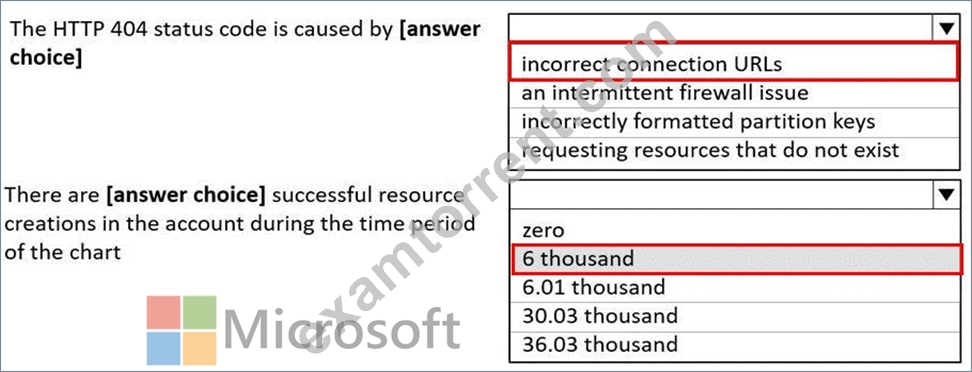
NEW QUESTION 23
Note: This question is part of a series of questions that present the same scenario. Each question in the series contains a unique solution that might meet the stated goals. Some question sets might have more than one correct solution, while others might not have a correct solution.
After you answer a question in this section, you will NOT be able to return to it. As a result, these questions will not appear in the review screen.
You have a container named container1 in an Azure Cosmos DB Core (SQL) API account.
You need to make the contents of container1 available as reference data for an Azure Stream Analytics job.
Solution: You create an Azure function that uses Azure Cosmos DB Core (SQL) API change feed as a trigger and Azure event hub as the output.
Does this meet the goal?
- A. No
- B. Yes
Answer: B
Explanation:
The Azure Cosmos DB change feed is a mechanism to get a continuous and incremental feed of records from an Azure Cosmos container as those records are being created or modified. Change feed support works by listening to container for any changes. It then outputs the sorted list of documents that were changed in the order in which they were modified.
The following diagram represents the data flow and components involved in the solution:
NEW QUESTION 24
You have the following query.
SELECT * FROM c
WHERE c.sensor = "TEMP1"
AND c.value < 22
AND c.timestamp >= 1619146031231
You need to recommend a composite index strategy that will minimize the request units (RUs) consumed by the query.
What should you recommend?
- A. a composite index for (sensor ASC, value ASC, timestamp ASC) and a composite index for (sensor DESC, value DESC, timestamp DESC)
- B. a composite index for (sensor ASC, value ASC) and a composite index for (sensor ASC, timestamp ASC)
- C. a composite index for (value ASC, sensor ASC) and a composite index for (timestamp ASC, sensor ASC)
- D. a composite index for (sensor ASC, value ASC, timestamp ASC)
Answer: B
Explanation:
If a query has a filter with two or more properties, adding a composite index will improve performance.
Consider the following query:
SELECT * FROM c WHERE c.name = "Tim" and c.age > 18
In the absence of a composite index on (name ASC, and age ASC), we will utilize a range index for this query. We can improve the efficiency of this query by creating a composite index for name and age.
Queries with multiple equality filters and a maximum of one range filter (such as >,<, <=, >=, !=) will utilize the composite index.
NEW QUESTION 25
You are designing an Azure Cosmos DB Core (SQL) API solution to store data from IoT devices. Writes from the devices will be occur every second.
The following is a sample of the data.
You need to select a partition key that meets the following requirements for writes:
Minimizes the partition skew
Avoids capacity limits
Avoids hot partitions
What should you do?
- A. Use timestamp as the partition key.
- B. Create a new synthetic key that contains deviceId and sensor1Value.
- C. Create a new synthetic key that contains deviceId and a random number.
- D. Create a new synthetic key that contains deviceId and deviceManufacturer.
Answer: C
Explanation:
Use a partition key with a random suffix. Distribute the workload more evenly is to append a random number at the end of the partition key value. When you distribute items in this way, you can perform parallel write operations across partitions.
Incorrect Answers:
A: You will also not like to partition the data on "DateTime", because this will create a hot partition. Imagine you have partitioned the data on time, then for a given minute, all the calls will hit one partition. If you need to retrieve the data for a customer, then it will be a fan-out query because data may be distributed on all the partitions.
B: Senser1Value has only two values.
C: All the devices could have the same manufacturer.
NEW QUESTION 26
You plan to create an Azure Cosmos DB Core (SQL) API account that will use customer-managed keys stored in Azure Key Vault.
You need to configure an access policy in Key Vault to allow Azure Cosmos DB access to the keys.
Which three permissions should you enable in the access policy? Each correct answer presents part of the solution.
NOTE: Each correct selection is worth one point.
- A. Unwrap Key
- B. List
- C. Wrap Key
- D. Verify
- E. Sign
- F. Get
- G. Update
Answer: A,C,F
NEW QUESTION 27
You need to implement a trigger in Azure Cosmos DB Core (SQL) API that will run before an item is inserted into a container.
Which two actions should you perform to ensure that the trigger runs? Each correct answer presents part of the solution.
NOTE: Each correct selection is worth one point.
- A. Register the trigger as a pre-trigger.
- B. For each create request, set the trigger name in RequestOptions.
- C. For each create request, set the access condition in RequestOptions.
- D. For each create request, set the consistency level to session in RequestOptions.
- E. Append pre to the name of the JavaScript function trigger.
Answer: A
Explanation:
C: When triggers are registered, you can specify the operations that it can run with.
F: When executing, pre-triggers are passed in the RequestOptions object by specifying PreTriggerInclude and then passing the name of the trigger in a List object.
NEW QUESTION 28
You have an Azure Cosmos DB Core (SQL) API account that is used by 10 web apps.
You need to analyze the data stored in the account by using Apache Spark to create machine learning models. The solution must NOT affect the performance of the web apps.
Which two actions should you perform? Each correct answer presents part of the solution.
NOTE: Each correct selection is worth one point.
- A. Create a private endpoint connection to the account.
- B. In an Apache Spark pool in Azure Synapse, create a table that uses cosmos.olap as the data source.
- C. In an Azure Synapse Analytics serverless SQL pool, create a view that uses OPENROWSET and the CosmosDB provider.
- D. In an Apache Spark pool in Azure Synapse, create a table that uses cosmos.oltp as the data source.
- E. Enable Azure Synapse Link for the account and Analytical store on the container.
Answer: B,E
Explanation:
Reference:
https://github.com/microsoft/MCW-Cosmos-DB-Real-Time-Advanced-Analytics/blob/main/Hands-on%20lab/HOL%20step-by%20step%20-%20Cosmos%20DB%20real-time%20advanced%20analytics.md
NEW QUESTION 29
You are developing an application that will use an Azure Cosmos DB Core (SQL) API account as a data source.
You need to create a report that displays the top five most ordered fruits as shown in the following table.
A collection that contains aggregated data already exists. The following is a sample document:
{
"name": "apple",
"type": ["fruit", "exotic"],
"orders": 10000
}
Which two queries can you use to retrieve data for the report? Each correct answer presents a complete solution.
NOTE: Each correct selection is worth one point.
A)
B)
C)
D)
- A. Option B
- B. Option C
- C. Option A
- D. Option D
Answer: A,D
Explanation:
ARRAY_CONTAINS returns a Boolean indicating whether the array contains the specified value. You can check for a partial or full match of an object by using a boolean expression within the command.
Incorrect Answers:
A: Default sorting ordering is Ascending. Must use Descending order.
C: Order on Orders not on Type.
NEW QUESTION 30
You have a container named container1 in an Azure Cosmos DB Core (SQL) API account.
You need to provide a user named User1 with the ability to insert items into container1 by using role-based access control (RBAC). The solution must use the principle of least privilege.
Which roles should you assign to User1?
- A. CosmosDB Operator only
- B. Cosmos DB Built-in Data Contributor only
- C. DocumentDB Account Contributor only
- D. DocumentDB Account Contributor and Cosmos DB Built-in Data Contributor
Answer: A
Explanation:
Cosmos DB Operator: Can provision Azure Cosmos accounts, databases, and containers. Cannot access any data or use Data Explorer.
Incorrect Answers:
B: DocumentDB Account Contributor can manage Azure Cosmos DB accounts. Azure Cosmos DB is formerly known as DocumentDB.
C: DocumentDB Account Contributor: Can manage Azure Cosmos DB accounts.
NEW QUESTION 31
......
Azure Cosmos DB Developer Specialty -DP-420 Exam-Practice-Dumps: https://prep4sure.examtorrent.com/DP-420-exam-papers.html
