Good study material does not need a high price tag to be high quality. ExamTorrent keeps the SOA Cloud Technology Lab practice package affordable so cost never blocks access, and you get 21 verified practice questions for the C90.03 exam along with free updates.
SOA C90.03 Exam Syllabus Topics:
| Section | Weight | Objectives |
|---|---|---|
| Automation & Management | 15% | - Cost optimization and resource tracking - Monitoring, logging, and scaling - Basic infrastructure as code |
| Cloud Storage & Networking | 20% | - Object, block, and file storage services - Virtual networks, subnets, and gateways - Load balancing and connectivity |
| Virtualization & Containerization | 20% | - Hypervisor & virtual network configuration - Container concepts (Docker, Kubernetes basics) - Virtual machine management |
| Cloud Infrastructure & Deployment | 25% | - Deployment models (public, private, hybrid, multi-cloud) - Cloud service models (IaaS, PaaS, SaaS) - Infrastructure provisioning & resource management |
| Cloud Security & Governance | 20% | - Identity and access management (IAM) - Security groups and firewall rules - Data encryption and compliance |
Everything About Our SOA Cloud Technology Lab Practice Questions
The SOA Cloud Technology Lab exam requires a score of 70% to pass, and the official registration fee is $195 USD. Planning around both numbers helps you set a realistic budget and study schedule.
We believe useful study material should be accessible to every candidate, whatever their budget. That is why our prices are kept reasonable, why a free demo is open to everyone, and why discounts run from time to time — quality preparation should never be a privilege reserved for the few.
This package includes 21 practice questions for the SOA Cloud Technology Lab exam. Every answer is verified by an experienced team of experts, so you can trust what you study.
You can contact our customer service online or describe your problem by email, and you will receive a reply with a solution as quickly as possible. Whether your question is about purchasing, downloading, or using the material, our staff treats your time as a priority and works the issue through with you until it is resolved.
You can register for the SOA Cloud Technology Lab exam through the official channels:
Many candidates combine practice questions with official training. Recommended options include:
The SOA Cloud Technology Lab exam contains 35 questions, and you will have 90 minutes minutes to complete them. Practicing under the same time pressure makes the real exam feel like a rehearsal.
No mandatory prerequisites; completion of C90.01 and C90.02 recommended
You can confirm the current eligibility requirements on the official C90.03 exam page before you register.
The SOA Cloud Technology Lab practice questions are organized around the official exam objectives. Key topics include:
- Automation & Management (15%)
- Virtualization & Containerization (20%)
- Cloud Infrastructure & Deployment (25%)
Targeted practice against these topics is far more efficient than unfocused reading.
SOA Cloud Technology Lab Sample Questions:
Cloud Provider X (which owns Cloud X) deploys two physical servers (Physical Servers A
and B) and two databases (Databases A and B). Virtual Servers A and B are hosted by
Physical Server A and Ready-Made Environments A and B are hosted by Virtual Server B.
Virtual Servers C and D are hosted by Physical Server B.
Cloud Service Consumer A regularly accesses Virtual Server D in order to test and deploy a new cloud service that
was developed on-premise by the cloud consumer organization operating Cloud Service
Consumer A.
Cloud Service Consumer B (operated by a different cloud consumer organization) has been regularly accessing Ready-Made Environment A in order to develop
and deploy a different new cloud service.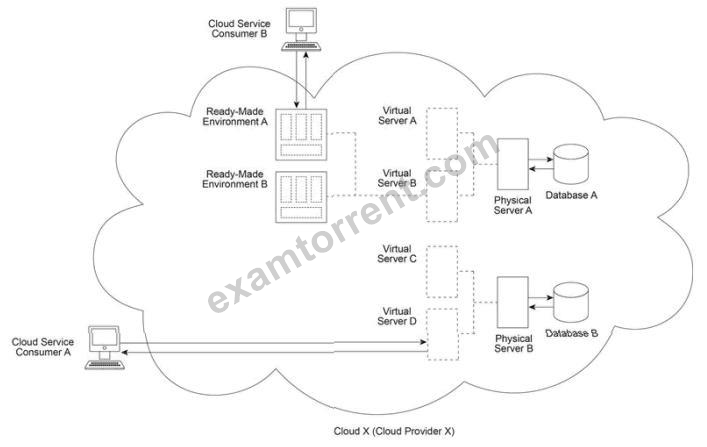
Cloud X is a private cloud that, to-date, has been set up within the cloud provider company
to provision IT resources free of charge to internal cloud consumers, via PaaS and IaaS
delivery models. The cloud consumers that have been operating Cloud Service Consumers
A and B represent different IT departments within the company that have been working
separately on the development of new cloud services. Cloud Service Consumer A has
been accessing Virtual Server D to make necessary configurations and administration
settings for the upcoming deployment of a new cloud service that was previously
developed outside of Cloud X.
Cloud Service Consumer B has been accessing Ready-
Made Environment A to develop and now deploy a different new cloud service.
Cloud Provider X (which is represented by a separate IT department dedicated to
governing and administering Cloud X) determines that it will need to introduce three
specific enhancements to Cloud X in order to accommodate both upcoming cloud services.
First, it needs to add a way to charge cloud consumers for the usage of cloud services.
Secondly, it needs to add a way for new cloud services to be automatically scaled. Finally,
it needs to add a way for a cloud consumer to be automatically notified when a cloud
service encounters runtime loads that exceed its allocated usage threshold.
Which of the following statements accurately describes a solution that fulfills all three
identified requirements?
- A. The state management database mechanism together with the virtual server mechanism
and the automated scaling listener mechanism can be implemented to address the
requirement for cloud service usage charges to be tracked and recorded, for cloud services
to be automatically scaled, and for notifications to be issued when cloud service loads
exceed thresholds. - B. The pay-for-use monitor mechanism can be installed to address the requirement for
cloud service usage charges to be tracked and recorded. The automated scaling listener
mechanism can be implemented to address the requirement for cloud services to be
automatically scaled. The multi-device broker mechanism can be implemented to address
the requirement for notifications to be issued when cloud service loads exceed thresholds. - C. The pay-for-use monitor mechanism can be implemented to address the requirement for
cloud service usage charges to be tracked and recorded, for cloud services to be
automatically scaled, and for notifications to be issued when cloud service loads exceed
thresholds. - D. The pay-for-use monitor mechanism can be installed to address the requirement for
cloud service usage to be tracked and recorded. The automated scaling listener
mechanism can be implemented to address both the requirement for cloud services to be
automatically scaled and for notifications to be issued when cloud service loads exceed
thresholds.
Correct Answer: D 🗳️
Organization A has been expanding and, as a result, is outgrowing the processing capacity
of its on-premise Service A implementation. It is determined that this is due to usage
thresholds of Service A and complex data processing limitations in Database A.
The diagram depicts Organization A's current on-premise environment, where Service
Consumers A.
B and C attempt to access Service A at the same time. Service Consumer A
successfully accesses Service A, which then successfully retrieves the requested data (1).
Service Consumer B successfully accesses Service A, but due to the complex data
structure, the request for the data times out and fails (2). Finally, Service Consumer C
attempts to access Service A, but is rejected because Service A is unable to accept more
concurrent requests.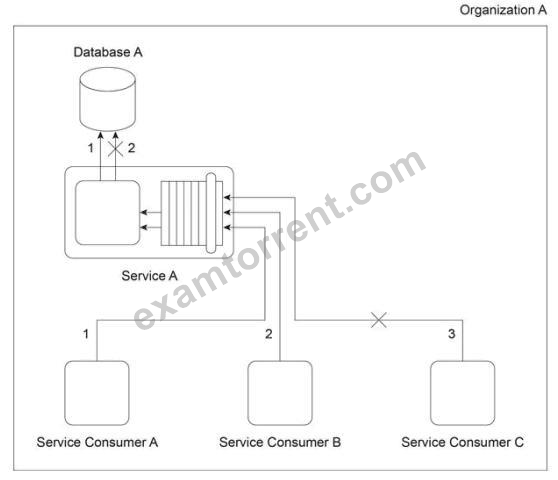
Organization A is required to continue using its on-premise Service A implementation, with
the exception of Database A, which does not need to remain on-premise. Database A is
dedicated to Service A and is comprised of relational data. Which of the following
statements provides a solution that uses cloud-based IT resources to solve the
performance limitations of Service A and Database A?
- A. A failover system can be implemented in a hybrid architecture comprised of
Organization A's existing on-premise environment and a public cloud environment. The
failover system would span both environments so that when Service A is unable to process
request messages from Service Consumers A, B or C, the failover system can
automatically route messages to a redundant implementation of Service A residing in the
public cloud. Similarly, when Database A is unable to process a data access request from
Service A.the failover system can automatically route this request to a redundant
implementation of Database A, also residing in the public cloud. - B. A cloud bursting solution can be implemented, whereby a redundant copy of Service A
is implemented within a public cloud. This cloud-based, redundant implementation of
Service A is referred to as Cloud Service A.
A copy of Database A is also implemented within the cloud and both the on-premise and cloud-based copies of Database A are
redesigned to be non-relational in order to improve data access performance. Service A
continues to act as a first point of contact for Service Consumers A, B and C.
An automated scaling listener is deployed so that when Service A's thresholds are met,
requests are automatically routed to Cloud Service A. - C. None of the above
- D. The state management database and resource replication mechanisms can be
implemented to establish redundant implementations of Service A and Database A in both
on-premise and cloud environments. Using resource replication, a cloud-based duplicate of
Service A (Cloud Service A) will be established in a public cloud and will remain in synch
with Service A via regular replication cycles. Using the resource replication mechanism
together with the state management database mechanism allows for Database A to be
dynamically replicated in an independent state management database that has redundant
implementations in both on-premise and cloud environments. The state management
database can be further optimized to support non-relational data to improve data access
performance.
Correct Answer: B 🗳️
A company is planning to build and launch a new SaaS product that will be available for
use by the general public. It intends to build the service on-premise and then deploy it in a
public cloud. The company has the following set of four requirements for the
implementation of the new service:
1. The cloud service needs to exchange messages primarily by using HTTP methods and
other features provided by HTTP.
2. The cloud service needs to store highly structured data with potentially complex
relationships.
3. The cloud service needs to be deployed on a dedicated virtual server that can be
administered with a high level of control by the cloud consumer's own cloud resource
administrator.
4. The cloud service needs to be deployed with a minimal amount of integration testing.
For this project, the company has a very limited budget. The company is assessing the IT
resources that are offered by Clouds X and Y within the constraints of its limited budget.
Cloud X can offer an IaaS environment with very few proprietary characteristics that
includes a database that supports only no relational storage, as well as support for the
deployment and usage of REST services.
Cloud Y can offer a PaaS environment with a pre-configured virtual server that includes
native support for WSDL and SOAP, as well as a database that supports only relational
storage. The implementation of a new service within Cloud Y will require compliance to a
high level of proprietary characteristics.
As previously listed, the company has identified four specific implementation requirements
for its new cloud service. Which of the following statements correctly identifies how many of
the four requirements Clouds X and Y can directly fulfill?
- A. Cloud X fulfills 3 out of 4 requirements. Cloud Y fulfills 1 out of 4 requirements.
- B. Cloud X fulfills 0 out of 4 requirements. Cloud Y fulfills 4 out of 4 requirements.
- C. Cloud X fulfills 2 out of 4 requirements. Cloud Y fulfills 2 out of 4 requirements.
- D. Cloud X fulfills 1 out of 4 requirements. Cloud Y fulfills 3 out of 4 requirements.
Correct Answer: A 🗳️
Viewing page 1 out of 7 pages.
Viewing questions 1-3 out of 21 questions.


 Winni

 Abraham

 Morton
 Arno
 Dinah

 Mandel
 Virgil
 Hyman
 Penelope
 Arlen
 Julius
 Amos
 Harold
 Melissa
 Yehudi
 Justin
 Enoch